



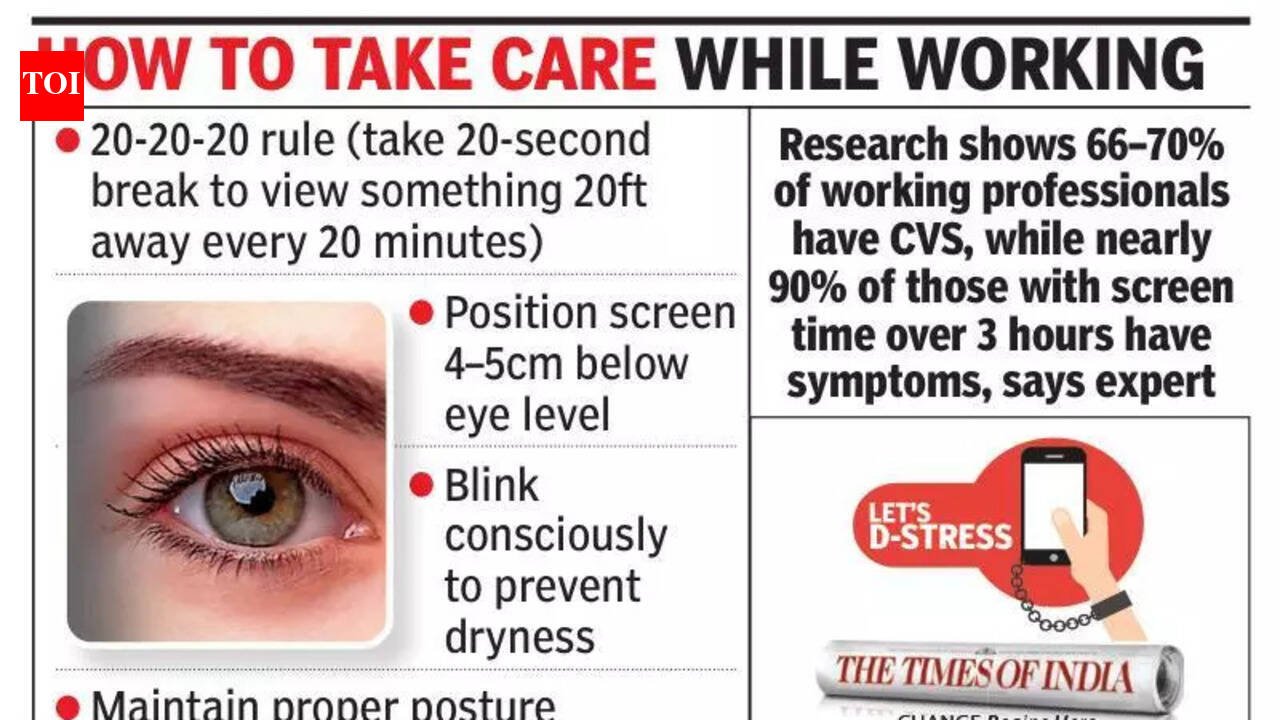
Bengaluru: Have you been feeling a nagging sensation in your eyes, often accompanied by redness and watering? Then you might be experiencing Computer Vision Syndrome (CVS), say ophthalmologists, as a significant section of the IT city’s working population shows one or more symptoms of the condition.CVS is a group of eye and vision-related problems caused by prolonged use of screens. “Existing research shows around 66–70% of working professionals have CVS, while nearly 90% of those with screen time exceeding three hours experience symptoms. In our own practice, we have seen at least 47% of patients present with signs of CVS,” said Dr Naren Shetty, director, HOD cataract & refractive, clinical & translational scientist, Narayana Nethralaya.While CVS is increasingly being reported across age groups — from children as young as nine to elderly individuals in their 90s — experts say working professionals remain the most vulnerable. “On average, I see about 4–5 patients per day with symptoms related to computer vision syndrome. And this is in the central part of Bengaluru. So, if we are seeing these many cases here, the numbers in tech-heavy areas like like Electronics City or Whitefield would likely be even higher,” said Dr Mahima Mahesh, consultant ophthalmologist, Dr Agarwals Eye Hospital, Coles Road.She added, “The human eye is naturally at rest when looking at distant objects. But for near tasks, the eye muscles have to actively work to focus. So, if someone is working on screens all day, the same group of eye muscles is continuously engaged, leading to fatigue by the end of the day.”Dr Savitha Arun, senior eye surgeon and medical superintendent, Nethradhama Super Speciality Eye Hospital, said CVS is not limited to eye-related issues. “Many patients also report neck pain, sleeplessness, and back pain, often due to poor posture while sitting in front of screens for long hours without breaks. Ergonomics plays a significant role in these symptoms,” she said.Management of CVS is holistic and involves addressing multiple factors, starting with symptomatic treatment for eye discomfort and evaluating whether corrective glasses are needed. “We also guide patients on proper ergonomics, including posture and workstation setup, along with emphasising regular breaks and healthy screen habits, while treating dryness if present. In cases where there is muscle imbalance, specific eye exercises are prescribed, with more severe cases requiring in-clinic therapy,” Dr Savitha said.Doctors also stress adopting the 20-20-20 rule — every 20 minutes, look at something 20 feet away for 20 seconds. Dr Naren added even small ergonomic changes can help. “Instead of positioning the screen at eye level, placing it about 4–5cm below eye level can reduce strain, as the eyelids offer better protection when the eyes are directed slightly downward,” he said.Inset 3: Prevention20-20-20 rule (take a 20-second break to view something 20ft away every 20 minutes)Position the screen 4–5cm below eye levelBlink consciously to prevent drynessMaintain proper posture and ergonomicsUse lubricating drops or blue light/anti-glare glasses if needed


