









Bengaluru: Karnataka is seeking to connect education with employment through a series of initiatives spanning school-level AI education, access to professional courses, a proposed AI university and a large government recruitment drive.
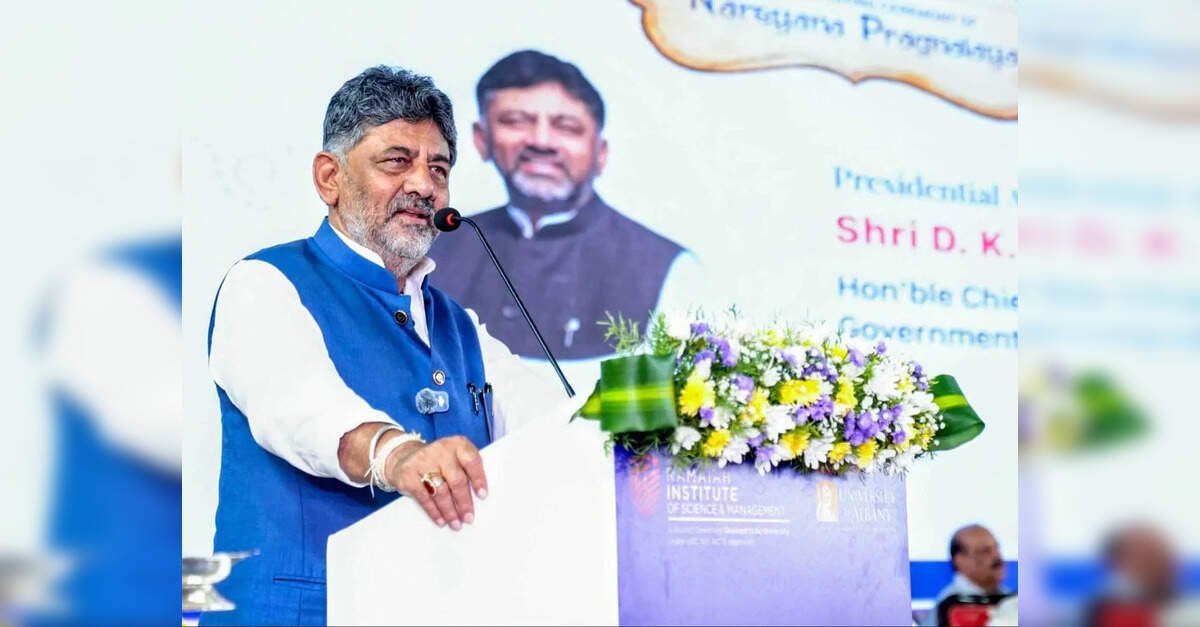
Chief Minister D K Shivakumar, in his 100-day message, highlighted measures including a 7.5% reservation for rural government-school students in professional courses, AI education from Class 6 onwards, a government-sponsored AI university and the filling of 72,000 government vacancies.
The state has also announced incentives for private job creation in its most backward districts and is pushing investment-led employment, creating a broader education-to-employment agenda for students and young job seekers.
7.5% quota for government-school students
One of the most significant education measures is the proposed reservation for rural government-school students seeking admission to professional courses.
Shivakumar had announced a 7.5% reservation for students from rural government schools for professional higher education, including medical and engineering courses, as part of his Independence Day address.
The proposal has since moved into the rule-making process. The Higher Education Department notified draft amendments on September 5 proposing that 15% of government seats in professional educational institutions be reserved for rural students, with the quota divided into two 7.5% categories.
One 7.5% category is proposed for students who studied from Classes 1 to 10 in government schools or government pre-university colleges run by the School Education Department in rural Karnataka. The other 7.5% would cover students who studied from Classes 1 to 10 in educational institutions located in rural areas, irrespective of whether the institution is government-run. The draft has been opened for objections and suggestions for 15 days.
The measure could potentially widen access to professional higher education for students from rural areas, particularly those coming through the government-school system.
AI education to begin from Class 6
The second major element of Karnataka’s education strategy is an early push towards artificial intelligence and coding.
The state has announced the AI Akshara Abhiyana and Coding Gurukula programmes to introduce AI education in schools from Class 6 onwards. The stated objective is to equip students with technology skills and prepare them for an increasingly AI-driven economy.
The move is significant because the state is attempting to introduce AI exposure well before students enter higher education. It also fits into Karnataka’s broader ambition of positioning itself as a technology and innovation hub beyond its traditional IT identity.
The success of the programme, however, will depend on curriculum design, teacher preparation and how effectively AI education can be taken to government schools across the state.
Proposed AI university to build higher education pipeline
The school-level AI push is being accompanied by plans for a government-led AI university in Bengaluru.
The proposed university is intended to focus on AI and emerging technologies, while a dedicated AI Hub is expected to facilitate research and collaboration among academia, industry and other stakeholders. Shivakumar has also indicated that the government wants industry to play a significant role in building the university.
The proposed university has already begun moving towards skill development, with AI-related programmes expected to be offered even before the formal establishment of the institution.
This creates a potential continuum in the state’s approach: AI exposure at school level, specialised AI education at university level and industry-linked opportunities after graduation.
72,000 government vacancies in employment push
The education agenda is being accompanied by a large government recruitment programme.
Shivakumar has said Karnataka has begun the process of filling 72,000 key government vacancies, with recruitment notifications expected over the following six months. The government has also announced a proposed Chief Minister’s Jobs Mission to prioritise vacant posts.
The government is also looking beyond public-sector recruitment. Its Yuva Udyoga Setu initiative is intended to create a digital platform connecting young people with private-sector employment opportunities.
For a state with a large pool of graduates and young job seekers, the combination of public recruitment and private-sector placement could become an important part of the government’s employment strategy.
₹2,500 incentive per job in 10 districts
Karnataka is also trying to push employment beyond Bengaluru and other established economic centres.
Under Udyoga Nidhi, the government has approved an incentive of ₹2,500 per month for every new job created for up to 24 months in 10 of the state’s most backward districts. The government expects the scheme to help create one lakh jobs.
The districts identified under the scheme include Yadgir, Raichur, Koppal, Haveri, Bidar, Kalaburagi, Belagavi, Vijayanagara, Gadag and Vijayapura.
The initiative effectively adds another layer to the state’s employment strategy: instead of relying only on government recruitment, the state is offering financial incentives to employers to generate jobs in regions that have historically lagged behind economically.
Investment pipeline adds another 66,000 jobs
The employment push is also being supported by fresh investment.
Earlier this month, Karnataka’s State High-Level Clearance Committee cleared 17 projects worth ₹29,679 crore. Nine of these projects are expected to generate around 66,360 jobs, with investments spread across sectors including renewable energy, aerospace, automobiles, toys and other manufacturing activities.
The figures provide another dimension to Karnataka’s education and employment challenge. As the state expands access to professional education and introduces AI and coding at school level, the availability of high-quality jobs will determine whether those investments in skills translate into improved employment outcomes.
From education access to employability
Taken together, Karnataka’s announcements point to an attempt to address different stages of the youth pipeline.
The rural quota is aimed at improving access to professional higher education. AI education from Class 6 seeks to introduce emerging technology skills earlier. The proposed AI university is intended to build advanced talent and research capacity. At the other end, 72,000 government vacancies, private-sector job platforms, employment incentives and new investments are aimed at creating employment opportunities.
The bigger test, however, will be implementation
For the education initiatives, questions around curriculum, teacher capacity, infrastructure and equitable access will determine whether AI education becomes a meaningful learning intervention rather than another technology programme. Similarly, the proposed professional-course reservation will need to move beyond draft rules before its impact on admissions can be assessed.
For Karnataka, the larger policy ambition is clear: build a stronger pipeline from school education to higher education, skills and jobs. The next phase will determine whether that pipeline can deliver at scale.


