



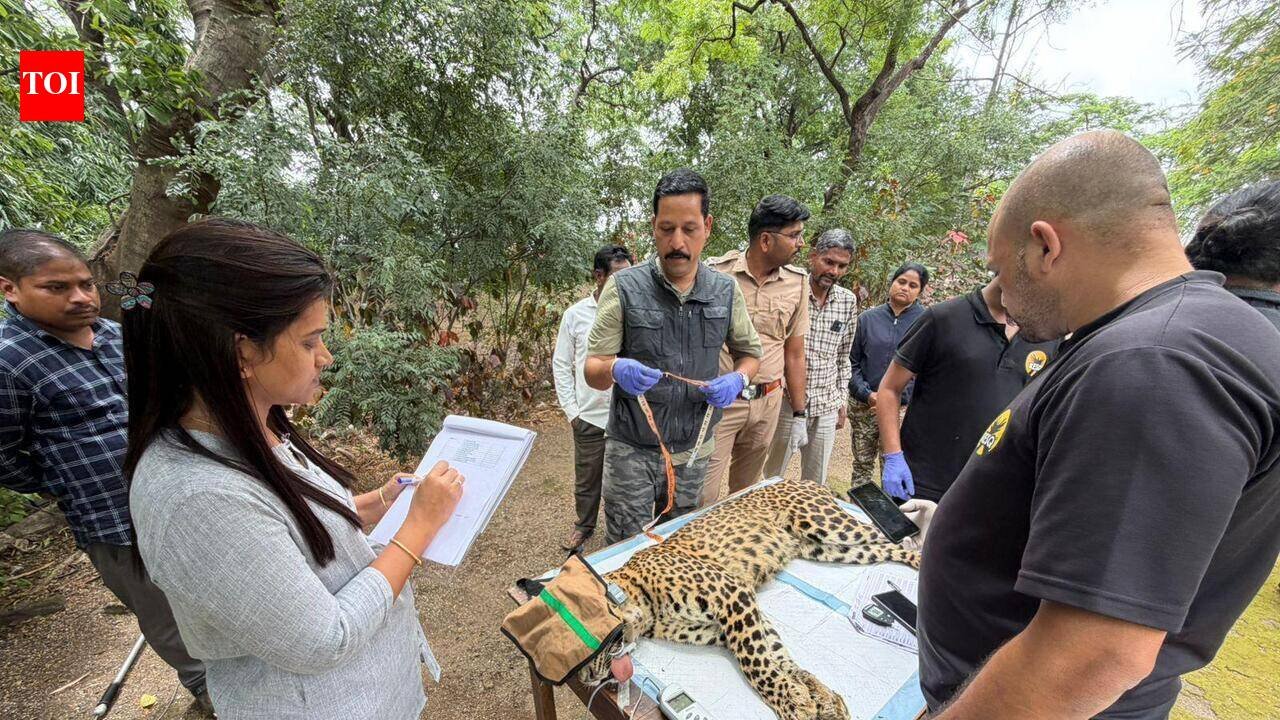
Pune: The Junnar forest division has released two radio-collared female leopards into the wild after administering immunocontraceptive drugs in a first-of-its-kind initiative across the country, marking a key experiment to assess whether fertility control could help reduce human-leopard conflict.Forest officials will track the leopards’ movements, behaviour and hormonal changes, while monitoring whether they conceive after mating in the wild. The findings will help determine if immunocontraception can be used as a long-term wildlife management tool in the conflict-prone areas. “This is the first approved immunocontraception experiment in big cats in India. The success of this project will be determined by whether the released female leopards conceive or not. The two female leopards were released a fortnight back,” Ashish Thakare, chief conservator of forests, Pune, told TOI on Saturday.The Junnar division is conducting parallel studies on captive and free-ranging leopards to compare physiological and behavioural responses to the treatment. “Both the experiments will tell us what hormonal changes are taking place in the animals. Our team is monitoring them and, based on the findings, we will decide the further course of action,” Thakare said.Assistant conservator of forests Smita Rajhans said the long-term impact of the treatment on free-ranging leopards would be closely studied by experts from Indian Council of Medical Research (ICMR) and the forest department. “Based on the findings, the plan is to develop a uniform framework that could be applied in other parts of the country. Every aspect of these experiments is being closely monitored,” Rajhans said.The collared leopards were released about two weeks ago and have shown no significant behavioural changes so far, officials said. Blood samples collected before release will be compared with fresh samples after the animals are recaptured.The experiment comes against the backdrop of recurring human-leopard conflict in Junnar and adjoining areas. Forest department records showed that leopard attacks had killed 22 people and injured 42 others since 2021. During the same period, as many as 16,593 cattle were killed, highlighting the conflict’s economic impact.Forest minister Ganesh Naik had said in Feb that the Junnar wildlife division had recorded 27 human deaths in leopard attacks over the past seven years. The region has witnessed repeated encounters, particularly around sugar cane fields that provide cover for leopards.The immunocontraception programme aims to temporarily suppress reproduction in selected female leopards to manage population growth in high-conflict landscapes. Unlike surgical sterilisation, the vaccine-based method is reversible and does not involve the removal of reproductive organs.Wildlife Institute of India scientist Bilal Habib, who has led leopard research in Junnar, said the treatment could prevent breeding for two to three years, but requires rigorous scientific evaluation before wider use.A former dean and scientist at the Wildlife Institute of India, highlighted the need to examine the feasibility, costs and long-term effectiveness of contraceptive interventions. “Along with this experiment, it is equally important to address ecological factors, including agricultural practices that provide cover for leopards and the availability of livestock and feral animals as prey,” he told TOI.Forest officials said the immediate objective was to develop a comprehensive standard operating procedure (SOP) covering drug administration, animal selection, post-treatment monitoring and assessment of reproductive outcomes. “The whole objective of this experiment is to frame a comprehensive SOP for immunocontraception so that, wherever required, the respective forest department can implement it,” a senior forest official said.The experiment comes as authorities face growing pressure to find a sustainable response to human-leopard conflict without compromising wildlife conservation. “Its findings will be purely scientific and it will help establish whether immunocontraception can become one component of a broader strategy in the division. Because there has been a consistent demand from villagers to control the birth of leopards in the region,” another forest official said.
