



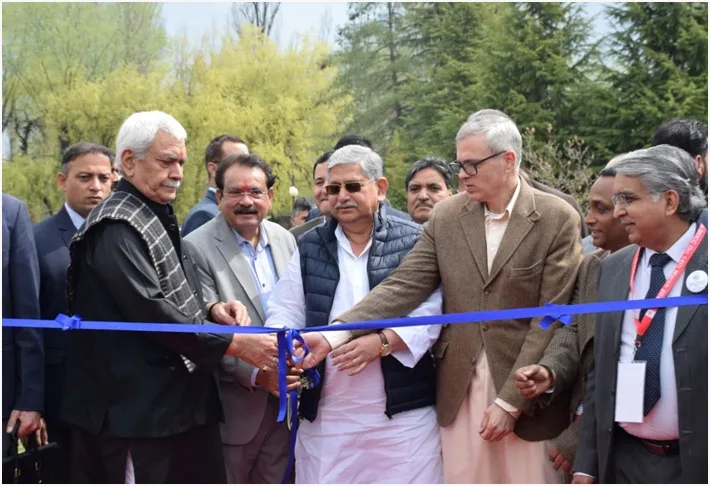
Srinagar, Mar 14: Union Minister for Fisheries, Animal Husbandry and Dairying and Panchayati Raj, Rajiv Ranjan Singh, on Saturday announced the sanction of a Rs 100-crore Integrated Aqua Park Project to be established in Anantnag district of South Kashmir.
He also released the Model Guidelines for the Development of Cold-Water Fisheries. He was addressing the first-of-its-kind National Conference on Cold Water Fisheries at SKICC, Srinagar.
The conference, organised by the Department of Fisheries, Government of India, was attended by Lieutenant Governor Manoj Sinha, Chief Minister Omar Abdullah, Union Minister of State for FAH&D and Panchayati Raj Prof S P Singh Baghel and J&K Minister for Agriculture Production Javid Ahmad Dar, among other dignitaries.
The proposed Integrated Aqua Park in Anantnag is expected to strengthen aquaculture infrastructure, boost the development of cold-water fisheries, enhance fish production and generate employment opportunities in the region.
Addressing the gathering, the Union Minister stressed the need to scale up trout production and improve the incomes of cold-water fish farmers by enhancing productivity, strengthening value addition and tapping into export markets where such species enjoy strong demand.
“The government is focusing on end-to-end value-chain development so that cold-water regions can efficiently produce, process and market trout and other fish species through modern infrastructure and stronger market linkages,” he said and urged States and Union Territories to organise fish farmers into cooperatives and Fish Farmer Producer Organisations (FFPOs) to help them access schemes, infrastructure and institutional credit.
Union Fisheries Secretary Dr Abhilaksh Likhi highlighted the importance of cold-water fisheries in preserving India’s indigenous germplasm, noting that more than 278 species contribute to production, eco-tourism and niche markets. “34 cold-water fisheries clusters have been notified across the country, including in Jammu & Kashmir, Ladakh and Uttarakhand, to promote region-specific development,” Likhi said.
Minister for Agriculture Javid Ahmad Dar, while speaking on the occasion, said the Union Territory contributes nearly 90 per cent of India’s trout production, with districts such as Ganderbal and Anantnag emerging as key centres of production. “UT government has taken several initiatives, including the expansion and modernisation of hatcheries and improved post-harvest management systems, to transform the sector into a technology-driven source of employment,” he said.
A short film showcasing the growth story and sustainable initiatives in the cold-water fisheries sector was also screened during the conference. The conference witnessed participation of more than 10,000 attendees in hybrid mode, including senior officials from the Department of Fisheries, Government of India; representatives from various ministries and institutions; scientists from ICAR institutions; faculty and students of SKUAST-Kashmir; fisheries cooperatives; progressive fish farmers; industry representatives; start-ups and entrepreneurs associated with the fisheries value chain.
Meanwhile, during the event, the Union Minister, Lieutenant Governor Manoj Sinha and Chief Minister Omar Abdullah presented awards to the best fisheries cooperative societies, progressive fish farmers, Kisan Credit Card (KCC) beneficiaries, fisheries start-ups and other stakeholders from across Jammu and Kashmir.
In the Best Fisheries Cooperative Society category, awards were presented to Jehlum Fisherman Cooperative Ltd, Mahrajpora Sopore (Baramulla); Affarwat Trout Fish Farmers Cooperative Ltd, Tangmarg (Baramulla); and Bandi Trout Fish Cooperative Limited (Kupwara) for their contribution to strengthening collective fish farming and value-chain development. Under the Progressive Cold-Water Fish Farmers category, Shakeel Mohammad Teeli (Anantnag), Mehjoor Sultan Mir (Kupwara), Umer Akbar Dar (Pulwama), Zaid Ul Ahad (Srinagar) and Sara Bano (Srinagar) were honoured for their role in promoting sustainable trout farming in the region.
Awards were also presented in the Kisan Credit Card (KCC) category to beneficiaries who have adopted scientific and credit-enabled practices in aquaculture. During the programme, the dignitaries jointly released the Model Guidelines for Reservoir Fisheries and Aquaculture Management, which provide a comprehensive framework for scientific seed stocking, cage and pen-based aquaculture, governance mechanisms, biodiversity conservation, value-chain linkages and monitoring systems.


