


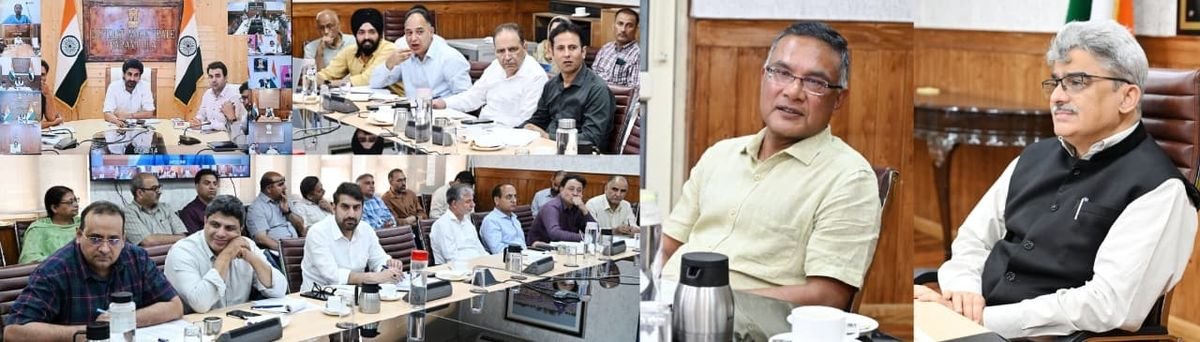
Srinagar, Jul 08: In a major policy initiative aimed at further strengthening inclusive governance and ensuring that government welfare schemes reach the most deserving families, Chief Secretary Atal Dulloo on Wednesday chaired a meeting of the Planning, Development & Monitoring Department to have first-hand appraisal of the proposed household-level enumeration of multidimensionally poor families across Jammu and Kashmir.
The meeting was attended by concerned Administrative Heads including ACS Finance, Commissioner Secretary PD&MD, Commissioner Secretary FCS&CA, Commissioner Secretary Social Welfare, Secretary RDD, HoDs of the Planning Department, and other concerned officers. Deputy Commissioners attended the meeting through video conferencing.
Speaking on the proposed initiative, the Chief Secretary maintained that the proposed household enumeration represents the next logical step in our development journey, seeking to identify actual households that continue to experience multiple deprivations with the objective of creating a scientifically validated and technology-enabled database. This will help government departments deliver welfare benefits with greater precision, improve inter-departmental convergence, and ensure that no deserving family is left behind.
The proposal, presented by Commissioner Secretary, Planning, Development & Monitoring Department, R Alice Vaz, lays down a scientifically designed framework founded on the National Multidimensional Poverty Index (MPI) framework developed by NITI Aayog in collaboration with UNDP, while adapting it for household-level identification of poor families within Jammu and Kashmir.
As proposed, the enumeration shall initially cover the most vulnerable categories already available in government databases, namely Antyodaya Anna Yojana (AAY) households, covering approximately 2.19 lakh beneficiary households across all twenty districts. The methodology follows the nationally accepted MPI framework by assessing every household across three dimensions—Health, Education, and Standard of Living—through twelve carefully defined indicators including nutrition, child and adolescent mortality, maternal health, years of schooling, school attendance, cooking fuel, sanitation, drinking water, electricity, housing, household assets, and financial inclusion.
Two structured digital schedules have been proposed: the first would collect household information for automated computation of the MPI score, while the second, applicable only to households identified as multidimensionally poor, would capture reasons for deprivation, gaps in access to government schemes, awareness levels, and barriers preventing families from availing benefits.
The Chief Secretary impressed upon Deputy Commissioners to work out human resource requirements in coordination with the Planning Department and directed the Department to frame capacity building programmes so that the exercise is taken up after the culmination of the two phases of Census operations across the UT, including the pastoral populations of J&K.
The household database generated through the exercise is expected to become a robust decision-support system for the Government, enabling convergence of welfare schemes relating to health, education, housing, drinking water, sanitation, clean energy, financial inclusion, livelihoods, and social protection, while also facilitating more efficient utilisation of public resources, strengthening monitoring of Sustainable Development Goals, and supporting evidence-based district planning.
