



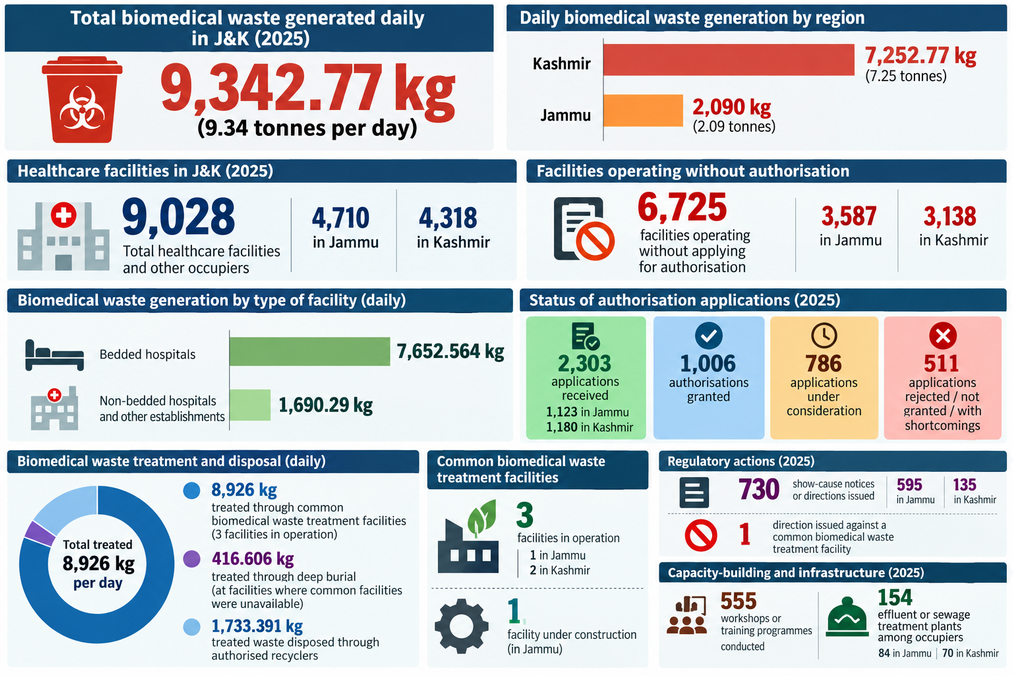
Srinagar, Oct 20: As hospitals, diagnostic laboratories, clinics and other healthcare establishments across Jammu and Kashmir generate more than nine tonnes of biomedical waste every day, a major regulatory compliance gap has emerged, with 6,725 healthcare facilities operating without applying for the mandatory authorisation, according to the annual report of the Jammu and Kashmir Pollution Control Committee (JKPCC).
The report, covering January to December 2025, puts the total number of healthcare facilities and other occupiers at 9,028 across the Union Territory, including 4,710 in Jammu and 4,318 in Kashmir.
“Of these, 6,725 facilities were listed as operating without applying for authorisation under the biomedical waste management framework. The figure includes 3,587 facilities in Jammu and 3,138 in Kashmir,” the report reveals.
The findings highlight the scale of the regulatory challenge in managing waste generated by the healthcare sector, where improper handling, segregation, storage, transportation or disposal can expose sanitation workers, healthcare staff and the public to infectious and hazardous materials.
“Biomedical waste includes contaminated dressings, pathological waste, laboratory materials, sharps such as needles, and other waste generated during medical diagnosis, treatment and research. Its safe management requires segregation at source, appropriate treatment and disposal through authorised systems,” it states.
The report, however, does not establish that every facility operating without authorisation has improperly disposed of its waste. The figures point to a substantial compliance gap that requires regulatory attention. According to the report, Jammu and Kashmir generated 9,342.77 kg of biomedical waste per day during 2025. Kashmir accounted for 7,252.77 kg daily, compared with 2,090 kg in Jammu.
“Bedded hospitals generated 7,652.564 kg per day, while non-bedded hospitals and other listed establishments accounted for 1,690.29 kg daily,” it reads. “The figures underline the importance of ensuring that waste from large hospitals, smaller clinics, diagnostic centres and laboratories enters an authorised collection and treatment chain.”
The report records three common biomedical waste treatment facilities in operation across the Union Territory—one in Jammu and two in Kashmir. Another facility was listed as under construction in Jammu.
“These common facilities treated a reported 8,926 kg of biomedical waste daily. In areas where common treatment facilities were unavailable, 416.606 kg per day was reported as being treated through deep burial at healthcare facilities,” it said.
The report also records 1,733.391 kg of treated biomedical waste being disposed of through authorised recyclers each day.
The treatment figures broadly correspond with the reported daily generation, although the totals show a small numerical difference that would require clarification from the Committee. The report records 2,303 applications for authorisation, including 1,123 from Jammu and 1,180 from Kashmir. Of these, 1,006 authorisations were reported as granted, while 786 applications remained under consideration. Another 511 applications were listed as rejected, not granted or having shortcomings.
The figures indicate that authorisation and compliance monitoring remain important areas for regulatory action, particularly given the number of establishments listed as operating without applying.
The Committee reported issuing 730 show-cause notices or directions to healthcare facilities—595 in Jammu and 135 in Kashmir. One direction was recorded against a common biomedical waste treatment facility. The report also lists closure orders against defaulters, although the district-wise figures in the available text require reconciliation before a definitive total can be quoted.
On infrastructure and capacity-building, the Committee reported conducting 555 workshops or training programmes during the year. It also recorded 154 effluent or sewage treatment plants among occupiers, comprising 84 in Jammu and 70 in Kashmir.
The report further lists 111 common biomedical waste treatment facilities or installations with continuous online emission monitoring systems, including 70 in Jammu and 41 in Kashmir.
The findings place the focus on the need to bring healthcare establishments within the authorisation framework, strengthen inspections and ensure that biomedical waste is segregated, collected, treated and disposed of in accordance with prescribed norms. With 9.34 tonnes of biomedical waste generated daily across Jammu and Kashmir, the challenge is not merely to expand treatment capacity but to ensure that every healthcare establishment follows the rules governing the waste it produces.
