



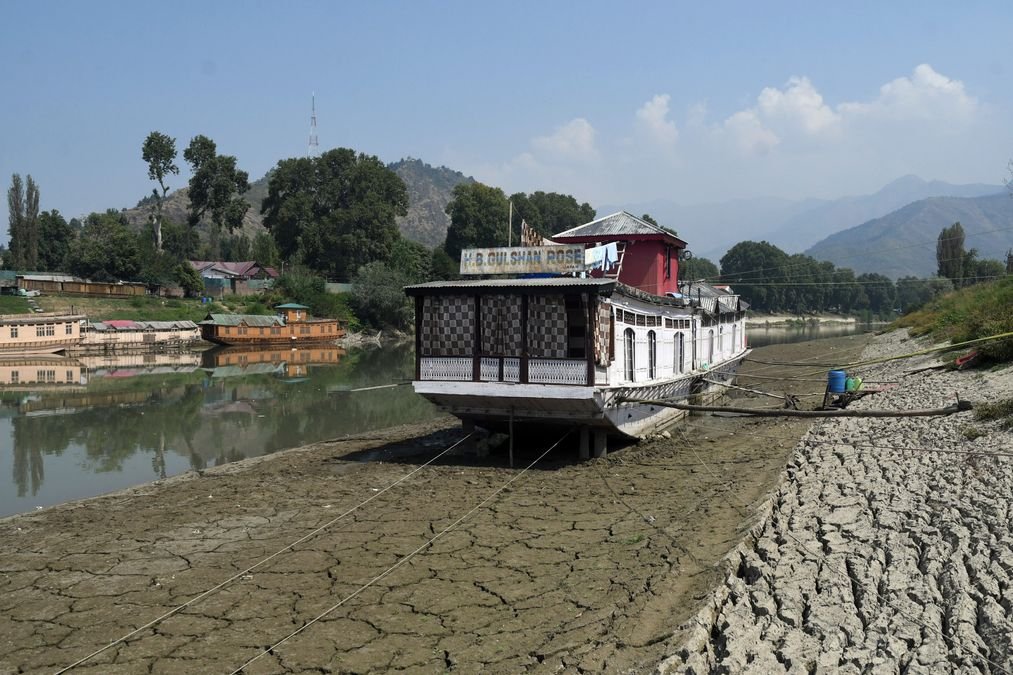
Srinagar, Oct 02: The Jhelum, Kashmir’s lifeline, has slipped below the zero-gauge mark at Sangam, recording –0.13 feet on Friday, as the Valley enters autumn with the river once again showing signs of depleted flows.
The latest reading is not the lowest ever recorded, but it is significant for early October, particularly when viewed against the increasingly erratic rainfall and snowfall patterns witnessed across Kashmir in recent years.
Historical records show how sharply the Jhelum can fluctuate. Data accessed by Rising Kashmir suggests that at Sangam, the river touched –0.65 feet on October 17, 2017, a level reported at the time as the lowest in the station’s 62-year record. In September 2023, the river fell to 0.09 feet, described as a 70-year low for the month.
“The situation became even more acute in late 2024 and early 2025. Sangam fell to –0.82 feet in November 2024, while on February 17, 2025, the river dropped to –1.01 feet amid a snow-deficient winter. It stood at –0.86 feet on March 5, 2026, underscoring the persistence of low-flow conditions,” the data reveals.
Against this backdrop, the present –0.13-foot reading is considerably higher than those extreme lows, but its occurrence at the beginning of October raises questions over how much water is being replenished in the Jhelum system ahead of winter.
Climate expert Dr Touseef Ahmad Bhat has previously linked Kashmir’s changing hydrological behaviour to a warming atmosphere and increasingly unstable weather patterns.
“The climate change is already affecting the region rather than remaining a distant threat, with changing atmospheric conditions altering rainfall behaviour across the Himalayas,” he said.
Dr Bhat also stressed that climate change and ecological degradation can compound one another, with the loss of forests, wetlands and natural drainage systems increasing the vulnerability of Kashmir’s fragile mountain ecosystem.
For senior environmentalist Dr Tanveer Ahmad Khan, the condition of the Jhelum is a reflection of the Valley’s wider ecological stress. He has pointed to pollution, encroachment and neglect as factors that have transformed the river from a vital natural asset into an increasingly stressed ecosystem.
“Whatever snowfall we had this season, we lost that abruptly due to rising temperatures. The increase in temperatures also led to the quick absorption of rainwater. Even though October is known for less water flow in Jhelum, slipping to minus at Sangam in the first days of October is a big concern,” he said.
“We are definitely heading for a water crisis if things don’t improve,” he added.
The concerns are also supported by recent scientific research on the Jhelum riverscape, which identifies declining stream flows linked to seasonal precipitation changes and rising temperatures, alongside pollution, encroachment and urban expansion, as major pressures on the river system.
The Jhelum’s importance extends far beyond its water level at a single gauge. Originating at Verinag, the river traverses the Valley before entering Wular Lake and remains central to Kashmir’s agriculture, water resources, hydropower, tourism and cultural landscape.
The latest reading comes as the Meteorological Centre is forecasting largely dry conditions in the immediate period, with the possibility of light rain and snowfall over higher reaches during subsequent weather systems. That makes the coming days important for determining whether the river receives any meaningful recharge.
For Kashmir, therefore, –0.13 feet is more than a number on a gauge. It is another snapshot of a river whose fortunes increasingly depend on an unpredictable combination of rainfall, snowfall, snowmelt, groundwater recharge and the condition of the ecosystems that feed it.
