


FRAGRANCE OF IDEAS
The Jharkhand students and youth agitation started on 25th July 2026 at Ranchi, the capital city of the Jharkhand state. It was five days after the “Sansad-Chalo” march held by the Jantar-Mantar protesters in Delhi on 20 July 2026 that showcased the magnitude of their agitation, primarily organised by the CJP, as abusive, indecent, violent and devoid of the moral standards. The tone and tenor at Jantar-Mantar, which gave a reflection of anti-national sentiments and slogans, had already vitiated the atmosphere at the venue of the agitation well before the march. Therefore, their march on 25 July, 2026 had a highly surcharged and motivated context.
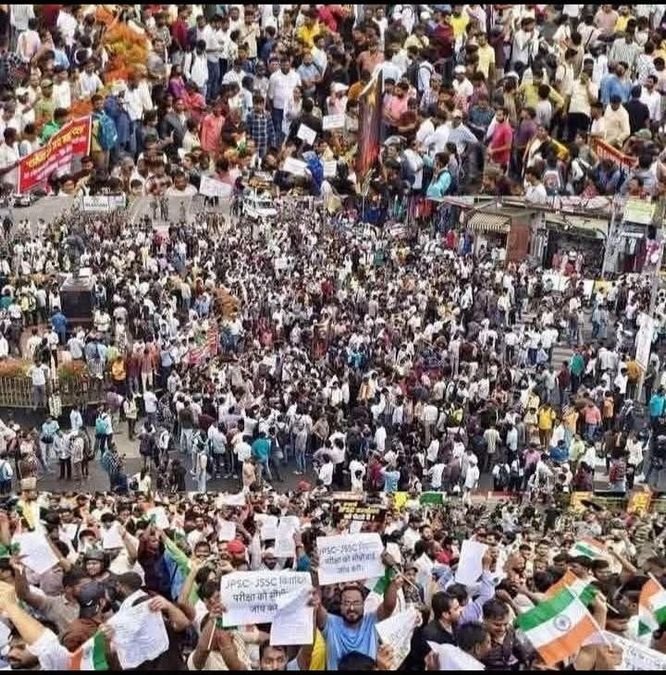
It was in such a background of controversial events that the students and youth of Jharkhand sat on a strike and sit-in-protest in the Jaipal Singh Munda Stadium at Ranchi to press for resolution of their demands from the Jharkhand government. Initially, the state government didn’t move at all, but the agitators showed a great amount of patience, perseverance and dedication to the cause. Here it needs to be understood that the protesters in Ranchi aren’t led by any political party or an ideological group or a motivated usual ever-ready agitators as was the case at Jantar-Mantar Delhi.
The agitators in Ranchi mostly comprise the job aspirants joined by the students of the state. They alleged huge irregularities and corruption in Jharkhand’s recruitment examinations conducted by the Jharkhand Public Service Commission (JPSC) and the Jharkhand Staff Selection Commission (JSSC). They haven’t, to date, permitted any political leader or prominent political activist of any political party or its affiliate to come on the stage of the agitation or hijack the course of events.
The reasonable distance from political groupings has surely given the agitation a special identity and recognition in the eyes of the public at large, not only in the state but throughout the nation. In fact, they have attracted sympathies from the countrymen significantly. A large number of students from various places have come to join them. The ongoing student agitation in Ranchi centres on protests against the alleged irregularities, paper leaks and corruption in the JPSC and JSSC recruitment examinations.
The agitation is being led by a group of student figures including Devendra Nath Mahto -the leader who went on an indefinite hunger strike on 2nd August 2026. They staged prolonged sit-ins, hunger strikes, and an assembly march demanding a CBI probe, cancellation of tainted examinations, and systemic reforms. The protesters specifically allege severe corruption and paper leaks in major state competitive examinations like the 14th JPSC and JSSC tests.
The students have completely rejected the state government’s CID probe and insist on a CBI investigation. They have also expressed their dissatisfaction with the administrative overhaul. Although the state government cancelled certain preliminary exams, accepted some demands, and saw JPSC members resign, the students have persisted with their core agitation for a CBI inquiry and thorough investigation.
The agitation peaked on 10-11 August 2026 when thousands of students attempted to breach barricades towards the Jharkhand Legislative Assembly. It resulted in a heavy police crackdown involving lathi-charges, tear gas, and water cannons on the agitators. A large number of student leaders and protesters, including Devendra Nath Mahto and Rahul Kranti, were hospitalised following extended hunger strikes and clashes with the security forces. The police and administration continued with their action throughout the night of 10-11 August, 2026.
The BJP, which is in the opposition in the state, gave outside support to the agitation. However, in response to the police action against the student protestors, the BJP called for a state-wide Jharkhand Bandh on 11 August, 2026. BJP enforced its Bandh call throughout the state, leading to road blockades and disruptions in Ranchi and other districts. However, it helped the cause of the agitators in a way that an awareness campaign was unleashed by a number of forces in regard to the agitation in the entire state and pressure on the government in regard to the agitation increased.
There is a great difference between the two agitations, one held at Jantar-Mantar and the other in process at Ranchi. The Jantar-Mantar protests were led by non-students, funded by known and unknown sources, both internal as well as external, joined by Bollywood figures having their allegiance to the left orientation and urban-naxals, activists who raised anti-national slogans at the venue consistently, anti-social elements who had nothing to do with NEET issue and who resorted to filthy and abusive language and violence on 20th July against police and paramilitary forces. They didn’t shy away from damaging public and private properties during their march on 20th July and are on record in regard to all their nefarious activities.
In comparison, the Ranchi agitation has remained peaceful despite a number of provocations. The organisers didn’t accept help from doubtful figures and didn’t allow the agitation to go into the hands of political figures. There were no political, anti-national or anti-social slogans raised by any section of the agitators. The Left-leaning student body AISA President, Neha Bora, was not allowed to make a speech there and was politely asked to leave the stage.
The agitators all along sang songs of patriotism and bhajans and also used the right and polished language during their speeches, press briefings and other expressions. The temple committees and other social activists like Bhairav Singh organised food for the agitators. The organisers at Ranchi, unlike at Jantar-Mantar, always expressed their preference for simple and Jharkhand-based food items for the agitators. The public came forward voluntarily to help the protestors.
The opposition parties and leaders who day in and day out came in support of the Jantar-Mantar stir kept themselves aloof from Ranchi and paid no attention to the agitation going on there. The leader of the opposition in Lok Sabha, Rahul Gandhi, AAP leader Arvind Kejriwal and other such leaders who criticised the way the protestors in Delhi were dealt with by the police and administration didn’t react to the treatment such protests got in Punjab, Kerala, Telangana and Karnataka, where there is the rule of INDI-Alliance partners.
In regard to Jharkhand brutalities by police, Rahul Gandhi was compelled to open his mouth very late. The behaviour of the opposition changed drastically in the states where they were the ruling parties. They should have been ashamed of their double standards in this respect. In the case of Punjab, about which they refused to accept the failures, the Punjab & Haryana High Court hasn’t only accepted that the massive paper leak happened there but also highlighted that the AAP government did absolutely nothing to stop it.
Back to Ranchi, the biggest impression that the agitators therein have made upon the minds of the people is about their non-political demands, language, conduct and their love for their nation. They don’t only seem well-behaved and responsible, but they have also given a great representation of their upbringing.
Moreover, a large number of them are themselves the victims of corruption, nepotism, paper leaks and negligence by the authorities of the examination bodies and also by the government for the last a number of years. The Chief Minister of Jharkhand, Hemant Soren, JMM leader, is also the Minister for Home, Administrative Reforms and the Department of Personnel. But no ill-will was ever expressed against his person by the agitators that can be castigated as unparliamentary or filthy as was the case at Jantar-Mantar.
The level of debates in public life, the language used by the leaders and their public conduct have surely impacted the youth who call themselves Gen Z. In addition, some of them have reflections of their upbringing as well, for which their parents and teachers are directly responsible. In this context, the Ranchi protestors have left a grand benchmark. It is very unfortunate for the nation that over the last some time, public debates and discourses have turned murkier and uninspiring for all the generations of the nation. This was clearly observed during the farmer’s agitation, Tukde-Tukde gang protests, Shaheen Bagh dharna, Delhi communal riots, the Jantar-Mantar episode and even the ‘skits’ played outside the Parliament building by the MPs.
We have recently come across a very unfortunate scenario in a Congress convention in Delhi in which Rahul Gandhi, Sandeep Dikshit and their other activists crossed all limits of political decency and decorum. Their theatrics were lustily cheered by their party audience present in the hall that sent waves of shame all around. The way they spoke and acted publicly in regard to the Prime Minister of a country (Italy) with which India has a nice relationship is simply condemnable and also reprehensible. They have exhibited their poor understanding of diplomatic norms and political conduct in international affairs. Unfortunately, that is the way the opposition has chosen as its march towards its doubtful destiny spreads rabid infection around them.
The Ranchi agitation has entered its fourth week. Some positive developments have also taken place, and the Soren government sent one of its cabinet ministers to the hospital to meet Mahto and discuss with him the issues involved. Some discussions were also held earlier by the government with different groups of agitators. It was expected that the Congress, which came in support of CJP in Delhi, would prevail upon the Jharkhand government of which they are a part of, but nothing of the sort happened.
The government also resisted Mahto’s joining the Tiranga Yatra on Independence Day. CM Soren should take lessons from PM Modi in this regard. It is hoped that good sense prevails, leading the agitating Jharkhand students, who showed the way how protests need to be done, meet success; and the agitation comes to an end as early as possible.
(The author is a senior BJP & KP leader, Human Rights Defender and a columnist and can be reached at: [email protected])
