


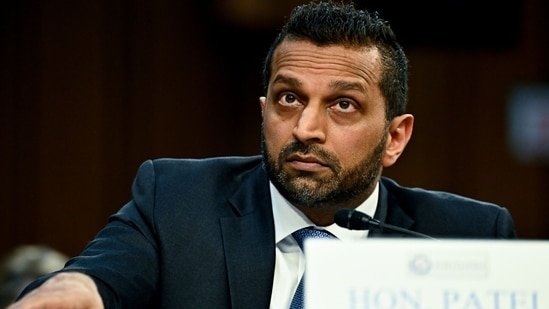
When Donald Trump’s chosen chief of the United States’ Federal Bureau of Investigation (FBI), Kashyap ‘Kash’ Patel, filed a $250-million defamation lawsuit against a news outlet on Monday, he thrust a big question further into the very public arena of American media law: does the head of the most powerful law enforcement agency in America have a drinking problem?

Yes, says the American publication The Atlantic, as its report says dozens of witnesses told its reporter Sarah Fitzpatrick that much, with evidence and citations.
In her detailed investigative piece published last week — titled ‘The FBI Director Is MIA’, meaning missing in action — she cited sources as saying Kash Patel had exhibited “bouts of excessive drinking”.
These unnamed sources described behaviour that had reportedly alarmed officials across both the FBI and the Department of Justice. He allegedly drank to the point of obvious intoxication at a private Washington DC club Ned’s, and continued drinking sprees through weekends at the Poodle Room in Las Vegas — in full view of White House and administration staff.
On multiple occasions last year, according to Justice Department and White House officials cited in the piece, Patel’s security detail had difficulty waking him due to apparent intoxication.
‘Request for breaching equipment’
On one occasion, the situation escalated to the point where a request for “breaching equipment” was made — the kind of request typically associated with hostage situations. His conduct, the article concluded, had been described internally as both a “management failure” and a “national-security vulnerability”.
Kash Patel’s response was swift and aggressive as, in the lawsuit filed in a Washington district court, he flatly denied the allegations and accused the magazine of relying on what he called “sham sources”.
He argued that anonymous testimony amounted to a shield for fabrication. “Defendants cannot evade responsibility for their malicious lies by hiding behind sham sources,” the suit stated. Reporter Fitzpatrick herself was named as a defendant alongside the publication.
The publication has stood its ground, as per news agency AP.
What the magazine said
In a statement, the magazine said it fully supported its reporting and would “vigorously defend” against what it called a “meritless lawsuit”.
Fitzpatrick noted that she had interviewed more than two dozen people, granting them anonymity to speak candidly about sensitive matters, a standard journalistic practice when sources risk professional or personal consequences for coming forward.
Kash Patel will now have to clear a bar set by the landmark 1964 US Supreme Court ruling ‘New York Times v. Sullivan’, which requires proof of “actual malice”. That would mean he’d have to prove The Atlantic either knew the claims were false or acted with reckless disregard for the truth. Courts have historically applied this standard strictly, and media organisations regularly prevail in such cases, AP noted.
Then there is the matter of how the White House has chosen not to say much, at all. Asked about the allegations, Trump’s spokesperson Karoline Leavitt pointed to falling crime statistics under the current US administration. She addressed Patel’s performance record as FBI chief, but sidestepped the specific misconduct claims.
There is one incident that particularly deepened the charge of instability during Patel’s tenure.
On April 10, he reportedly panicked after being unable to log into an internal FBI computer system, making frantic calls to aides declaring he had been fired by the White House. It was, in the end, a technical error.
