


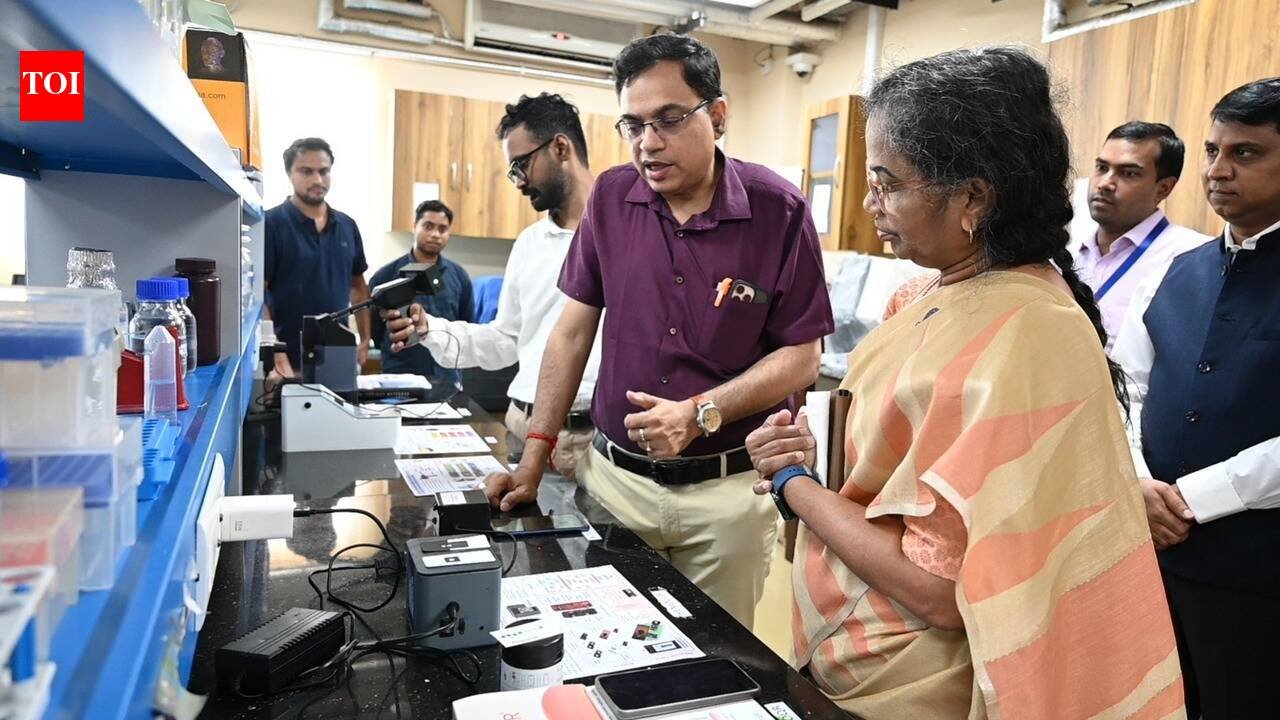
KOLKATA: The Sustainable Phase of the Common Research and Technology Development Hub (CRTDH) on Affordable Healthcare at IIT Kharagpur was inaugurated on Saturday by Dr N. Kalaiselvi, Secretary of Department of Scientific and Industrial Research (DSIR) and Director General of Council of Scientific and Industrial Research (CSIR),The hub has successfully completed its initial grant-supported phase, established in 2019, and will now operate as a self-sustaining national facility meeting its operational costs through user fees, translational partnerships, and industry sponsorships.Addressing the attendees at the Ben Gupta Auditorium, Dr. Kalaiselvi emphasised the role of DSIR and the network of CRTDHs in enabling MSMEs, start-ups and individual innovators to strengthen indigenous capability in medical technology. She said, “The continued functioning of a CRTDH beyond the period of DSIR support demonstrates the intended outcome of the programme i.e. to serve industry and innovators in a self-sustaining mode.” She emphasised that wider utilisation of these facilities would contribute to strengthening the country’s indigenous technological capabilities, advancing self-reliance in medical device technologies, and supporting the vision of the Prime Minister for Viksit Bharat 2047.Highlighting the journey of the 5,000-square-foot facility, IIT Kharagpur director Suman Chakraborty noted the critical role of frugal innovation in real-world healthcare delivery. He stated that “designing technologies for use in settings without sophisticated infrastructure and by frontline health workers requires engineering solutions that are robust and accessible”.Chakraborty, also the principal investigator, CRTDH, said, “The sustainable phase of the CRTDH marks an important transition from developing technologies to building an enduring ecosystem that can take innovation from the laboratory to the market and, ultimately, to the communities that need it most. Affordable healthcare is not merely about reducing the cost of technology; it is about developing robust and accessible solutions for real-world conditions and creating the partnerships, skills and delivery mechanisms required to take them to the last mile. The journey of this Hub demonstrates how academia, industry and grassroots healthcare delivery can come together to strengthen indigenous innovation and contribute meaningfully to the vision of Viksit Bharat 2047.”The hub has already facilitated over 20 technology transfers, many of which are now commercialized. The inauguration event featured an MSME Voices session where mentored enterprises shared their experiences translating laboratory prototypes into commercial products. Additionally, fifteen frontline health workers from remote areas, including the Sundarbans and Birbhum, recounted their experiences deploying affordable diagnostic technologies at the community level. Trained under the Hub’s skilling programs, these workers now support crucial screening, referral, and follow-up services for communities where diagnostic access remains limited.
