



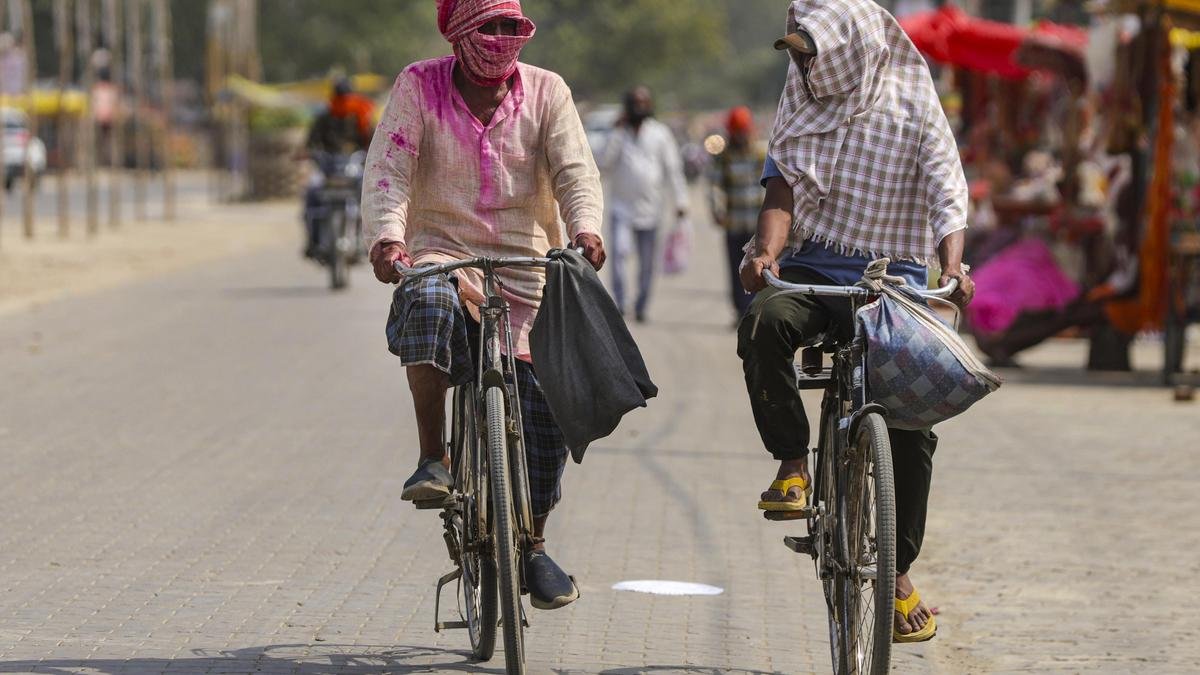
People cover their faces to protect themselves from intense heat in Prayagraj, May 20, 2026.
| Photo Credit: PTI
A: A heatwave is not like a wave or pulse of heat travelling through the air. The name probably comes from the way a heatwave feels, as something that spreads, surges, and overwhelms before subsiding. Some meteorologists prefer the team “heat event” instead.
For example, in April and May, the sun is almost directly overhead over most of peninsular India, and the ground heats for weeks. When a stable, high-pressure weather system settles over a part of the peninsula, air slowly sinks down from higher in the atmosphere, becoming compressing and warming. This suppresses the process that forms clouds, which allows sunlight to keep beating down. In this time, the peninsula also bears hot, dry continental winds from India’s interior rather than from the seas, which doesn’t come far inland. Finally, if the soil is dry, less heat goes into evaporating water and more into heating the air.
When these conditions persist for a few days, a heatwave can occur.
This said, large undulations in the jet stream called Rossby waves can sometimes create high-pressure ‘domes’ of heat that stagnate over an area. However, the heat itself is not literally a wave moving through the air.
Have a question you’d like answered? Please email science@thehindu.co.in with ‘Question Corner’ in the subject.
Published – May 22, 2026 07:30 am IST


