



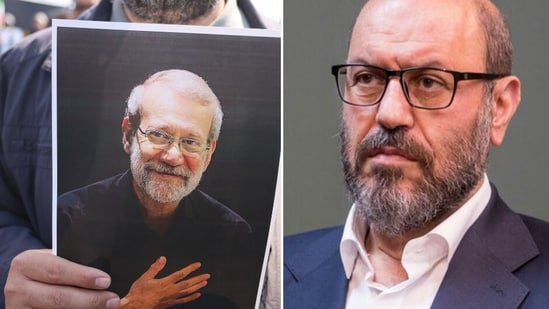
When Iran appointed veteran military leader Hossein Dehghan as its new national security and intelligence chief this week, succeeding Ali Larijani who was killed in an American-Israeli military strike, the regime moved seamlessly from one doctorate-holder to another.


Ali Larijani had a PhD in Western philosophy. Dehghan has a PhD in public administration. The handover was, in that sense, entirely typical of how the Islamic Republic has staffed its upper reaches for nearly five decades.
Across its presidents, foreign ministers, military commanders and senior officials, the cleric-led, religion-driven regime that replaced the despotic Shah in 1979 has among its ranks a striking number of people with advanced university degrees.
Some earned them in the UK; some in the US even. Many got their PhD from the Tehran University or at institutions the regime built specifically for the purpose. Their subjects range from the rationalist ideas of 18th-century German philosopher Immanuel Kant, to Islamic jurisprudence, to international self-defence.
Philosophy PhD killed by Israel
For decades, Ali Larijani was described as the “calm, pragmatic face” of the Iranian establishment. He wrote at least three books on Kant, and also negotiated nuclear deals with the West.
He held a bachelor’s degree in mathematics and computer science, and pursued both a master’s degree and a doctorate in Western philosophy at the University of Tehran, writing his thesis on Kant.
Iran’s Supreme National Security Council, of which he was secretary, referred to him as “God’s righteous servant, Martyr Dr Ali Larijani”. The title ‘Doctor’ for his formal education sat next to ‘Martyr’, a word with more religious connotations. In practice, within the Ayatollah-led regime, this does not constitute a contradiction.
Hamidreza Azizi, a visiting fellow at the German Institute for International and Security Affairs, told CNN about Larijani after the killing: “The Islamic Republic is designed to survive the loss of individuals, but figures with such diversified experience are not easy to replace. He was a true insider who spent decades at the centre of the system, which gave him credibility across different parts of the elite.”
Management PhD who came after Larijani
Dehghan holds a master’s degree in metallurgy and a PhD in public administration from Tehran University. He is a very different figure, analysts say.
According to a terror tracker portal, Counter Extremism Project, he is considered a key figure in the formation of Hezbollah in Lebanon, modelling it after the elite Iranian military wing, the Islamic Revolutionary Guard Corps or IRGC. He was also among the chief decision-makers of the Iran-Iraq war, 1980-88.
His interface with the West is limited, though.
On that count, Iran’s current foreign minister, Abbas Araghchi, has been a regular as a spokesman of the regime particularly during the war.
British PhD at the foreign ministry
Araghchi, whose nightly appearances on CNN, ABC and other channels have made him a household name among avid news consumers, carries a British university degree.
Araghchi earned his PhD in Politics and Government from the University of Kent in 1996 under the supervision of Professor David McLellan, a British scholar of Marxism. His dissertation analysed how the Western concept of political participation can coexist with the Islamic principle that sovereignty belongs to God alone, according to Barbara Slavin, Distinguished Fellow at the think tank Stimson Centre in Washington.
She wrote: “Araghchi’s dissertation, ‘The Evolution of the Concept of Political Participation in Twentieth-Century Islamic Political Thought,’ analyzes the compatibility of the Western concept of political participation with religion in Islamic societies. Araghchi concludes that modern Islamic political thought has sought to reconcile the absolute sovereignty of God with popular sovereignty, integrating elements of Western democracy with Islamic principles to create democratic institutions within the framework of Islamic law.”
Iran’s foreign ministry website lists the Kent doctorate as the foundation of a career that took him through ambassadorships in Finland and Japan, nuclear negotiations in Vienna, and ultimately the minister’s chair.
Slavin also wrote after his appointment in 2024 that his credentials “could partially shield him from domestic criticism should Iran make concessions on key issues”. Meaning, the education, including the PhD, is not merely an academic qualification but also heightens stature in the public eye.
American PhD on self-defence
Before Araghchi, among the most internationally prominent Iranian doctorate-holders was Mohammad Javad Zarif, who was also foreign minister, from 2013 to 2021.
He earned his PhD in International Studies from the University of Denver in Colorado in the US in 1988, with a thesis titled ‘Self-Defense in International Law and Policy’. His doctoral committee supervisor, Professor Tom Rowe, told the university as per its records, “He was extremely bright, had seriousness of purpose and put in enormous effort. Javad Zarif is a person who believes in the power of dialogue and diplomacy.”
The legal framework he studied in Colorado centred on states’ right to self-defence under international law. After the killing of a top Iranian commander, General Qassem Soleimani, Javad Zarif was quoted as saying, “In exercising our right to self-defense, we are bound by international law, unlike the United States, which is not bound by international law.”
Glasgow PhD on Islamic law
Hassan Rouhani, Iran’s President from 2013 to 2021, pursued his doctorate in Scotland. His doctoral thesis, submitted to Glasgow Caledonian University in 1999 under his birth name Hassan Fereydoun, is titled ‘The Flexibility of Shariah (Islamic Law) with reference to the Iranian Experience’, the BBC has reported.
An extract published by a researchers’ consortium called United States Institute of Peace read: “This thesis verifies that no laws in Islam are immutable. Immutability is only applicable to the faith, values and ultimate goals in Shariah. Those laws which look immutable even in ritual part of the religion are not actually immutable and are subject to change under special circumstances.”
Dr Mahdi Zahraa, one of Rouhani’s supervisors at Glasgow Caledonian, told the BBC, “From our discussions, I ascertained that he had a modern and reformist approach to Shariah law.”
Why so many PhDs? What experts say
The accumulation of doctoral degrees across Iran’s leadership is not coincidental. Scholars who have studied the Islamic Republic point to decisions taken at its very founding.
“The number of senior government appointments from among Imam Sadegh and Imam Hussein University graduates has risen. Trained in these institutes, such appointments are designed to maintain the ideological dominance of the government that perpetuates the orthodoxy of post-Revolutionary Iran and the longevity of the government,” Dr Sara Bazoobandi of the GIGA Institute of Global and Area Studies in Hamburg, wrote in a 2024 paper on Iran’s higher education system.
The paper also quoted the then Supreme Leader Ali Khamenei directly, from a 2016 address to students: “My advice to revolutionary students and professors is that they should play their role. We have said to the youth that they are the officers of the soft war. You university professors, too, are the commanders of this soft war.”
Professor Mehrzad Boroujerdi of the University of Edinburgh did a four-decade study of more than 2,500 members of the Iranian political elite forPeaceRep, a research consortium.
“Only 11 per cent of the current political elite of the Islamic Republic have studied outside Iran. Their favourite destinations for study in order of preference have been the United States, Western Europe, the Middle East, Asia, Eastern Europe and Australia,” he wrote.
He also noted the regime’s focus: “The need to educate and train revolutionary men and women forced the Islamic Republic to form new cadre training schools like Imam Sadeq University, Imam Hossein University, Imam Khomeini Educational and Research Institute, and the University of Judicial Sciences and Administrative Services. Many of the rising elite are nowadays either instructors or recent graduates of these highly ideological institutions.”
However, the PhD alone is never the whole story, he said.
“Authoritarian systems demand the loyalty of conformist functionaries who believe that being part of the inner sanctum enables them to enjoy benefits from state apparatuses and patronage to the fullest extent,” he explained. “Iranian apparatchiks who are rising through the ranks of the existing system recognise that economic fortune, political fame and legal leniency are reserved for those who have managed to situate themselves in the ever-tightening circle of trust formed around the Supreme Leader.” he further argued.


