



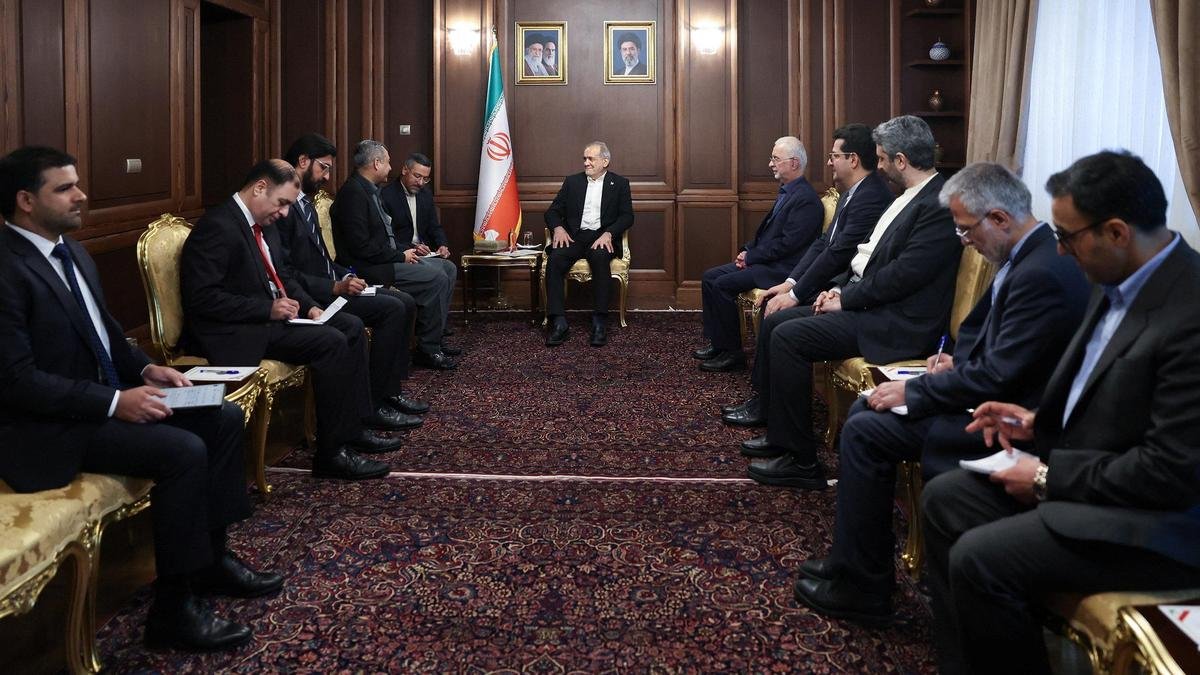
Iranian President Masoud Pezeshkian meets with Pakistan’s Interior Minister Mohsin Naqvi, in Tehran, on Iran, May 17, 2026.
| Photo Credit: Iran’s Presidential website via Reuters
Iran has submitted a new 14-point proposal to the U.S. through Pakistan, aimed at ending the war amid a diplomatic impasse and fears of renewed hostilities, even as President Masoud Pezeshkian said the country “will not bow to any power”.
On April 10, Iran had sent its response to an American plan, which President Donald Trump dismissed as “totally unacceptable”. According to Iranian officials, Tehran proposed negotiations to focus on ending the war, while deferring talks on the nuclear file to a later stage. The U.S. subsequently sent a formal reply to Iran’s proposal, with Tehran’s latest 14-point plan constituting its response to the American text.
“In line with the recent practice of exchanging messages, Iran has also once again submitted its text in 14 points through the Pakistani mediator after making amendments,” an Iranian official said, according to the Tasnim news agency.
Tasnim quoted another Iranian official as saying that the U.S. has agreed to waive sanctions on Iran during the negotiation period. Iran has insisted that removal of all sanctions on the country should be part of a final agreement. “The United States has proposed a waiver of OFAC (Office of Foreign Assets Control) sanctions until a final understanding is reached,” the agency reported.
The U.S., which along with Israel launched the war on February 28, announced a ceasefire on April 8, citing progress in negotiations. Iranian and American officials held one round of direct talks in Islamabad on April 11 but failed to reach any breakthrough. Immediately after the talks failed, Mr. Trump announced a blockade of Iran’s ports. Iran, which took control of the Strait of Hormuz after the war broke out, has demanded the U.S. end the blockade as a confidence building measure to take talks forward. Meanwhile, both sides have exchanged their proposals through Pakistan.
“We will not bow. I will never bow before any power. We will not sacrifice the country’s dignity for the sake of comfort-seeking and our own worldly desires, but we must manage the country with prudence and wisdom,” Mr. Pezeshkian said on Monday (May 18, 2026) about the negotiations, according to Press TV.
Iran’s Foreign Ministry spokesperson Esmaeil Baghaei told reporters in Tehran on Monday (May 18, 2026) that the diplomatic process continues through Pakistan despite the tensions. Tehran received “a set of corrective points and considerations” from the U.S. “[O]ur points of view were presented to the American side in return. Therefore, the process continues through Pakistan,” he said.
One of the key sticking points, besides the nuclear programme, is Iran’s control of the Strait of Hormuz through which almost one-fifth of the world’s oil passed before the war. Since the war, Tehran has declared sovereignty over the strait and asked ships to coordinate with the Islamic Revolutionary Guard Corps Navy.
On Sunday (May 17, 2026), Iran unveiled a new body, the Persian Gulf Strait Authority (PSGA), to control the Strait. According to the new mechanism, all ships seeking to transit the Strait should get a confirmation message, about “ruled and regulations” from the PGSA.
Published – May 18, 2026 09:44 pm IST


