


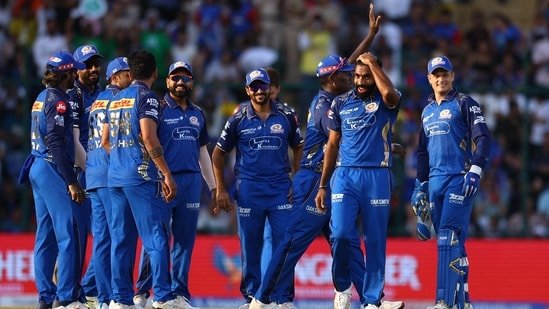
For the past few years, the Indian Premier League’s hierarchy has been changing every season. Unlike the past, when the best were usually Mumbai Indians or Chennai Super Kings, but now these two sides have lost all that aura, especially in IPL 2026. This year, both CSK and MI have been highly inconsistent, failing to build any momentum.
Before, when you would enter the Wankhede to face MI in their prime or take on CSK in a crunch game, the match was usually over even before the first ball was bowled. But their aura was also built on their consistency and continuity. CSK, under MS Dhoni, dominated in the art of pacing tournaments, peaking only when it mattered most. Meanwhile, MI had a settled core and match-winners.
But now their aura is fading.
Hardik Pandya’s captaincy hasn’t really worked for MI, and now they are eighth in the standings. They have won only twice and have lost five games. Meanwhile, CSK have won three fixtures, losing four times and are fifth in the table.’
Playing field levelled and new generation of cricketers
The mega auctions have levelled the playing field, making the league more competitive. Meanwhile, every few seasons, squads are broken up, and even successful ones have to rebuild again and again. Now the difference between a table-topper and a struggling team is marginal.
The new generation of cricketers is not in awe of IPL as they have grown up with it. MI or CSK don’t hold the same psychological weight for these players. They have seen such teams lose, and their idols face setbacks, yet they know they can challenge any player of any calibre in the IPL.
Match-ups and analytics
Now IPL revolves around match-ups and analytics. Bowlers don’t just run in to send top-speed deliveries; they execute plans made for specific batters. Teams look to dissect patterns, identify weaknesses, and capitalise on them continuously. Big players are not unsolvable puzzles anymore. They have become case studies, examined closely by opposition teams. When preparation reaches such a high level, legacy and aura alone can’t guide a team.
Collective display more important than star power
Earlier, teams relied too much on star power, which would take them past the finish line. But now that is no longer possible. In the past, a few big names could win you a game, but now that’s not possible anymore. Now, a collective display is more crucial as teams need all departments to contribute. If one department doesn’t perform well, then the entire team plays poorly.
It was perfectly reflected on Thursday as MI lost to CSK, courtesy of Sanju Samson’s hundred. The opener smacked an unbeaten knock of 101* runs off 54 balls, packed with 10 fours and six maximums, and he was also striking at 187.04. Just one player broke past MI’s star power, and Hardik Pandya accepted it after the match. The MI skipper said, “It’s just that Sanju played an outstanding knock. At the same point of time, their batters kept coming and kind of chipping in and got them to a decent total. I think more than a decent total on that track. For us to chase this down, we needed to have a good powerplay and the momentum had to be with us, but that could not happen.”
New reality
The new reality has opened doors for teams without any historical pressure. Franchises like Punjab Kings and Rajasthan Royals have taken advantage, with the former under Shreyas Iyer’s captaincy and the latter under Riyan Parag’s leadership. Both these franchises show that aura is not a permanent tag. It shifts from franchise to franchise, and even from player to player, depending on form and the overall collective.
