








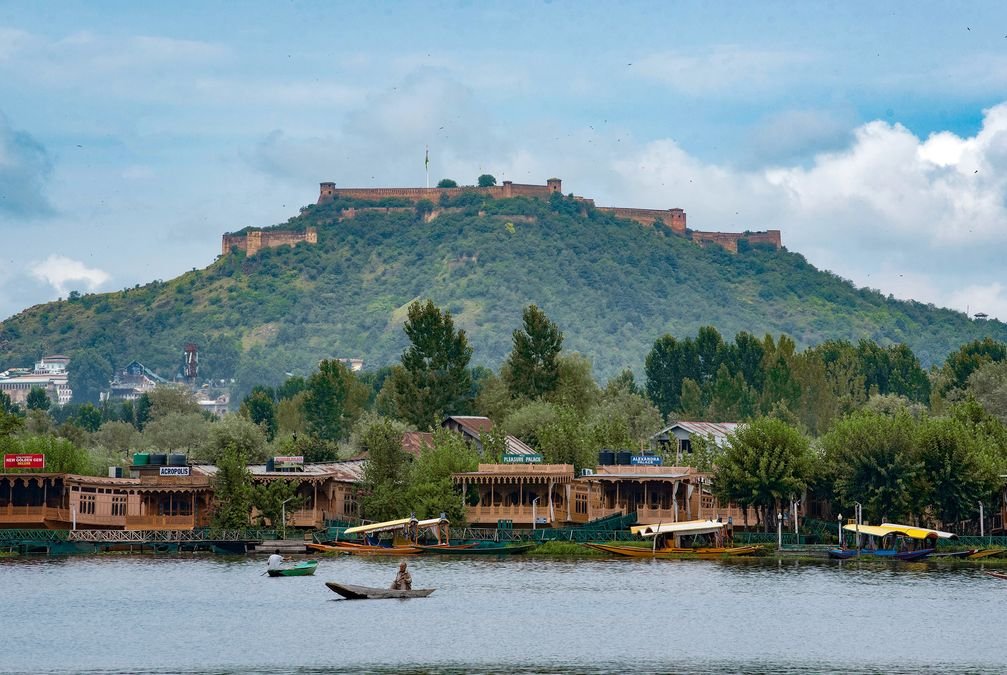
Srinagar, Sep 12: Kashmir’s mountain air may look pristine against its snow peaks and green slopes, but an invisible layer of soot is telling a different story, rather setting alarm bells ringing.
A 2025 study on carbonaceous aerosols in the north-western Himalaya has detected black carbon at multiple locations across the Kashmir Valley, with researchers finding fossil-fuel combustion to be the dominant source of the pollutant.
Published in the Indian Journal of Pure & Applied Physics, the study ‘Variability of Carbonaceous Aerosols in Two Distinct Climatic Zones of the North-Western Himalaya (India)’ – an expedition during summer 2022 examined black carbon and other carbonaceous aerosols at Srinagar, Qazigund, Pahalgam and Gulmarg.
The researchers recorded average black carbon concentrations of 6.36 micrograms per cubic metre (µg/m³) at Gulmarg, 6.18 µg/m³ at Qazigund, 6.10 µg/m³ at Srinagar and 3.77 µg/m³ at Pahalgam during the June–July 2022 campaign.
“Fossil-fuel sources contributed 81–94 per cent of black carbon at the Kashmir Valley sites, while biomass burning accounted for 6–19 per cent,” the study found. “The soot burden is not confined to Kashmir’s main urban centre. Black carbon was detected at locations ranging from Srinagar to the high-altitude landscape of Gulmarg and the southern Valley sites of Qazigund and Pahalgam.”
It said that Gulmarg recorded the highest average concentration among the four monitored Kashmir locations, at 6.36 µg/m³, despite being a high-altitude tourist destination.
The figures, however, represent measurements from individual monitoring locations and should not be interpreted as annual black-carbon emissions for entire districts. “Qazigund and Pahalgam are in Anantnag district, and Gulmarg is in Baramulla district, but their readings cannot be treated as district-wide averages,” the study notes.
A six-year study published in Environmental Pollution in 2022, based on observations from Srinagar between 2012 and 2017, reported a mean annual black-carbon concentration of 6.06 µg/m³.
The study recorded an average of 8.60 µg/m³ during winter and 8.31 µg/m³ during autumn, while November recorded 13.88 µg/m³ and December 13.4 µg/m³.
The researchers linked the winter accumulation to temperature inversions, a shallow atmospheric boundary layer and stagnant conditions that restrict pollutant dispersion.
The same study found that fossil-fuel combustion contributed 60–70 per cent of Srinagar’s black carbon, while biomass burning became a substantially larger contributor during autumn and winter.
Climate expert and environmentalist Dr Touseef Ahmad Bhat said the wider climate implications of such environmental changes could no longer be ignored.
“Climate change is no longer a distant threat. It is happening now,” Dr Bhat told Rising Kashmir. Known for his environmental conservation work and popularly referred to as Kashmir’s “Tree Man”, Dr Bhat also stressed the need to treat ecological protection as part of climate resilience.
“Black carbon is particularly important in the Himalayan context because it absorbs sunlight and contributes to atmospheric warming. When deposited on snow and ice, the dark particles can reduce surface reflectivity and increase solar absorption, potentially accelerating snow and glacier melt,” Dr Bhat said.
For Kashmir, where snow and glaciers are closely linked to water availability and ecosystem stability, the issue therefore extends well beyond conventional urban air pollution. Earlier Srinagar research had also pointed to regional atmospheric transport as an additional factor, indicating that part of the Valley’s black-carbon burden may originate outside the region.
What remains missing is a comprehensive district-wise black-carbon emissions inventory for Jammu and Kashmir, quantifying annual emissions and separating contributions from transport, residential heating, biomass burning, industry and other sources.
The 2025 study provides an important snapshot of the Valley’s soot burden, while older Srinagar observations demonstrate how sharply concentrations can rise during autumn and winter. From Srinagar’s urban landscape to Gulmarg’s mountains, the invisible pollutant is now firmly on the Valley’s environmental radar.


