






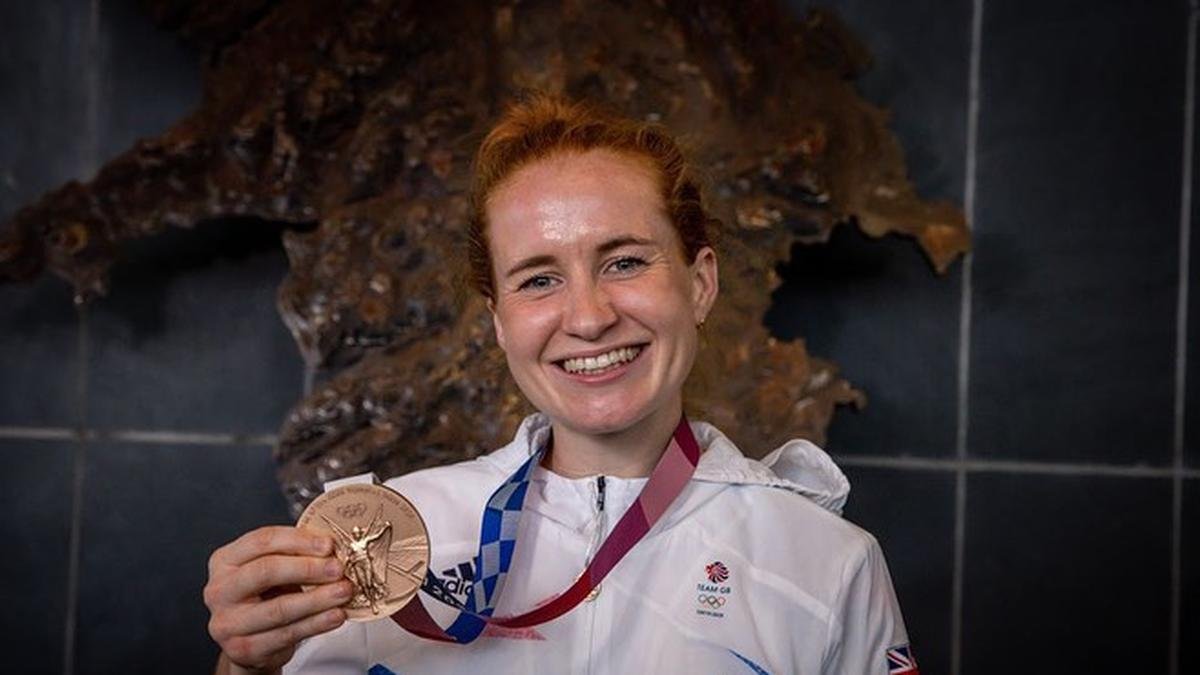
Sporting careers never happen in isolation. More so when they happen in blooming ecosystems riddled with developmental challenges of diverse kinds. Wales veteran Sarah Jones can attest to this.
A football nut in her formative years, her journey with the sport abruptly ended when opportunities to formally play alongside the boys dried up. It sent her in hockey’s direction.
The rest is history. Jones was a mainstay for Great Britain on the global stage until her GBr retirement in 2024, was part of the bronze medal-winning outfit at the Tokyo Olympics in 2021 and earned her 200th international cap during the FIH Women’s World Cup Qualifiers in Hyderabad, becoming only the second Welsh player to reach the milestone.
The 35-year-old, in a conversation with The Hindu, spoke about early pathways for girls in sport, how university life shaped her professional career and how she’s using her experience in hockey to make an impact in other disciplines. Excerpts:
What do you remember of your international debut way back in 2011?
Gosh, it feels like a lifetime ago. It was in a place called Largs in Scotland, and it feels like a world away from the hockey that we play and see now. Neither me nor the girls had ever played in India before. The game is in an interesting place. The sport has moved to a place that is filled with a passion so integral to a country’s make-up and personality.
When you burst onto the scene, you would’ve had a checklist of things you might have wanted to achieve. What have you managed to tick off? What’s left?
I was too naive back in the day to have a checklist as such. I knew I wanted to participate in the Commonwealth Games, but I unfortunately missed out on Delhi 2010. I’m not sure I quite believed that I could go to the Olympics, but that eventually happened.
I just love hockey and I love playing. Every time I get to play a hockey game for Wales, every time I represent my country, it feels like a privilege. I am probably too much in the present to think about the future, which is why I’m playing 15 years on.
What drew you to hockey in the first place? In Wales and England, kids that age tend to gravitate towards football or rugby…
I did play football when I was younger and I loved it. But it was mainly a boys’ game back then. When I started secondary school, I was introduced to hockey, and I loved how fast and intense it was. That was it. I love that you have to be switched on at every moment. The breaks in play are so short, even for the stoppages in time. There are few sports like that where it’s so go, go, go all the time.
Even though my legs are getting older and I’m not sure how long I can keep up with all the young ones out there, it keeps me in the game.
Were you a midfielder in football?
Yes. I always say that if you can’t be good enough at scoring goals and you can’t be good enough at defending goals, you’re probably somewhere in between (laughs).
You became the first Welsh outfielder to play hockey for Great Britain…
It’s probably the thing that I feel most proud of in my hockey career… to show others that this is what they’re capable of doing. I hope me being around even now provides some inspiration to the players… to show them that the path is very much there for them.
What changes in the sport, besides the big rules and regulations kind, have made a big difference?
Probably, the biggest thing is about the pace of the game. The fact that you can make on-off subs through the game… having the self-pass rule that was introduced in 2012 has meant that the game is just so much faster. The astroturf also contributes to that. When you watch hockey being played with the offside rule on grass 20 years ago, with the same 11 on the pitch, it’s a very different game to now.
The game does have to continue to evolve in order to keep interest in comparison to other sports. Having said that, keeping it as a 11-a-side game is important because it makes things interesting.
Have you come across purists of the sport with whom you might have had to defend the current version of hockey?
Whenever a rule comes in, there is always some apprehension about it. The aerial rule and the way it changes all the time is probably a good example of that. Understanding where we want the game to go and also understanding that sometimes something might not work is important. The safety aspect is there, too.
In rugby, for example, they’ve looked at the tackle height to ensure that the game is safe. To get people into the game we love, we want it to be safe, and we want to show that it’s safe. So, no, I haven’t come across too many people who haven’t understood that they want the game to move on. Hopefully, when I look back in 50 years, I’ll recognise the game for what it is too.
Is there any discarded rule that you want to revive?
I’m not sure I would. I would change the aerial rule, but who wouldn’t? I think the men’s game and women’s game are officiated slightly differently. The aerial rule is umpired more freely in the men’s game. It’s more fluid in the women’s game, and I would want to move it closer to how it is in men’s.
What goes through a player’s mind when he or she gets picked for the Olympics?
We had four first cappers for the opening game against Scotland (in the recent World Cup Qualifiers in Hyderabad). The one thing I said was, ‘when we sing the national anthem, take a moment to appreciate the magnitude of getting the first cap for your country’. Thinking about my opening game at the Olympics or my first Welsh cap or my first Commonwealth Games or anything like that, I was so wrapped up in the moment of the game. I was thinking about what was going to happen that maybe I didn’t want… you don’t take it all in. It’s easy for these moments to pass by you.
What is your best achievement so far?
Bronze medal at the Tokyo Olympics. It is hard to argue that there might be better ones.
But if you have to put that aside, what would you pick?
Beating India at the Commonwealth Games in 2018. The tangible stuff like the medals are great. But it’s the memories and the people who you meet that are the things which stay in your heart.
You are an alum of Loughborough University. How did the period there impact your sporting journey?
I went to Loughborough not knowing that it was an incredible sporting university. There, the person who became one of my best friends, who was next door to me in university halls, said, “Do you want to go to hockey trials?” I immediately agreed. I eventually got into Loughborough’s third team.
I didn’t really know what that meant. There were five hockey teams just for the university. That’s when I first thought, ‘OK, so if I’m in the threes, if I work hard enough, I can surely get to the twos and then maybe to the ones.’ I watched the women’s ones team play for the first time. I think it was the first time I saw something and thought, “I want to be that.” I eventually played for the ones and then broke into the Wales team after graduation. If I hadn’t gone to Loughborough, I wouldn’t have fallen in love with hockey.
Hailing from Wales, which football team do you support?
I moved around a lot and I never really had a true base. But I’m moving back to Cardiff very soon, which is my childhood home. So I think I’ll be supporting Cardiff City. I supported Chelsea [while growing up] a little bit, but I’m always reticent to say that because people don’t like Chelsea. Gianfranco Zola was particularly incredible.
You are now involved in weightlifting and fencing. How did that happen?
I was fortunate to represent Great Britain and be funded by National Lottery and UK Sport for eight years. When I retired from Great Britain post the Paris Olympics, I knew I wanted to do something in sport. A role came up within fencing as head of talent. It’s an individual, combat sport, something very different from the environment I am used to, but it’s a great opportunity to find similarities and differences and figure how I can develop the sport of fencing.
You always say that hockey is an inclusive sport. Why so?
It is inclusive in the UK for gay women but not so much for other members of the LGBTQ community.
All the teammates I’ve had over the years, or people I’ve played against, have accepted me and loved me for the person and player I am. I am grateful for that, whilst also recognising that not all members of the LGBTQ community feel the same.
Did the young Sarah growing up have any apprehension about coming out at any point?
To be honest, it’s an everyday thing. While it gradually gets easier, there are always moments when you think you’ve gotten to an end. Those challenges will continue to exist for probably the rest of my life. But again, as long as it becomes a little bit easier for me and the others who follow, it’s a good direction to be heading in.
What do you do to wind down?
I love gardening. I love using my hands in the soil and seeing things start really small and grow. I have a dog, a Vizsla called Nala. I love walking her and spending time with her. I enjoy spending time with family and friends and having a laugh.
Are there any quirks about yourself that the world doesn’t know?
The gardening one is a bit odd. I think I’ve hit that about 50 years too early. That’s really a retirement thing. But it makes me feel very grounded.
If you could tell something to your younger self, what would you say?
I’d say, I know this is really difficult to believe, but in 25 years, women’s sport will look a lot different than it does now. You won’t have to play with the boys to play a sport. Don’t think that you’re weird just for wanting to be outside and playing. Keep trying because one day, you might go on to do wonderful things.


