



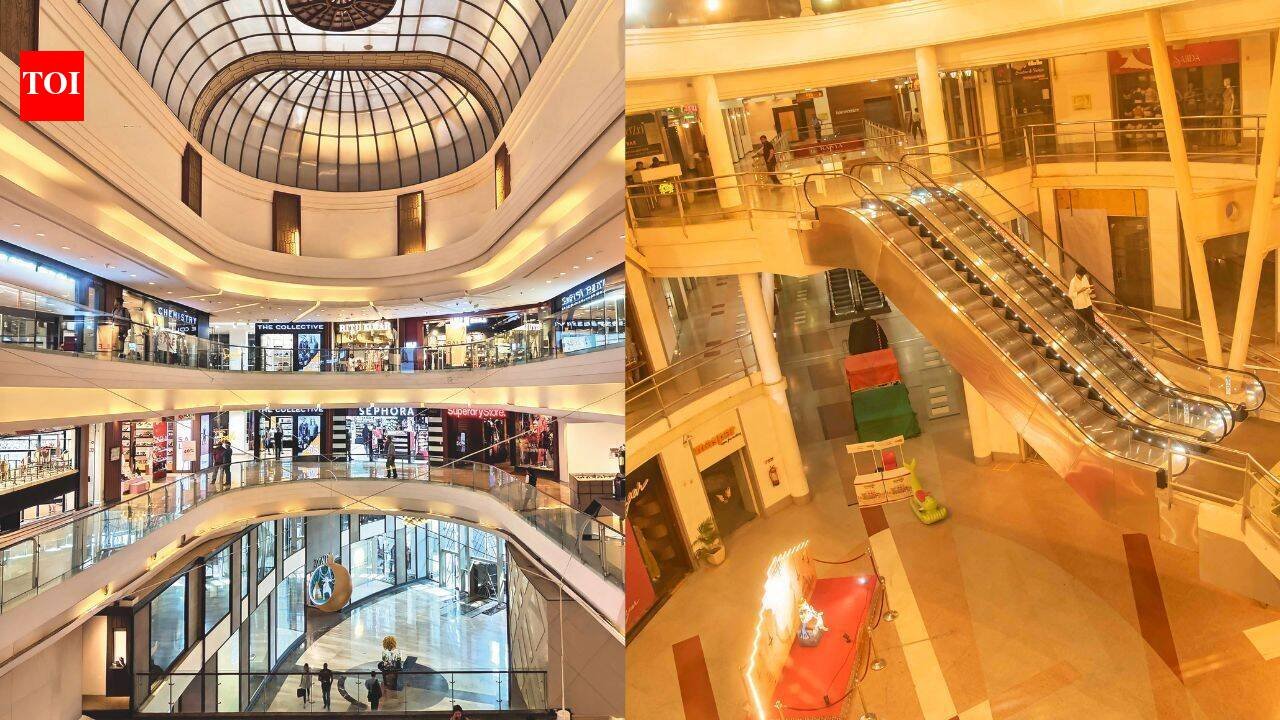
When Ansal Plaza opened in 1999, it was something Delhi had never seen. A semi-circular structure with an air-conditioned food court, the city’s first Shoppers Stop and a McDonald’s where getting a table needed luck. For a generation of Delhiites, going there felt like an event. “Visiting Planet M and discovering new music was a thing for us. But now even entering that mall is scary,” says Sheetal Singh, 37, who frequented the mall during her school days.She’s not wrong. Walk through Ansal Plaza today and shuttered fronts outnumber open ones. Corridors echo with footsteps of a handful of people. Instead of the bustle of shoppers, there is the flutter of pigeons.Now drive to DLF Emporio in Vasant Kunj or The Chanakya. The difference is stark. The tenant roster includes Valentino, Jimmy Choo, Louis Vuitton and Dior. Behind the scenes, global luxury houses are waiting for space. But most of them are told the same thing: Aap kataar mein hain.One part of Delhi has malls with empty shops. Another has brands waiting to get into the right ones. The city does not have too many or too few malls. It has a large volume of the ‘wrong’ kind.Delhi is not the only city living this contradiction. Bengaluru has ghost malls, even as destinations such as Mall of Asia and UB City cater to premium shoppers. Mumbai has underperforming malls, alongside luxury destinations such as Jio World Plaza and Phoenix Palladium. Kolkata too has ghost malls, while Quest Mall serves as its luxury retail anchor. These are also cities where international brands are actively looking to expand. Yet the paradox persists: India has an abundance of retail space, but a scarcity of the right kind.
‘Top brands are ready to enter India, but there’s no space’India has only three true luxury malls: DLF Emporio and The Chanakya in Delhi, and Jio World Plaza in Mumbai, as per Reuters. Earlier this year, Saurabh Bharara, head of luxury malls at DLF, told Reuters that LVMH, Kering and Richemont regularly ask for more space. “We have top 15 brands that are ready to enter India if we give them space tomorrow,” he said, adding that there was “zero availability”. The shortage is stark. Patek Philippe and Loro Piana have no physical stores in India. Prada has no fashion stores and only one beauty store. Chanel has one fashion store and select beauty boutiques. But, in China and Tokyo, comparable brands operate 14-18+ flagship stores. These markets have luxury retail clusters across multiple locations and neighbourhoods.“There are more brands that want to enter the Indian market but real estate hasn’t caught up,” says Samir Gadhok, co-founder of Burgundy Brand Collective. For some brands, he says, the wait to reach the presentation stage can stretch to 12-18 months. “The supply has not even been close. There is a very real supply wall. There are huge gaps in most tier-1 cities,” says Anuj Kejriwal, CEO of Retail at Anarock Group.Why old malls are difficult to fixWhy can’t existing malls simply be upgraded? Many were built when organised retail was still finding its feet, and were poorly planned or designed around outdated shopping patterns.Also, ownership fractures the vision. Architect Goonmeet Chauhan points to the strata-selling model, in which individual units are sold to different owners. Coherent curation then becomes difficult. “Ansal Plaza made the mistake of selling,” he notes. Milin Rohinesh, Head of Retail at Cushman & Wakefield India, shares, “When you have individual owners, every decision becomes a negotiation. They all do not have a common vision. ”
Consumer memory is harder to erase than walls. “If a ghost mall is sitting in a location for five years, the consumer remembers that they haven’t been there for half a decade,” Rohinesh says. A new facade or brighter lighting cannot erase that memory.Sometimes the building itself is the problem. Repositioning requires redesigning the layout, accommodating larger stores, rebuilding the tenant mix, renegotiating leases and upgrading infrastructure. “Mall developers often perceive that building an entirely new asset from the ground up is cheaper and easier,” Kejriwal says.This explains the paradox: India has mall space, but not the large, modern, well-located space global brands demand. Ghost malls are often half a million square feet or smaller, says Rohinesh, while newer developments approach or cross a million.An empty shop isn’t available spaceWhy can’t brands simply move into one of the many existing malls? Because the right space is about more than size.“The availability of space does not necessarily make it the right location,” says Sathyajit Radhakrishnan, CEO of Galeries Lafayette India and International Mono Brands at Aditya Birla Fashion and Retail. “Scale, catchment, accessibility and surrounding environment – all have to work together.”A Grade-A or Grade-A+ mall is professionally managed, institutionally owned, designed for large-format stores and curated for the right mix of brands. A Grade B or Grade C mall is older, often strata-owned, and typically lacks the infrastructure, management and tenant mix that premium brands require.A Grade-A mall is increasingly expected to be a destination: shopping, entertainment, dining, hospitality and offices under one roof. Premium brands need larger stores, strong facilities management and the right mix of neighbouring brands. They want spaces that give people a reason to stay, not simply shop. “The arrival experience starts from something as basic as the parking lot,” says Rohinesh.For luxury brands, even visibility has to be carefully considered. “Earlier people believed if their shop was on the main road, it would be successful. But when it comes to premium luxury brands, concealing is important,” says Goonmeet.“What’s more important to them now is who your neighbours are, who your adjacencies are,” explains Gadhok. That is why an empty shop in a struggling mall cannot simply be equated with available space. A brand may have the square footage it needs but still lack the catchment, neighbours, infrastructure or environment it wants.“It is not constructing a shell, cutting up the shell into multiple small or big stores, adding some escalators, having some glitzy lobby and then having people come there,” Rohinesh says, adding, “Retail space is very scientific.”
A mall is no longer the only answerFor brands unwilling to compromise – and unable to wait for new malls – the mall is no longer the only answer.Galeries Lafayette’s India entry is one example. The Parisian department store, brought to India by ABFRL, opened in two restored colonial buildings in Mumbai’s Kala Ghoda rather than a conventional mall. “The choice of Kala Ghoda was deliberate,” says Radhakrishnan. “South Mumbai has the consumer base we are looking to cater to, while Fort offered a setting where fashion, culture and experiences could come together. ”The standalone format was not simply a workaround for the shortage of mall space. But for brands that want a conventional mall presence, the shortage remains. Delhi and Mumbai are not the only cities where developers are betting on new formats. Luxury-focused malls are also being planned in eight major cities in the country, including Hyderabad, Ahmedabad, Pune, Kolkata, and Chennai but all are still some years away.Across the market, brands are increasingly pursuing two strategies: find an iconic standalone location, or wait for a Grade-A mall. What they will not do is compromise on size, floor, zoning or neighbours simply to get in. “They will take their time,” says Rohinesh.The Grade-A mall space shortage, in numbersThe shortage of Grade-A malls becomes clearer in the numbers. India has only about 110 million square feet of Grade-A mall stock, compared with more than 400 million in China and around 700 million in the US, according to Anarock. In the first half of 2026, retailers leased 4.1 million square feet of Grade-A mall space across the top seven cities, while developers delivered just 0.9 million square feet of new supply, a demand-to-supply ratio of 4.5 to one. Grade-A mall vacancy has fallen to a 16-year low of 6.7 per cent.Delhi-NCR was the only one of the top seven cities to add Grade-A mall space in H1 2026, with around 0.9 million square feet of new supply, according to Anarock. Bharti Real Estate is developing The Mall at Worldmark at Aerocity, part of a nearly three-million-square-foot retail development, which is expected to add 200,000 square feet of luxury retail to Delhi’s supply.The market is effectively splitting in two: a large stock of ageing malls that shoppers have abandoned, and a small pool of premium destinations that brands are fighting to enter. Retail leasing fell 24 per cent in the first half of 2026, while new completions fell by 57 per cent, according to Anarock. “For supply to catch up, institutional investors must commit to large-scale, experience-led developments in major consumption hubs,” says Kejriwal.But the next generation of retail may not look like the mall of 1999. Goonmeet Singh Chauhan, the architect behind Select City Walk, expects more experiential, family-centric and tourism-oriented destinations, where hotels, offices, wellness centres, cafes and indoor and outdoor experiences sit alongside retail. The question is no longer whether India has enough mall space. It is whether it has enough of the kind that brands want to enter.
