



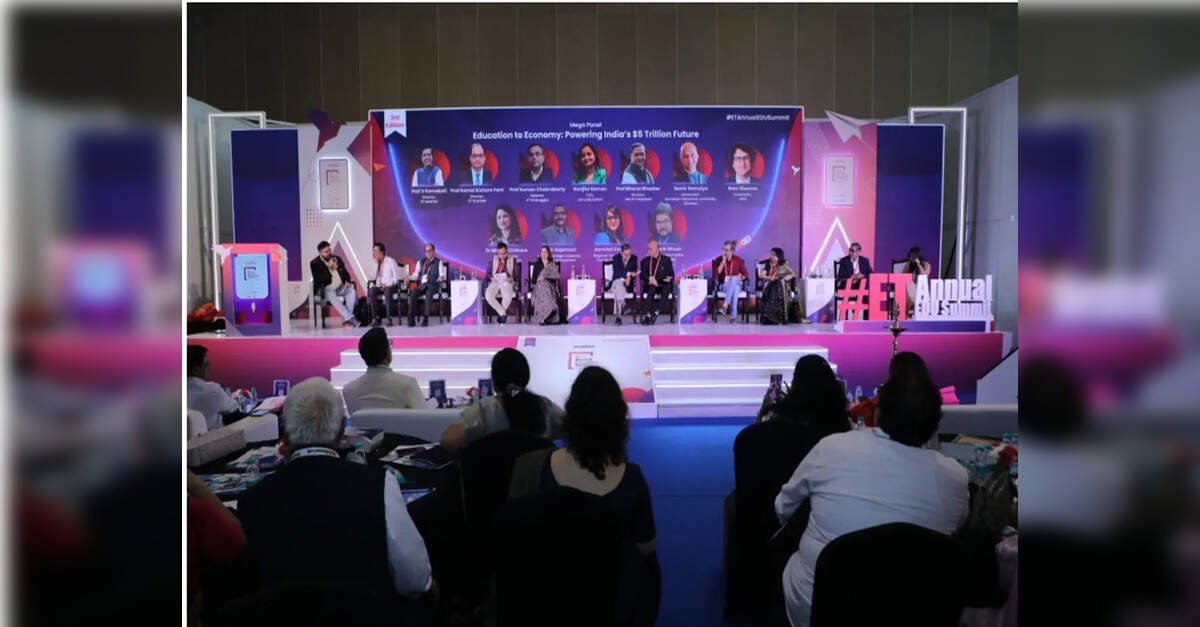
India’s economic ambitions will depend not only on producing more graduates but on building universities that can convert knowledge into innovation, research into impact and learning into long-term capability, education leaders opined.
Speaking at a leadership discussion during the third edition of the ETEducation Annual Education Summit 2026, organised around the theme “India’s Education Revolution: For the World, With the World,” speakers argued that higher education must now move beyond academic silos and short-term employability metrics to prepare learners for an economy increasingly shaped by artificial intelligence, deep technology and continuous reinvention.
A recurring message across the discussion was that universities can no longer measure success only through admissions and placements. Instead, institutions must become engines of innovation, translation, ethical leadership and lifelong learning.
Prof V Kamakoti, Director, IIT Madras, said India should approach artificial intelligence from its own strengths rather than replicate global models. “We are the largest producer of data. If systems have to get validated, it will be in Bharat, and only in Bharat,” he said.
Kamakoti argued that India’s opportunity lies in building frugal, domain-specific and energy-efficient AI rather than competing blindly in the race for ever-larger models.
“You should not shoot a mosquito with a revolver,” he said, advocating for smaller and more sustainable AI architectures that solve real problems at scale.
Connecting innovation to economic outcomes, Prof Kamal Kishore Pant, Director, IIT Roorkee, said higher education must create stronger pathways between science, technology, engineering and business.
“Science, technology, engineering — that has to be connected to management and converted into business,” Pant said.
He pointed to sectors including semiconductors, manufacturing, agriculture, robotics and space as opportunities where universities can play a direct role in improving productivity and competitiveness.
For Prof Suman Chakraborty, Director, IIT Kharagpur, the larger challenge is not innovation but translation. “Working in academic silos is a killer,” he said.
Chakraborty argued that institutions often create knowledge but struggle to move ideas into real-world deployment. He said future breakthroughs will require integration across disciplines and a balanced approach that combines AI with physical systems and local realities.
The conversation also examined whether degrees alone remain sufficient in a rapidly changing labour market.
Ranjita Raman, CEO, Jaro Education, said institutions must create a seamless relationship between formal education and lifelong learning. “Degree education gives foundation; lifelong learning gives momentum,” she said.
She added that tomorrow’s leaders must not only understand technology but also know how to apply it for business and societal outcomes.
Prof Bharat Bhasker, Director, IIM Ahmedabad, said management education must evolve to prepare leaders who can navigate uncertainty and use technology responsibly. “It is not about AI versus humans,” Bhasker said.
According to him, future leadership will require AI curiosity, ethical judgement, data-led decision-making and the ability to work across domains.
Adding a broader societal lens, Samir Somaiya, Chancellor, Somaiya Vidyavihar University, Mumbai, said universities must remain rooted in India’s realities while preparing students for the future.
He argued that education should help learners engage with challenges around agriculture, health, land, energy and inequality rather than treating technology as an end in itself.
At the same time, speakers cautioned against reducing universities to workforce pipelines.
Ram Sharma, Chancellor, UPES, said institutions must prepare students not just for jobs but for life. “The university’s role is not to commoditise our students,” Sharma said.
He argued that universities have a broader responsibility to develop resilience, values, sustainability and the ability to question assumptions.
Echoing this, Dr Madhu Chitkara, Pro Chancellor, Chitkara University, Rajpura, said institutions must move beyond placement outcomes and focus on preparing students to learn, relearn and adapt.
Industry leaders stressed that employability must be embedded across the learning journey.
Arun Rajamani, Managing Director, Cambridge University Press & Assessment, South Asia, said critical thinking, communication, adaptability and problem-solving will remain essential even as job roles evolve.
Meanwhile, Aanchal Chopra, Regional Head – North, Google Cloud India, said universities must give students greater access to real tools, practical environments and industry exposure.
“We need to embrace industry, embrace technology,” she said.
The discussion pointed to a common conclusion: India’s higher education challenge is no longer about expanding capacity but about creating institutions capable of generating ideas, translating them into impact and preparing learners for a world where careers, technologies and industries will continue to evolve.
As India enters its next phase of growth, speakers suggested that the real measure of success will not be how many graduates universities produce — but how many innovators, problem-solvers and future-ready leaders they create.


