


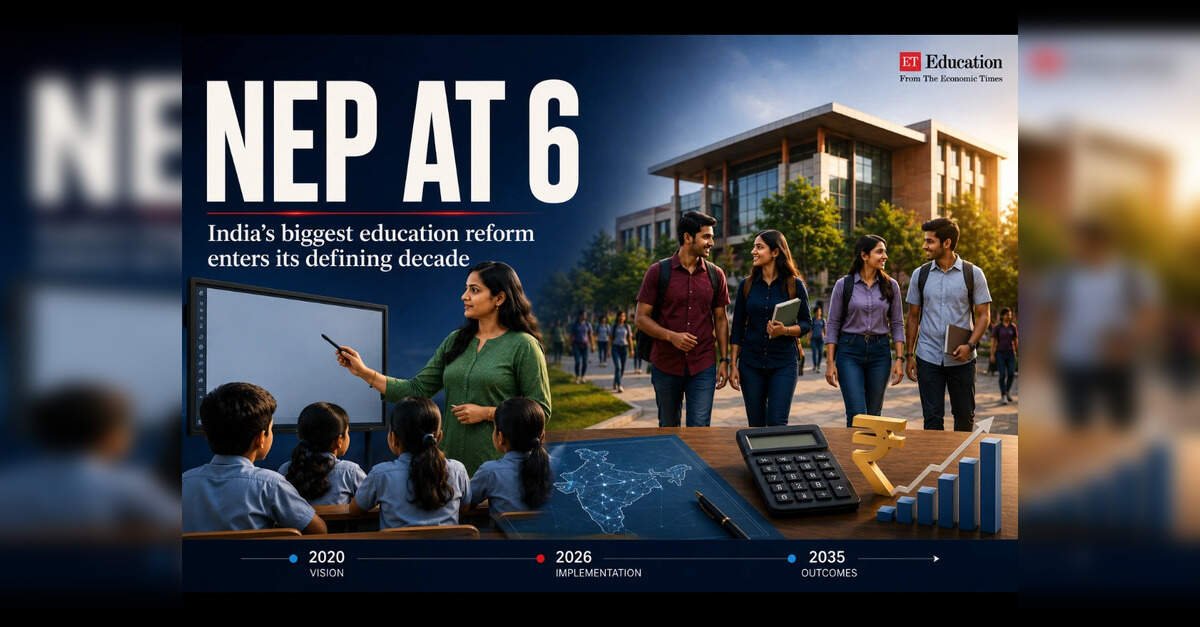
When the Union Cabinet approved the National Education Policy (NEP) on July 29, 2020, it promised a reset of India’s education system: multidisciplinary learning in place of rigid silos, competency-based education in place of rote memorisation, a single regulatory framework in place of fragmented oversight, and lifelong learning in place of a degree-centric model.
Six years later, that reset is visible across India’s classrooms and campuses. Four-year undergraduate programmes have become mainstream in central universities. The Academic Bank of Credits has laid the foundation for academic mobility. The National Curriculum Framework has begun reshaping school education under the new 5+3+3+4 structure. CUET has changed how undergraduate admissions work across participating universities. APAAR has started building lifelong digital academic identities.
Perhaps NEP’s biggest success is that it has changed the vocabulary of Indian education. Multidisciplinary learning, flexibility, skilling, Indian Knowledge Systems, credits, and multiple entry and exit are no longer policy-document phrases; they now show up in classrooms, university boardrooms and government agendas.
Yet the sixth anniversary also marks a turning point. The easy part of reform, announcing frameworks and launching schemes, is largely done. What remains depends far less on vision and far more on legislation, financing, teacher capacity and the ability of states to execute at scale.
A policy that changed the conversation
Before 2020, conversations in Indian education centred on board exams, admissions and degrees. Today policymakers, vice-chancellors and school leaders routinely discuss competency-based assessment, credit transfer, employability and flexible curricula.
At the Conclave on Transformational Reforms in Higher Education under NEP in August 2020, Prime Minister Narendra Modi described the policy’s core shift as moving education toward “how to think” and away from “what to think,” framing it as a move toward inquiry-based and analysis-based learning over content accumulation. That framing has stuck; it is now among the most repeated lines used to describe NEP’s intent.
A former senior Ministry of Education official who was closely involved in NEP’s drafting and early rollout put the gap between vision and ground reality this way: “We spent years building consensus and getting the vision right. The frameworks are solid. But when you move from Delhi announcements to actual classrooms in Rajasthan or Bihar, you see how much depends on state buy-in, teacher readiness, and money that simply hasn’t flowed at the promised scale. Some days it feels like we built a beautiful aircraft that’s still waiting for fuel.”
The unfinished reforms
The biggest structural promise still pending is regulatory overhaul. The Higher Education Commission of India, originally envisaged as a single regulator to replace UGC, AICTE and NCTE, has evolved into the Viksit Bharat Shiksha Adhishthan (VBSA) Bill, 2025, a 48-page draft that includes an overriding-effect clause (Clause 49), a statutory appeals mechanism (Section 37), and a supersession power over non-compliant institutions (Section 47). Introduced in the Lok Sabha on December 15, 2025, the Bill was referred to a 31-member Joint Parliamentary Committee chaired by D Purandeswari, with its report due by the first day of the last week of the Monsoon Session. A JPC meeting scheduled for July 20 to adopt the draft report was cancelled without an explanation and no new date has been set, leaving the Bill’s near-term path uncertain. Until Parliament acts, the existing regulators continue to function under the old framework.
Teacher education is the other major gap. Curriculum reform has moved faster than teacher preparation, even though teacher quality remains the single biggest determinant of classroom outcomes.
The implementation problem, in one number
NEP 2020 set an explicit, dated target: universal foundational literacy and numeracy (FLN) in primary school by 2025. That deadline has now passed, unmet. The government’s own NIPUN Bharat mission has since pushed its implementation timeline to 2026-27.
The scale of the gap is visible in ASER 2024 data: only 23.4% of Grade 3 government school children could read a Grade 2-level text, the best figure since ASER began tracking this metric in 2005, but still short of even the halfway mark. The state-level spread is stark, from 49.7% in Himachal Pradesh to 6.7% in Jammu & Kashmir, a gap of over 40 percentage points within one country’s primary school system. Uttar Pradesh, notably, posted one of the sharpest two-year gains, from 16.4% to 27.9% between 2022 and 2024.
This is NEP’s core paradox in miniature: the policy architecture exists, the national mission exists, but the outcome it was built to guarantee first, before any other part of the policy could matter, is still a work in progress five years past its own deadline.
| Reform | Status |
| Four-year undergraduate programmes | Implemented across central universities and several state universities |
| Academic Bank of Credits | Operational |
| Multiple Entry-Multiple Exit | Operational in many HEIs |
| National Curriculum Framework | Released and under implementation |
| PM SHRI Schools | Rollout underway |
| APAAR Digital ID | Being implemented |
| CUET | Adopted by participating universities |
| ANRF | Established |
| HECI/VBSA | Awaiting legislation |
| Teacher education reforms | Partial implementation |
| Public spending at 6% of GDP | Yet to be achieved |
The money question
Nearly every unfinished promise under NEP eventually comes down to funding. NEP reiterated India’s long-pending commitment to raise public education spending to 6% of GDP, a target first proposed by the Kothari Commission in 1966.
The actual number is further from that target than commonly assumed. As per the Economic Survey 2025-26, combined Centre-and-State government expenditure on education stood at 2.7% of GDP in the FY26 budget estimates, down from 2.9% in FY20, the year NEP was approved. That places India behind South Africa (6%), Brazil (5.6%), and China and Russia (4% each), and even below the lower-middle-income country average of 3.4%.
Union education budgets have grown in absolute rupee terms since 2020, and recent Budgets have prioritised skilling, AI and digital learning. But school education funding remains heavily state-dependent, which produces the uneven implementation visible in the FLN numbers above. Six years in, funding is not a supporting issue in NEP’s story. It is the central one.
Where India stands versus its own targets
| Indicator | NEP goal | Current position |
|---|---|---|
| Public expenditure on education (combined Centre + States) | 6% of GDP | 2.7% of GDP (FY26 BE, Economic Survey 2025-26) |
| Higher education GER | 50% by 2035 | 30.0% (AISHE 2023-24, up from 29.5% in 2022-23) |
| Universal foundational literacy and numeracy | By 2025 | Deadline passed; NIPUN Bharat now targets 2026-27; 23.4% Grade 3 reading proficiency (ASER 2024) |
| Single higher education regulator | One regulator (replacing UGC, AICTE, NCTE) | Awaiting legislation (VBSA Bill) |
| Research and innovation ecosystem | Globally competitive | ANRF established; funding scale remains a challenge |
What NEP did not anticipate
When NEP was drafted, generative AI barely existed as a mainstream concern. Today, universities are launching AI programmes, schools are piloting AI-assisted learning, and employers increasingly expect graduates to arrive with AI literacy. The next phase of NEP will be judged not only on how well India executes what was written in 2020, but on how the policy adapts to a technological shift the original document could not have fully anticipated.
A timeline of six years
| Year | Milestone |
|---|---|
| 2020 | NEP approved by Union Cabinet; Ministry of Human Resource Development renamed Ministry of Education |
| 2021 | Academic Bank of Credits framework launched; NIPUN Bharat mission launched |
| 2022 | Four-year undergraduate programmes introduced across central universities |
| 2023 | National Curriculum Framework for School Education released |
| 2024 | Anusandhan National Research Foundation (ANRF) established; APAAR rollout accelerates |
| 2025-26 | VBSA Bill introduced in Lok Sabha (December 15, 2025); referred to Joint Parliamentary Committee; report due by last week of Monsoon Session, 2026 |
What defines the next chapter
The next six years of NEP will not be judged by how many frameworks get announced. They will be judged by outcomes that are, for the most part, currently short of target: Can every child achieve foundational literacy? Can higher education participation actually reach 50% GER? Can public universities compete globally? Can states implement reforms at comparable pace, rather than the 40-point gaps visible in FLN data today? And can India move its combined education spending from 2.7% toward the 6% figure that has been the policy’s unmet aspiration since 1966?
The same former official offered a grounded closing view: “I’ve seen policies come and go. NEP has better architecture and broader ownership than most. But education reforms don’t succeed on vision alone, they succeed on persistence, realistic funding, and treating states as genuine partners rather than implementers. We’re at the point now where the hard, unglamorous work will decide if this becomes transformative or just another well-meaning document.”
NEP 2020 declared that by 2040, India should have “an education system second to none.” Six years in, that ambition is intact. What is no longer settled is execution: whether India can sustain the political will, the financing, and the federal cooperation needed to close the gap between what the policy promised and what it has, so far, delivered.
