



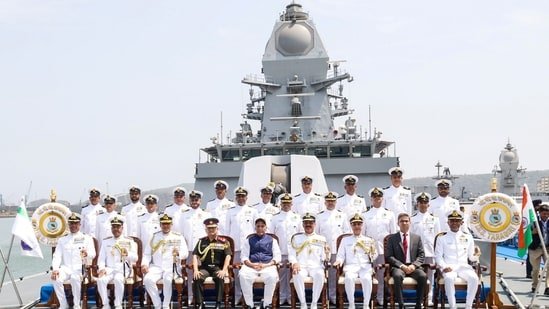
India’s defence minister Rajnath Singh on Friday commissioned two major additions to the the Indian Navy at Visakhapatnam: the indigenous, nuclear-powered submarine INS Aridhaman, and the stealth frigate INS Taragiri.


INS Aridhaman: All you need to know
- INS Aridhaman is India’s third nuclear-powered ballistic missile submarine, built under the Advanced Technology Vessel (ATV) project at Visakhapatnam.
- It is part of the Arihant class, following INS Arihant (commissioned 2016) and INS Arighaat (August 2024).
- Aridhaman is an upgraded version of its predecessors, with greater capacity for submarine-launched ballistic missiles. Technical specifications remain classified.
- The submarine strengthens India’s nuclear triad — the ability to deliver nuclear weapons from land, air, and sea. The sea-based leg is considered the most survivable, backing India’s second-strike capability under its No First Use nuclear policy.
Ahead of the ceremony, Rajnath Singh posted on X: “Not just a word, ‘Aridhaman’ is power!” The name from Sanskrit literally translated to “destroyer of enemies”.
INS Taragiri: Ready for missiles, also for relief efforts
- INS Taragiri is the fourth frigate of the Indian Navy’s Project 17A class, built by Mazagon Dock Shipbuilders Limited (MDL), Mumbai.
- It weighs 6,670 tonnes and carries over 75 per cent indigenous content, with more than 200 MSMEs involved in its construction.
- The ship features a reduced radar cross-section for stealth operations; and is armed with supersonic surface-to-surface missiles, besides medium range surface-to-air missiles, and an anti-submarine warfare suite.
- It is also configured for humanitarian assistance and disaster relief (HADR) missions.
Notably from an industrial standpoint, the ship has an indigenous content exceeding 75%, with over 200 Micro, Small and Medium Enterprises (MSMEs) contributing to its construction, news agency ANI reported.
The Indian Navy has highlighted this as a direct embodiment of the government’s Aatmanirbhar Bharat (self-reliant India) initiative.
Testing and research facility set to be built
Rajnath Singh also laid the foundation stone for a large cavitation tunnel at the Naval Science & Technological Laboratory (NSTL). Such a tunnel is used for testing marine equipment and ship models by simulating underwater environments. It is also used for research in torpedo systems, propeller design, and underwater vehicle hydrodynamics.
Addressing the gathering, the minister said, “The research being conducted here on torpedo systems, underwater mines, decoys, and autonomous underwater vehicles — all of this is taking India forward in the direction of making it a strong naval power.”
He also noted India’s progress on Lithium-ion battery technology for submarines: “Earlier, we used to depend on others for these things. Today, we are designing ourselves, developing ourselves, and working with small and large industries to advance it.”


