



Since judo started as a demonstration sport in 1986 in Edinburgh, it has had a chequered journey in the Commonwealth Games.
A casual glance at how the sport has progressed in the Games will show how judo has been in and out of the programme over the years.
After Edinburgh, from 1990 to 2014, it remained an optional sport, not being included in the 1994 Victoria and 1998 Kuala Lumpur Games, before being included in the 2002 Manchester Games and again going out of favour in 2006 Melbourne and 2010 Delhi. While it was included in the 2014 Glasgow Games, it was removed from the programme for the 2018 Gold Coast Games. It, however, made a comeback in 2022 Birmingham.
When it was retained for the 2026 Glasgow Games, judo performed remarkably well compared to many other disciplines.
After athletics and para-athletics, judo became the sport that spread its medals across most number of nations —18 in all, according to the Commonwealth Sport website.
“Judo spread its medals across 18 nations at Glasgow, more than any sport except athletics and para-athletics. That reach was particularly striking because judo offered only 14 medal events. England and Canada finished with four golds each, but the podium extended far beyond the established powers,” it observed.
Detailing the reach of judo in other countries, the website went on: “Malaysia and Mauritius produced their first champions, Cyprus collected seven medals, while Gabon, The Bahamas and Tonga all reached the podium on the final day.”
Moreover, the report mentioned that at Birmingham 2022, “16 nations won judo medals. Glasgow increased that number to 18, underlining how many different routes the sport now offers to Commonwealth success.”
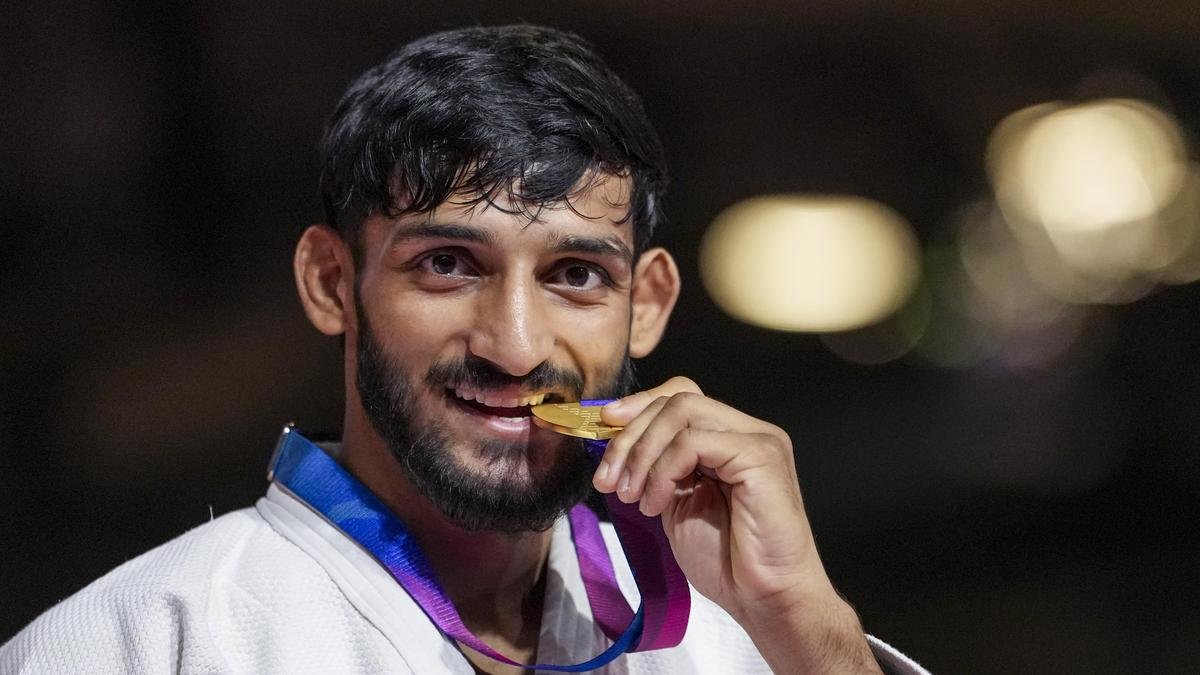
The most striking development, however, was the emergence of India as a power to reckon with. India won four medals, including a historic two gold medals — its first-ever in Commonwealth Games.Will judo now become a core sport in the 2030 Games centenary edition in Ahmedabad?
There is no guarantee, though. In the recently held Commonwealth Sport’s Programme Review, judo did not find a place on the list of sports that are certain to feature in Ahmedabad. It remains one of the sports under consideration. Commonwealth Sport has confirmed that 15-17 sports will feature with the final line-up likely to be announced next year.
The two historic gold medals won in Glasgow, however, could strengthen judo’s case when the Games return to India. The country’s success overall, coupled with the sport’s remarkable geographical spread — with medals going to 18 nations in Glasgow — provides a strong argument for its inclusion.
Asmita Dey celebrates after defeating Canada’s Heidi Quach to win the 48kg gold medal at the Glasgow Commonwealth Games.
| Photo Credit:
PTI
The stars who made that possible were Asmita Dey and Harsh Singh.
Asmita’s women’s 48kg field at Glasgow was respectable and quite competitive, but certainly it was not an exceptionally deep field by world-judo standards. The important point is that Asmita entered as the No. 1 seed, and that was justified by the world rankings (International Judo Federation) at the Games. Asmita was the No. 1 seed and world No. 48 while Canada’s Heidi Quach was the No. 2 seed and world No. 57.
In the regular four-minute contest, Quach initially took the lead with a yuko (partial score), while Asmita was also penalised. Asmita fought back to level the contest, and neither judoka could produce a decisive score in regulation time. The bout went into ‘Golden Score’, where Asmita eventually produced the winning action to prevail 2-1 and become India’s first-ever Commonwealth Games judo champion and Harsh followed suit.
“Winning two gold medals is a big achievement,” said Jiwan Kumar Sharma, Indian women’s team head coach, who was at Glasgow.
The 64-year-old said the gold was possible only due to the willpower and mental strength of the 23-year-old from Tripura.
“We were actually sure that at least one gold medal this time. We exceeded expectations by winning four medals including two golds. Asmita fought exceptionally in semifinals and final where she was trailing. But it was her willpower that brought her the gold,” he said.
For Harsh, the other gold medal winner for India in the men’s 60kg category, the medal was priceless as he came to the Games after incurring a serious knee injury in August last year.
Harsh underwent knee surgery in Bengaluru in October the same year. He then went through almost a year of rehabilitation before returning to competition and went on to win gold, which showed his determination and fierce drive.
In Glasgow, Harsh was world ranked 99 and seeded fourth, while his opponent in the final, Australian Joshua Katz, was 115 in the world rankings and seeded sixth.
In fact, Harsh was not the favourite to bag the title. Facing top-seeded Australian Pedro Carlos Antun Neto, who was ranked 33rd in the world, in the semifinal, the Indian produced a sensational performance, beating Neto 10-0.
Harsh’s summit clash was different from Asmita’s. While Asmita had to survive a tense battle that went into ‘Golden Score’, Harsh absorbed Katz’s early pressure before doing well to seal the gold.
Katz started aggressively and tried hard to impose himself on the contest. Harsh defended calmly and did not rush into an attack. The Indian waited for the right moment, countering rather than forcing the play.
Head coach Jiwan was all praise for Harsh’s relentless drive against the odds to succeed.
“Harsh didn’t have that experience coming into the Games as he was playing in third or fourth international event. But his willpower is great as he is from the Indian Army. After the surgery, he was feeling helpless as he was not able to compete in many International competitions,” said Jiwan, who trains Harsh at Inspire Institute of Sport. “My ward outplayed all his opponents with clear technique and it was really great performance by Harsh.”
Now with a historic performance under their belt, Indian judokas will be facing far tougher competition at the Asian Games to be held in Japan in September-October.
India’s record in judo has been poor at the Games. Its last medal came in the 1994 Games in Hiroshima when Poonam Chopra bagged a bronze in the women’s 56kg category.
Jiwan Kumar knows it better than anyone else. He still expects a medal in Aichi-Nagoya, Japan, at the Asian Games.
“This time, I am expecting at least one medal. Of course, that depends on the draw and how we maintain our performance. I am sure they are capable of defeating anyone. Japan, Korea, Uzbekistan, Kazakhstan, Mongolia and China are very good as they have many Olympic champions, but we have defeated them earlier. Let’s hope for the best,” he said.
Asmita Dey competes against Canada’s Heidi Quach in the 48kg final at the Glasgow Commonwealth Games.
| Photo Credit:
PTI
For the Asian Games so far, only three women — Asmita (48kg), Yamini Mourya (57kg) and Inunganbi Takhellambam (70kg)— have qualified as they are ranked among the top six in Asia, according to Jiwan.
“The National Federation has told the Sports Ministry that the medallists from the CWG should also be included as they are in good form,” he said.
Yashpal Solanki, who has been coaching Asmita for the last eight years, believes Indian judo is catching up fast with the established powers.
“Canada, UK and New Zealand are the powerhouses in judo, but India is catching up fast. Because now in the Government, things have changed. In our time, there used to be one- or two-month camps for the Indians. Now, we have camps throughout the year. That time, we didn’t have sponsors.
Right now, we have Sanskar Dham Academy (Ahmedabad) and many private academies, accredited academies. Then, we have JSW and Olympic Gold Quest,” he said.
Yashpal believes Asmita is capable of winning a medal in the Asian Games, though he admits it will be quite tough.
“It is very difficult. But it totally depends on the day. If she performs well and plays to her potential, she can win a medal. Not gold, but at least win a medal,” he said.
Indian judokas have raised expectations after their stupendous show in Glasgow, and it is incumbent upon them to keep raising their performance for the sport to remain in the radar and gain popularity and people’s acceptance.
The Asian Games will be a litmus test.


