



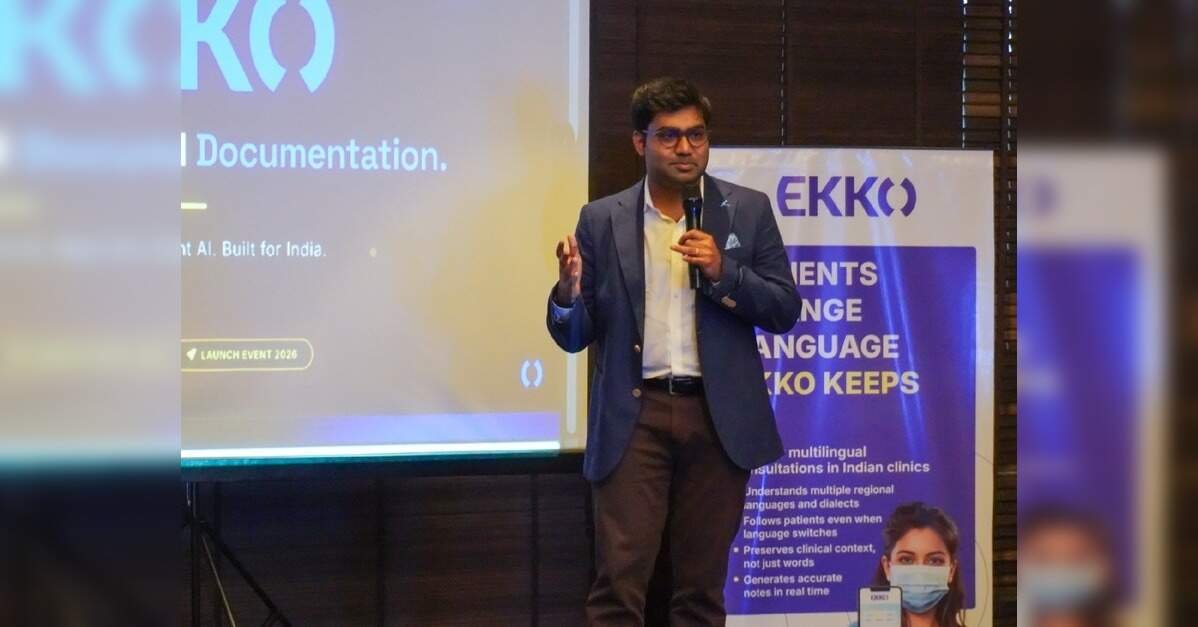
While the world races to deploy AI scribes, a quiet revolution is taking shape in India, one that listens before it transcribes. Chennai-based Ekko believes the future of clinical AI will be built locally, not imported.
Walk into any outpatient clinic in Chennai, Coimbatore, or Kochi, and you will see a familiar scene. A doctor, mid-consultation, glances down at a paper register or types furiously into an EHR while a patient describes their symptoms. The eye contact is fleeting. The conversation is fragmented. And by evening, the doctor is still catching up on documentation she should have finished hours earlier.
This is the silent friction in Indian healthcare: not a shortage of clinical knowledge, but a shortage of clinical attention. And it is this friction that ambient AI promises to dissolve.
Most ambient AI tools available today were not designed with Indian clinicians in mind. They were trained on American transcripts, optimised for fee-for-service billing workflows, and built around documentation conventions that bear little resemblance to how an Indian outpatient department actually runs.
That gap between imported technology and indigenous reality is exactly what Ekko was built to close.
A Different Starting Point
Most AI scribe products start with a question: how do we automate documentation? Ekko started with a different one: What does an Indian clinician actually need from AI?The answers, gathered across hundreds of conversations with general physicians, specialists, and hospital administrators across India, were striking. Clinicians did not ask for faster transcription. They asked for fewer interruptions. They did not want longer notes. They wanted cleaner patient histories. They were not impressed by language models. They were impressed by tools that respected their time and their judgment.
This insight shaped Ekko from the ground up. Where other platforms focus narrowly on note generation, Ekko built an end-to-end clinical documentation companion capable of capturing the conversation, structuring vitals and lab results, maintaining longitudinal patient history, and surfacing relevant context when the clinician needs it.
That clarity of purpose did not emerge from a boardroom. It came from the clinic. Ekko was founded by Dr. Gerrit Jacob, a physician who had spent years watching colleagues lose precious consultation time to the demands of documentation. His mission was never abstract: give doctors their time back. What made the transition from problem to platform unusually fast was a rare convergence. Dr. Jacob combined a clinician’s insight into real-world healthcare bottlenecks with a deep passion for technology and years of immersion in Silicon Valley. What he took away from Silicon Valley was not a playbook but a discipline: that building anything starts with a well-defined problem and the people who can solve it. Ekko was the product that evolved from that discipline.
Designed for Indian Clinical Reality
Indian outpatient care has its own rhythm. A senior consultant may see 60 patients in a single session. Studies across government hospital OPDs document average loads of 40 to 60 patients per physician per day, with certain specialties exceeding 200.[1] Multiple languages may be spoken in a single consultation: Tamil and English, Hindi and English, Malayalam and English. Patient files travel in physical folders, on WhatsApp, and across multiple hospital systems. Lab results arrive as PDFs, photos, and printed sheets.Ambient AI built elsewhere struggles with this complexity. Ekko was designed for it.
The platform is engineered to handle code-switching between English and Indian languages, to ingest vitals and lab data from disparate sources, and to maintain a coherent medical history across visits, even when the underlying records are fragmented. For clinicians, the experience is intentionally minimal. The technology recedes into the background. The conversation with the patient returns to the foreground.
The Trust Equation
What separates a tool clinicians tolerate from one they trust? In conversations with practising doctors, three themes recur.
The first is transparency. AI that operates as a black box invites doubt; AI that shows its reasoning invites ownership. Ekko’s outputs are structured for rapid clinician review, designed to be corrected in seconds, with the doctor always in control of what enters the record.
The second is respect for clinical workflow. Software that demands the doctor adapt to it will be abandoned by week two. Ekko was built to slot into existing workflows, not replace them.
The third, and perhaps most important, is local fluency. A platform that understands the cadence of Indian clinical care, the linguistic diversity of Indian patients, and the operational realities of Indian healthcare will always have an edge over one engineered elsewhere.
Why This Moment Matters
India is at an inflection point in digital health. The Ayushman Bharat Digital Mission (ABDM), which had linked over 490 million health records to ABHA IDs as of early 2025, is building the rails for nationwide health data interoperability.[2] Clinical workforce shortages remain acute, and India continues to fall short of the WHO-recommended doctor-to-population ratio of 1:1000, with significant urban-rural maldistribution compounding the strain,[3] pushing hospitals to seek productivity gains wherever they can. And patients, increasingly digital natives, expect a more attentive, modern care experience.
Ambient AI is no longer a futuristic concept. It is an active infrastructure. By the close of 2025, nearly two-thirds of U.S. hospitals on Epic EHR systems were already utilising ambient AI documentation tools, with studies showing reductions in documentation time of up to 16 minutes per encounter.[4] India’s adoption curve is just beginning. And the question is no longer whether Indian clinicians will adopt it; it is whose product they will adopt.
Ekko’s bet is simple. The clinicians who will define the next decade of Indian healthcare want AI that was built with them, not for them. They want a partner that listens before it speaks, that adapts to their workflow rather than disrupting it, and that earns trust by getting the small things right, visit after visit, patient after patient.
The trust equation in healthcare AI is not solved by bigger models or louder marketing. It is solved by listening. And that, perhaps, is the most clinical thing of all.
Ekko is an Ambient-AI powered clinical documentation platform headquartered in Chennai, India. The company partners with hospitals and independent clinicians across India to reduce documentation burden, improve patient interaction quality, and maintain comprehensive longitudinal patient records.
MEDIA CONTACT
Email: info@ekkomd.com
Phone: +91 95009 95295
Office: 70A, New. 116B, Vellalar Street, Mogappair, Chennai 600037
Web: www.ekkomd.com
REFERENCES
[1] Patel et al., “Patient-doctor ratio across nine super speciality clinics in government hospital,” International Journal of Community Medicine and Public Health — ijcmph.com
[2] Ministry of Health and Family Welfare, GOI, “Update on Ayushman Bharat Digital Mission,” February 2025 — mohfw.gov.in
[3] Sriram et al., “Human resource shortage in India’s health sector: a scoping review,” PMC / NCBI, 2024 —pmc.ncbi.nlm.nih.gov
[4] Tierney et al., “Ambient AI Tool Adoption in US Hospitals and Associated Factors,” American Journal of Managed Care (AJMC), 2025 — ajmc.com
Disclaimer – The above content is non-editorial, and TIL hereby disclaims any and all warranties, expressed or implied, relating to it, and does not guarantee, vouch for or necessarily endorse any of the content.


