






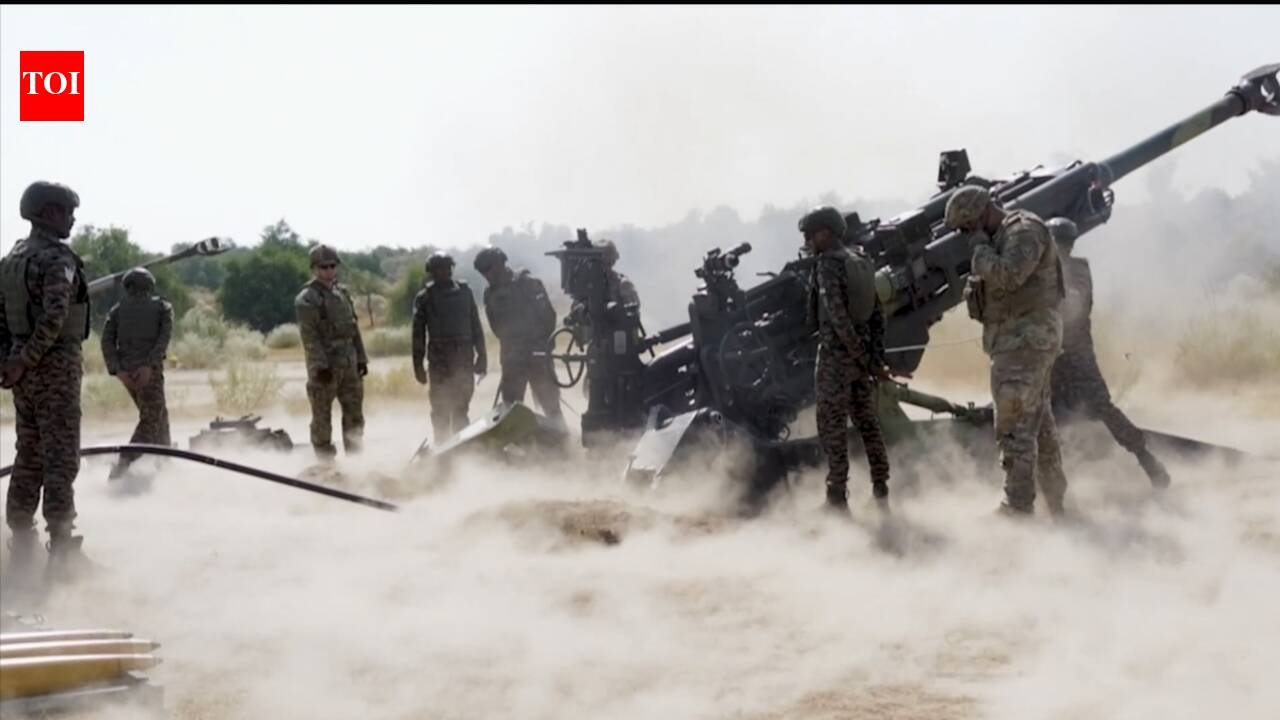
Jaisalmer: The roar of rocket launchers, artillery guns and attack helicopters reverberated across the Mahajan Field Firing Range in Rajasthan, where Indian and US Army troops are finetuning advanced firepower and battlefield interoperability through integrated drills during Exercise Yudh Abhyas 2026.The 22nd edition of Exercise Yudh Abhyas 2026, a joint bilateral military training program between the Indian Army and the US Army, will run from Sept 9 to Sept 28.The Mahajan Field Firing Range (MFFR) in Rajasthan has turned into a showcase of modern artillery, rocket and counter-drone capabilities.A key attraction of the exercise is the presence of the US Army’s HIMARS (High Mobility Artillery Rocket System) alongside India’s indigenous Pinaka Multi-Barrel Rocket Launcher, bringing two highly mobile rocket-artillery systems together in a major bilateral military training environment.The deployment provides the two armies an opportunity to familiarise themselves with each other’s fire-support concepts, target-acquisition procedures and methods of coordinating precision fires in a complex battlefield environment.India’s M777 Ultra-Light Howitzers and Dhanush 155mm guns are participating in artillery drills, while L70 air-defence guns and the US Army’s M-LIDS counter-UAS system add air-defence and counter-drone dimensions to the exercise.A major thrust of the training is on the ability to rapidly move from target detection to coordinated engagement. Indian and US troops are conducting joint drills involving target acquisition, observation, fire planning, communications and engagement coordination.US Army personnel have also trained alongside Indian artillery crews operating the M777A2 and Dhanush systems. The bilateral training has included technical familiarisation, maintenance activities, weapon-system procedures and practice drills. Indian crews subsequently demonstrated firing procedures of the M777A2 and Dhanush systems, with US soldiers observing the drills.The two sides are also exchanging expertise in battlefield surveillance and target acquisition. Troops have been familiarised with systems including the Lightweight Laser Designator Rangefinder 2H, while joint training is focused on accurately identifying, observing and communicating target information.The counter-drone component is another major feature of the exercise. The US Army’s M-LIDS (Mobile, Low, Slow, Small Unmanned Aircraft Integrated Defeat System) is being showcased as part of the effort to counter small unmanned aerial threats. The system integrates radar, sensors, electronic warfare capabilities and kinetic effectors, including a 30mm cannon and Coyote interceptors.Adding an aerial punch to the ground combat drills, Indian Army AH-64E Apache attack helicopters are also operating alongside Indian and US troops as part of integrated operational training.At the command level, staff officers of both armies are undertaking a Joint Planning Process, analysing missions, assessing available capabilities and evaluating threats across a multi-domain environment.The exercise is aimed at developing a common operational understanding and improving synchronisation between the two forces.The Mahajan drills underline the growing emphasis on mobile firepower, precision engagement, integrated aviation, counter-drone warfare and rapid battlefield coordination as the two armies train for increasingly complex operational environments.
Attachment
Attachment
Attachment
Attachment
Attachment
Attachment
Attachment
Attachment
Attachment


