



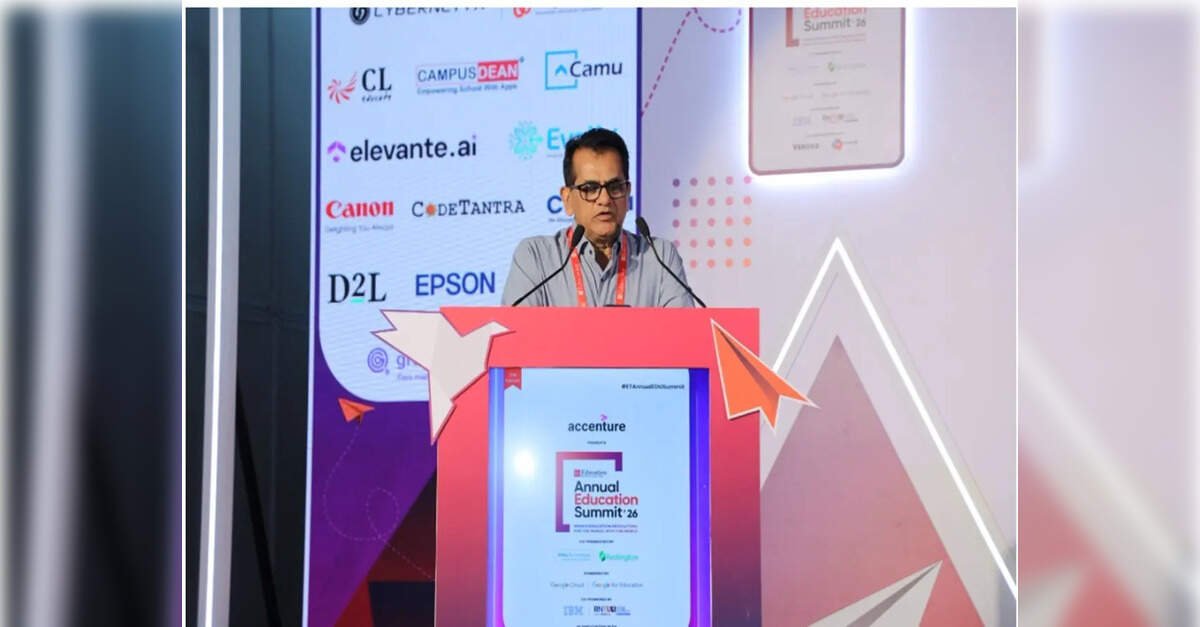
India’s next phase of economic and global leadership will depend on whether its universities can move beyond expansion and become engines of excellence, innovation and talent creation, Amitabh Kant, Chancellor, NIIT University; Former G20 Sherpa (India); and Former CEO, NITI Aayog, said on Friday.
Speaking on the second day of the third edition of the ETEducation Annual Education Summit 2026, organised around the theme “India’s Education Revolution: For the World, With the World,” Kant said India has already achieved scale in education but must now convert access into outcomes, institutions into research ecosystems and students into globally competitive talent.
“We have scaled, but my view is that we must build excellence at scale. We have access, and now we must build outcomes,” Kant said.
According to Kant, India is entering a decisive phase in its education journey, with more young people participating in higher education than at any point in history. However, he cautioned that enrolment growth alone will not position India as a global education leader unless it is matched by quality, strong faculty, modern infrastructure, employability and research depth.
He said the National Education Policy (NEP) 2020 goal of raising the higher education gross enrolment ratio, including vocational education, to 50 per cent by 2035 should not become an exercise in numbers.
“This expansion must not become a numbers game,” he said.
Kant argued that India should build large multidisciplinary institutions, strengthen accreditation frameworks and encourage institutional consolidation where required, while rewarding outcomes rather than administrative compliance.
A central focus of his remarks was faculty. “Buildings do not create universities. Faculty do,” Kant said.
He described faculty development as India’s most urgent higher education challenge and called for a national effort to strengthen the academic talent pipeline.
Referring to faculty shortages and limited doctoral capacity, Kant proposed stronger support for PhD pathways, greater mobility between academia and industry, and more opportunities for collaboration across Indian and international institutions.
He said world-class universities cannot emerge through infrastructure investment alone and that institutional excellence ultimately depends on attracting, retaining and continuously developing strong faculty.
Kant also argued that employability must stop being treated as a placement-stage outcome and instead become part of institutional design.
“Make employability a design principle and not an afterthought,” he said. He said universities should integrate classroom learning with workplace exposure and involve industry more deeply in curriculum design, laboratories, apprenticeships and research partnerships.
Pointing to models that combine academic learning with practical application, Kant said employability can be embedded from the beginning when institutions are designed around real-world outcomes.
At the same time, he cautioned against reducing universities into degree-granting systems. “India must not merely consume frontier technologies. We must actually create,” he said.
Kant called for a transition from teaching-led institutions to research-led universities capable of generating intellectual property, supporting entrepreneurship and contributing to national competitiveness.
He said India must invest in research ecosystems that connect universities with industry and focus on sectors where the country can achieve global leadership.
Referring to international examples of university-industry collaboration, Kant argued that India should create stronger pathways between research, innovation and commercial application.
He also positioned higher education as a strategic opportunity for India globally. “India must become the higher education hub of the Global South,” he said.
According to Kant, India has the opportunity to build universities that attract international students through affordable, high-quality, English-enabled and digitally supported education.
On technology, he said artificial intelligence must become foundational to education rather than an optional addition.
“AI must get embedded in all our education institutions, particularly the universities,” Kant said. He added that AI, digital public infrastructure and trusted digital credentials could help democratise access to quality learning while improving outcomes at scale.
Kant argued that the next phase of reform must move from regulation to enablement — with stronger accreditation, institutional autonomy and accountability for outcomes.
He urged universities to move beyond administration and build cultures centred on ambition, innovation and impact. “The next decade must be India’s university decade,” he said.
His remarks reflected one of the strongest messages emerging from the summit: India has demonstrated that it can expand education at scale; the next challenge is whether it can build universities capable of producing research, innovation, employability and global influence at scale as well.


