



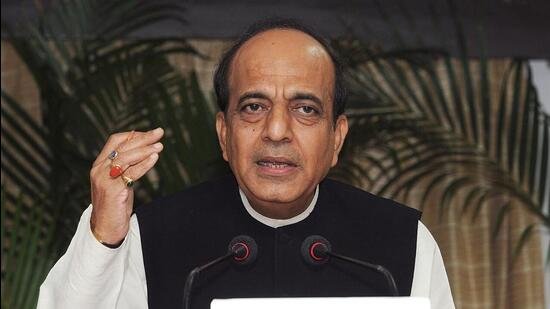
The government has given the status of cabinet minister to India’s high commissioner to Bangladesh, Dinesh Trivedi, in a signal of the importance that New Delhi attaches to relations with Dhaka at a time when the two sides are working to repair their ties, people familiar with the matter said.


Trivedi is the first political appointee to be chosen for the key position in Dhaka in almost five decades. A notification issued by the Union home ministry on Wednesday stated that Trivedi “has been assigned the equivalent status of Union Cabinet Minister in the Table of Precedence”.
While there have been precedents of ambassadors, mostly political appointees, being given the status of cabinet minister, even long-time watchers of Indian diplomacy were hard-pressed to cite instances from recent years. For instance, late Congress leader Siddhartha Shankar Ray was given the status of cabinet minister when he served as ambassador to the US during 1992–1996. It has also been given to a handful of former Union ministers upon being appointed as envoys.
The people said the status given to Trivedi, which the notification described as a “measure personal to him”, will apply only to ceremonial functions and not change the Table of Precedence, which is a list of dignitaries and officials in the order of precedence for protocol matters.
However, the status is meant to boost the prestige of the envoy and signal that he has a direct line to the top leadership in New Delhi, the people noted. At the same time, Trivedi’s enhanced status is intended to help him interface more directly with Bangladesh’s political leadership instead of relatively junior officials in the foreign ministry.
The development comes at a time when efforts by India and Bangladesh to repair their relations — which hit an all-time low when the government of Sheikh Hasina collapsed in the face of student-led protests in August 2024 and was replaced by the interim administration led by Muhammad Yunus — have again hit a rough patch.
The Indian side has made a concerted outreach to the Bangladesh Nationalist Party (BNP), which won the general election in February, including sending Lok Sabha Speaker Om Birla to the inauguration of Prime Minister Tarique Rahman in the same month.
Bangladesh foreign minister Khalilur Rahman’s visit in April, when he met national security adviser Ajit Doval, external affairs minister S Jaishankar and petroleum minister Hardeep Puri, resulted in more steps to normalise ties, including the resumption of existing mechanisms to address differences and bolster trade and energy cooperation.
However, several developments thereafter — including the campaign for the Assam and West Bengal assembly elections, in which illegal migration from Bangladesh, Assam chief minister Himanta Biswa Sarma’s comments about Bangladesh, and Sheikh Hasina’s interviews from Indian soil criticising the BNP government — have impacted efforts to normalise relations, the people said.
Trivedi, who arrived in Bangladesh on June 12 by walking across a land border checkpoint, is expected to now get down to the task of rebuilding the relationship after presenting his credentials to Bangladesh President Mohammed Shahabuddin in Dhaka on Thursday. As a first step soon after assuming office, Trivedi announced the resumption of normal visa operations in Bangladesh — suspended during the violent protests in mid-2024 — and said applications for tourist visas will be accepted from June 28.


