


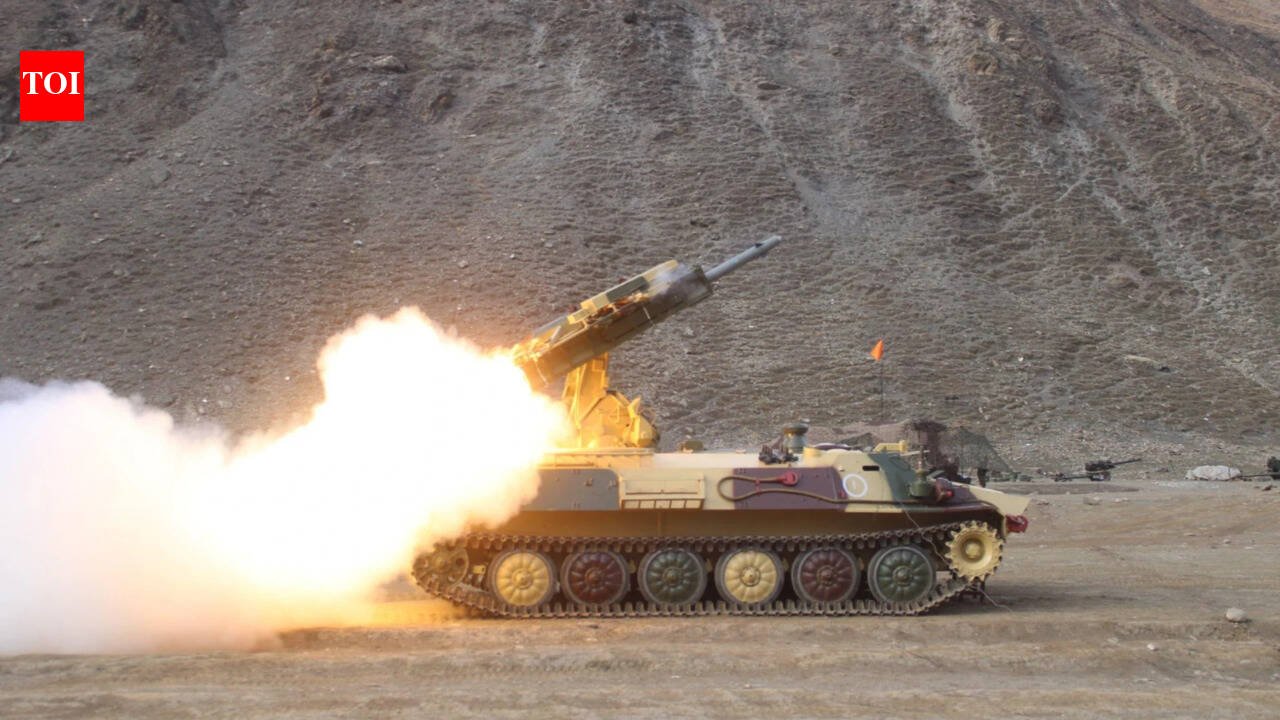
NEW DELHI: The Defence Acquisition Council (DAC), chaired by defence minister Rajnath Singh granted in-principle approval for the procurement of several weapon systems for the armed forces. Of the 10 systems cleared by the DAC, three are specifically meant to strengthen India’s air defence: the Medium Range Surface-to-Air Missile (MR-SAM), the Very Short Range Air Defence System (V-SHORADS) and the Akash Tarang Anti-Unmanned Aerial Vehicle (UAV) Electronic Warfare System.Together, these systems will help defend against a wide range of aerial threats, from advanced fighter aircraft and cruise missiles to small drones.The global focus on air defence has intensified in recent years, particularly with the rise of inexpensive drones that are often deployed in swarms to overwhelm defensive systems. The use of ballistic missiles in West Asia by Iran and Russia’s deployment of the Oreshnik ballistic missile against Ukraine have also prompted countries to strengthen their air defence capabilities.
India’s air defence during Operation Sindoor
During Operation Sindoor, Pakistan deployed a range of weapons against India, including small drones and the Fatah-II ballistic missile. According to the government, these threats were intercepted before they could inflict damage on Indian military assets.The Pakistan Air Force also fired CM-400AKG supersonic missiles in an attempt to target the S-400 air defence system stationed at Adampur Air Force Station near Jalandhar. Those missiles were also intercepted by Indian air defence systems.Several indigenous systems played a key role in countering these attacks, including the Akash surface-to-air missile system and the domestically upgraded L-70 air defence guns.
The defence of nation starts with air defence. It is the shield that protects a country – its people and critical assets from attacks coming through the air. It also maintains or denies air superiority. Think of it like this, land forces hold territory, the navy defends from threats from the sea and air defence holds the sky above both. Without it, everything else is exposed from above.
Major General Pradeep Goswami, air defence veteran
Strengthening India’s air defence shield
Three months after Pakistan sought peace, bringing the kinetic phase of Operation Sindoor to an end, Prime Minister Narendra Modi announced plans for a nationwide integrated air defence network named Sudarshan Chakra.The proposed system aims to create a pan-India air defence umbrella capable of countering a wide spectrum of aerial threats, from ballistic missiles to drones. Most components of the network are expected to be indigenous, although systems such as the S-400 will continue to play an important role.The three air defence systems recently cleared by the DAC will further strengthen this emerging shield.The MR-SAM is the most capable of the three. Developed jointly by Israel Aerospace Industries (IAI) and the Defence Research and Development Organisation (DRDO), it is based on the Barak-8 missile and is manufactured in India by Bharat Dynamics Limited (BDL).With a range of more than 70 km, the missile can engage unmanned aerial vehicles, helicopters, fighter aircraft and cruise missiles. Reports also suggest that the system intercepted a Pakistani Fatah-II ballistic missile over Sirsa during Operation Sindoor. The MR-SAM is already in service with the Indian Army, Navy and Air Force.The Very Short Range Air Defence System (V-SHORADS) forms the innermost layer of a layered air defence network. It serves as the last line of defence against aerial threats and is deployed to protect what the armed forces designate as Vital Areas and Vital Points (VA/VP).India currently relies on the Igla missile, L-70 guns and Zu-23 mm guns in this role. DRDO is also developing an indigenous V-SHORADS.The Akash Tarang system is an electronic warfare platform designed to neutralise drones by jamming the frequencies on which they operate. By severing the communication link between the drone and its operator, the system renders the drone ineffective. Unlike hard-kill systems, it does not physically destroy the target.A robust, layered air defence network is critical for protecting the country against a wide range of aerial threats. The procurement of these three systems will enhance India’s air defence capability and form an important part of the broader Sudarshan Chakra shield.
