



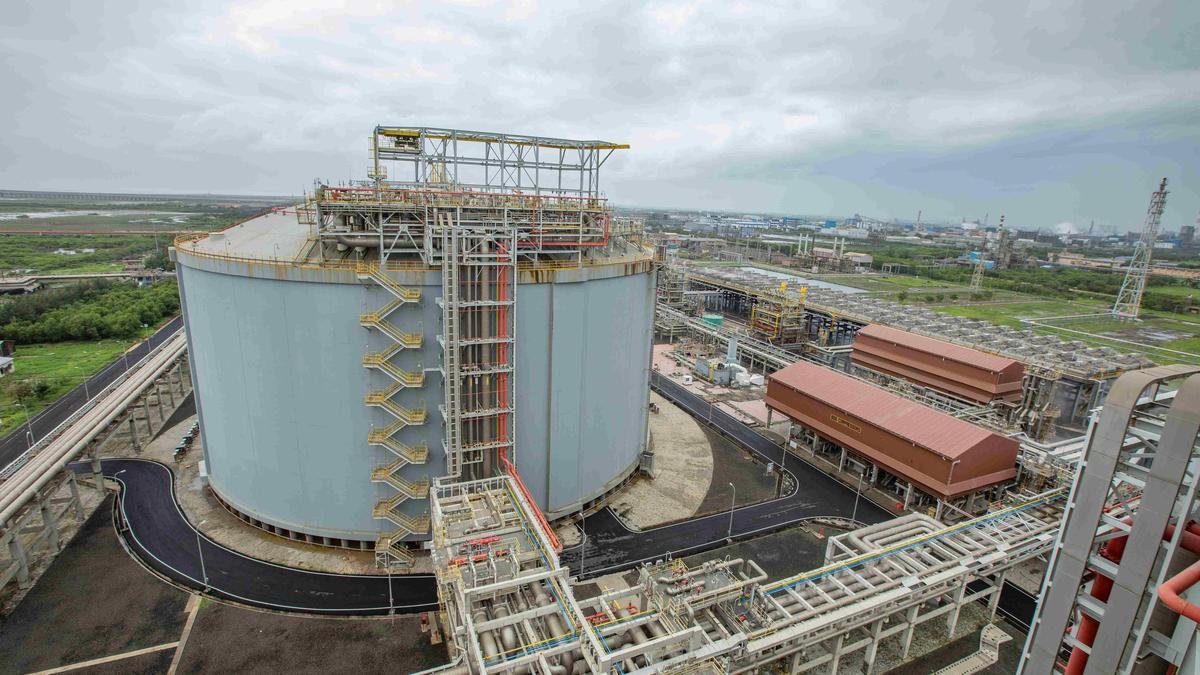
Dahej LNG terminal ranks as the sixth largest globally.
| Photo Credit: The Hindu
India added 52.5 million tonnes per annum (mtpa) of regasification capacity across eight terminals, as it surpassed Spain to become the fourth largest market for regasification capacity in 2025, according to the International Gas Union’s (IGU) World LNG Report.
Rising demand for fertilizer, city gas and utilities as well as the government’s push for enhanced share of liquefied natural gas (LNG) in the energy mix was seen helping the country
Among operational LNG regasification terminals in India, Dahej LNG (17.5 mtpa) stands out as the only ultra-large facility and ranks as the sixth largest globally.
Large-scale category
The remaining seven terminals fall into the large-scale category, each with a regasification capacity of 5 mtpa.
In 2025, India commissioned two LNG regasification projects, including one new onshore terminal, Chhara LNG, with a regasification capacity of 5 mtpa, and one expansion project at the Dabhol LNG terminal through the completion of its breakwater infrastructure.
The project has effectively enhanced the terminal’s operational efficiency and has increased its capacity to 5 mtpa from 2.9 mtpa. Previously idle during the monsoon season, the Dabhol LNG terminal now enables uninterrupted, year-round operations after commissioning of the breakwater.
India currently has four LNG projects under construction, including one new terminal and three expansion projects at existing facilities, including the expansion of India’s largest terminal, Dahej LNG.
Once commissioned, these projects are expected to add a combined 11.3 mtpa of regasification capacity by 2028.
According to the International Energy Agency, India’s natural gas consumption is forecast to increase by nearly 60% by 2030, driven by robust growth in city gas distribution, industrial demand, and power generation.
India’s LNG regasification utilisation fell to about 47% in 2025, down from 58% in 2024, reflecting a combination of weaker LNG imports during the summer months and an increase in regasification capacity following recent infrastructure additions.
Asia led the global LNG regasification capacity additions in 2025, with all new capacity coming from China and India, contributing 15.1 mtpa and 7.1 mtpa, representing 24% and 11.3% of global additions, respectively.
Although the Asia Pacific remained the largest LNG-importing region, IGU found imports into Asia fell by 9.2 MT to 108.7 MT, driven mainly by lower intake in China and India.
Published – July 09, 2026 02:19 pm IST


