


Independent retail has remained surprisingly resilient against a backdrop of economic uncertainty, geopolitical tension and tariff chaos that has rocked the bottom lines of major conglomerates. This isn’t to say that local businesses haven’t faced their fair share of challenges in recent years, but according to wholesale technology platform Faire’s Independent Retail Report for Q2 2026, indie retailers — particularly those in small towns — are on the rise.
This shift follows a wave of big-box store closures (think Macy’s, Dollar Tree and Joann) over the past year, while independent retailers have opened more doors in the same period. Though the market may still seem oversaturated with chain stores, independent retail actually accounts for more than 50% of retail locations in every U.S. state, and 65% of U.K. retail, according to Faire. Now, these retailers have an opportunity to further expand their influence by leaning into what makes them unique. Here’s what’s cementing their rise:
Taste and Trends
“We see it happening already: Independent retailers succeed by stocking distinctive products that reflect their own point of view and their community’s character, something a chain buying centrally for hundreds of stores can’t replicate,” Faire Chief Revenue Officer Jennifer Burke tells Fashionista over email. “The playbook is to double down on that, not compete on price or scale.”
Photo: Courtesy of Faire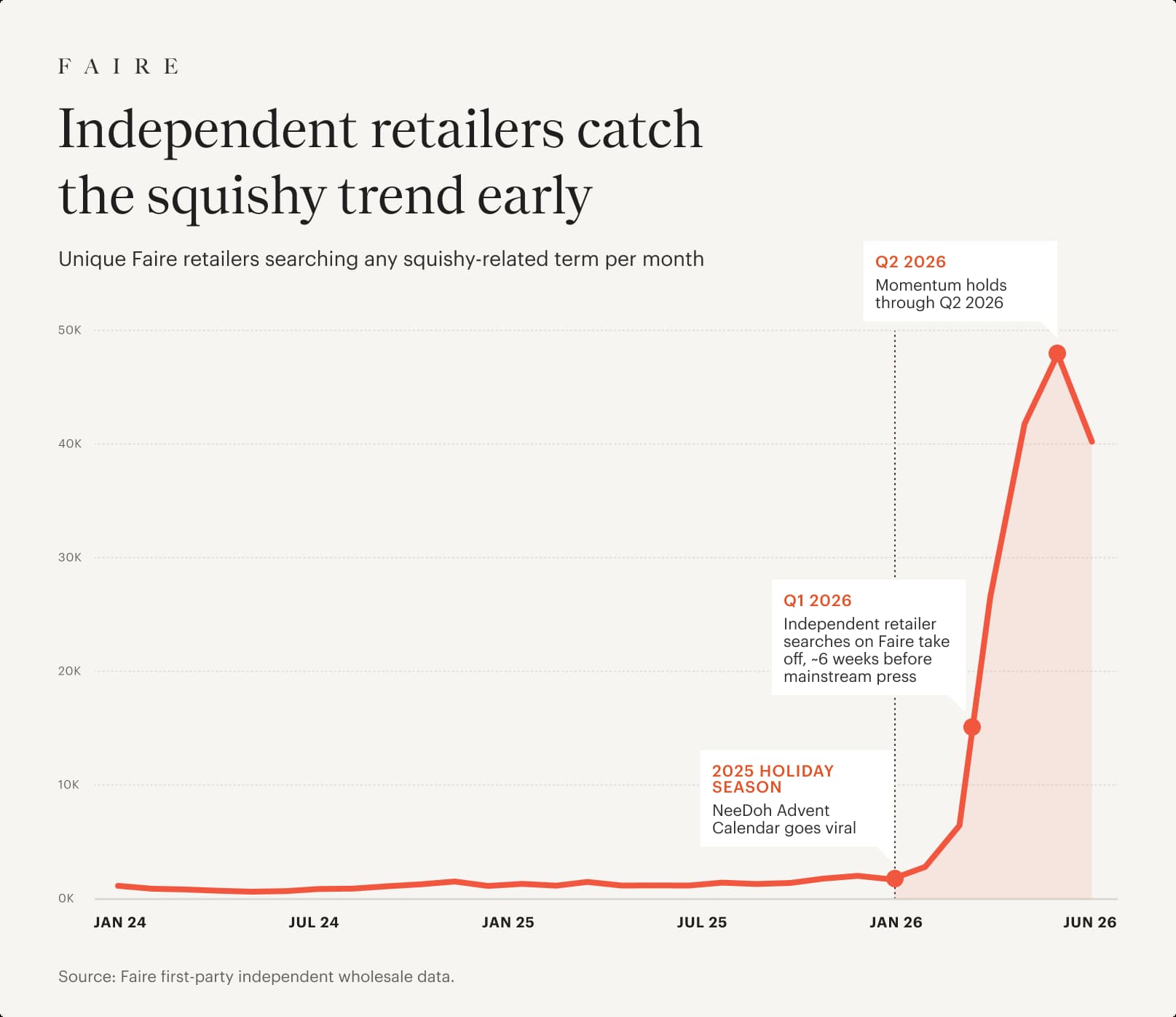
Independent retailers are often the first to take a chance on up-and-coming brands and viral trends, leading to a differentiated and thoughtfully curated selection. Since they’re typically sourcing for a single location, rather than a nationwide fleet of flagships, they’re able to act quickly. For example, independent retailers were already stocking the “squishy” trend (see: NeeDoh Advent Calendar and various squishy toys) by the time searches for “squishy-related” terms surged more than 400% on Faire’s website in Q2.
Embracing Local Community
Faire reports that this renewed interest in independent retail is also fueled by two major shifts in consumer behavior: community and local travel. Consumers — especially Gen Zers, Burke notes — are increasingly looking at physical retail as social spaces that offer a respite from doomscrolling and Amazon rabbit holes. This appetite for IRL retail shines through in Faire’s data: Across the globe, brick-and-mortar and multichannel retailers grew their wholesale purchasing at roughly 2.2x the rate of online-only stores in Q2 2026.
Photo: Courtesy of Faire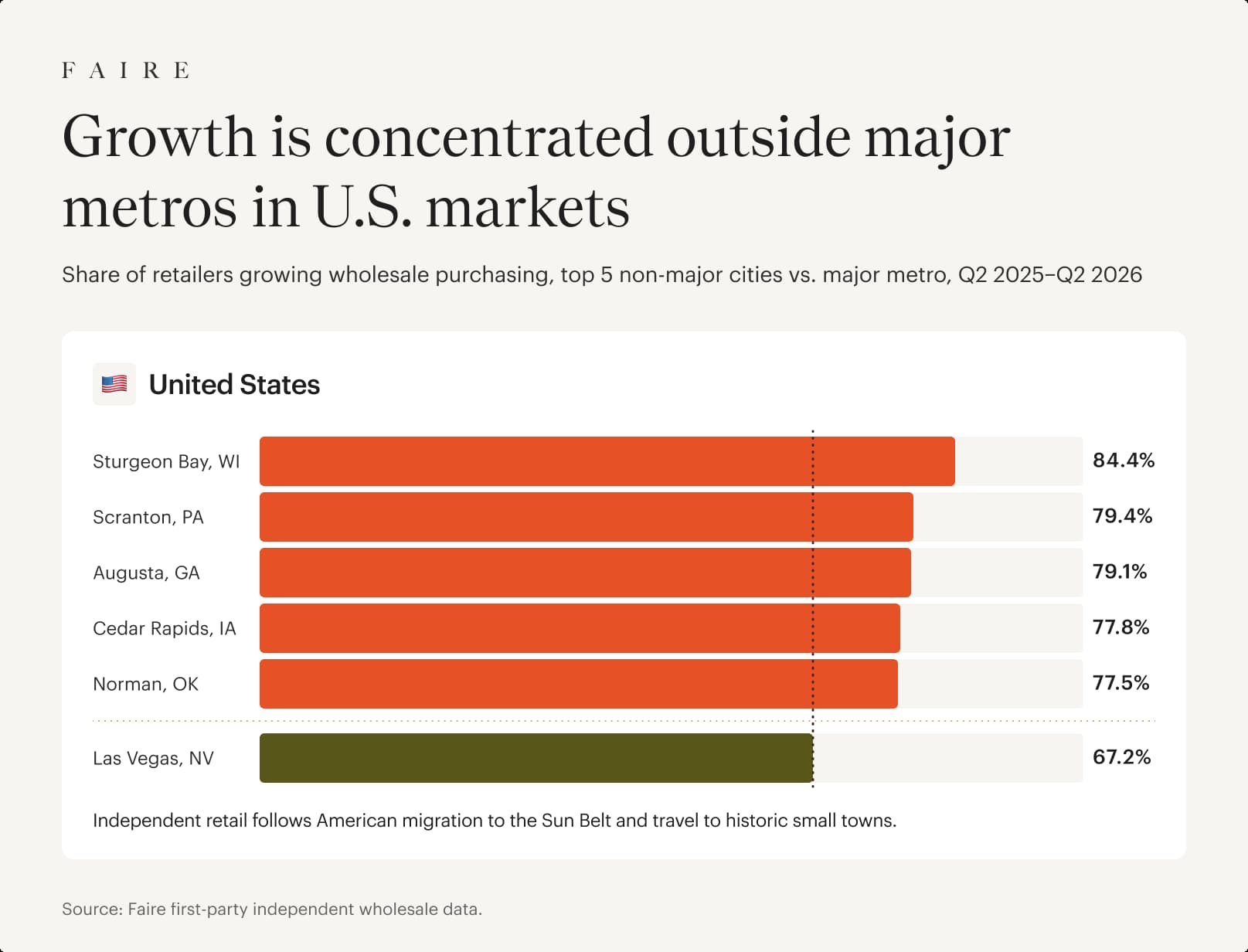
As domestic travel rises, independent retailers also contribute to the inimitable local flair of their hometowns: Tourists may head to the Hamptons for coastal-inspired staples or to Arizona’s deserts for authentic Western ready-to-wear. Independent retail growth is also evidently following Americans as they move into Sun Belt towns like Auburn, AL and Augusta, GA. Sturgeon Bay, WI, emerged as the city with the highest share of retailers growing wholesale purchasing in the U.S. at 84.4%, followed by Scranton, PA, at 79.4%. This shift is also being observed internationally: The U.K., Australia, Germany, Canada and France have all seen smaller cities outpace major metros in terms of wholesale growth.
“Walking into an independent store, you stumble onto something you didn’t know to look for, and a real person can tell you the story behind it,” Burke says. “That kind of serendipitous discovery is something e-commerce still can’t fully replicate, and it’s a big part of why people are re-engaging with their local main streets.”
Sourcing & Tariffs
Burke also points to an opportunity for small brands who may not be finding sufficient retail pickup or sell-through in big cities or online these days. “Small towns aren’t a lesser launch market; they actually carry an outsized share of what we call ‘Scouts’ on Faire — retailers most willing to bet on new brands,” she explains. Within the U.S., small and rural states like Mississippi, North Dakota, Maine and Hawaii had the largest share of of them.
Photo: Courtesy of Faire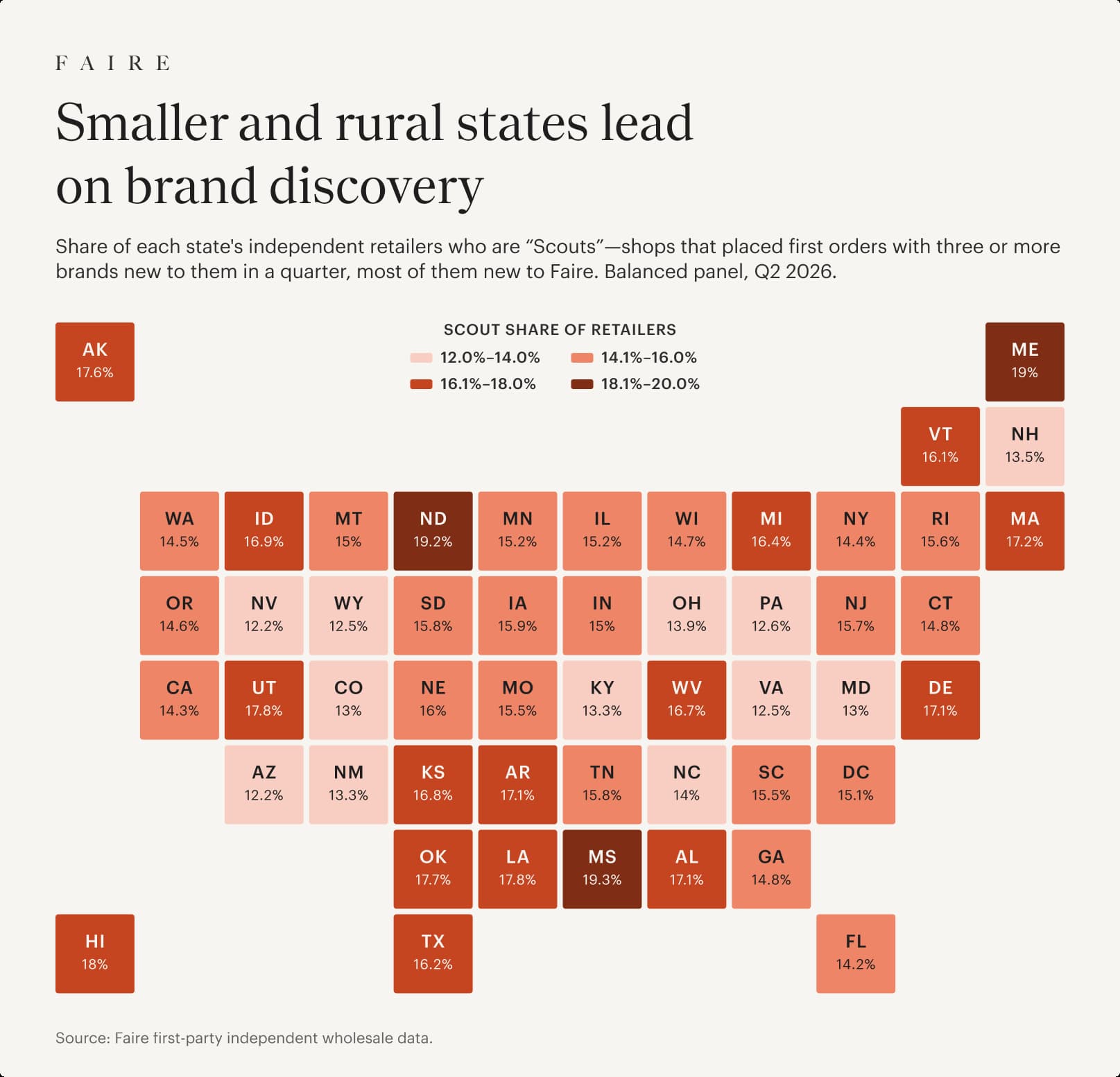
Fashion and beauty brands would be wise to consider these nontraditional, off-the-beaten-path retail opportunities. “Fashion and beauty are increasingly showing up in gift shops, cafes and other non-traditional retail, and the data backs that up in a big way,” she continues. For example, gift shops are the top buyers of beauty products on Faire, outpacing salons and spas by 5%. In fashion, gift shops and general stores rank as the second- and-third largest buying categories overall.
President Donald Trump’s (unconstitutional) 2025 tariffs also had an impact on the indie retail landscape, but not in the way you might expect: Demand for “Made in U.S.A.” labels spiked once tariffs went into effect, leading more retailers to buy more U.S. products. Following the president’s latest tariffs, U.S. exports to Canada are showing signs of a rebound: Share of spend on U.S. products rose 1.7 points in Q2 of 2026 on a same-store basis.
Photo: Courtesy of Faire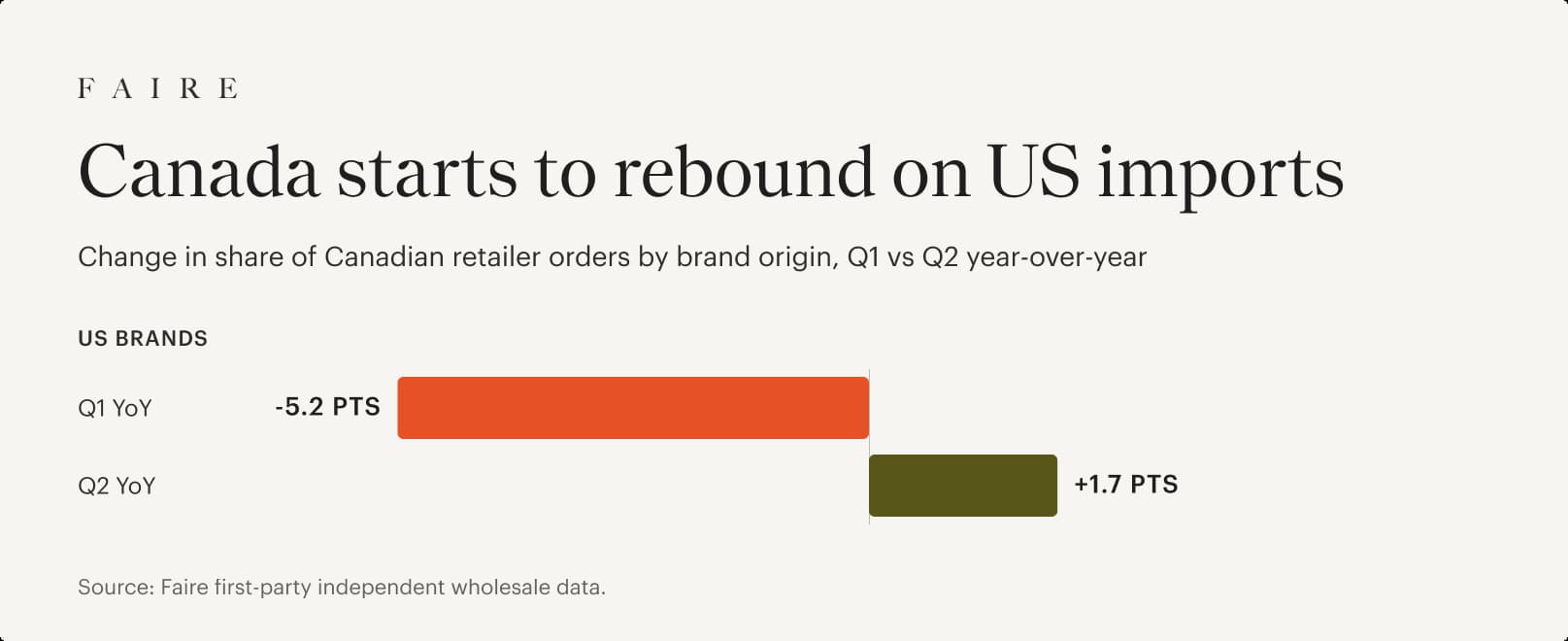
Overseas imports continue, but they’ve gotten more strategic and intentional. “Country of origin has become shorthand for quality in these categories: Italian leather, Moroccan weaving,” Burke says. “That association carries more weight with the customer than any individual brand name, meaning customers won’t want to compromise on a local substitute.”
Bottom line: The indie retail renaissance has legs, and the industry should pay attention. “Given how crowded fashion and beauty are right now — fuller shelves, louder claims, buyers everywhere hunting for something differentiated — the retailers who win are the ones treating that speed and curation as the whole strategy, not a nice-to-have,” Burke says.
Read Faire’s full report here.
Please note: Occasionally, we use affiliate links on our site. This in no way affects our editorial decision-making.
