


I expected a holiday. I got a lecture.
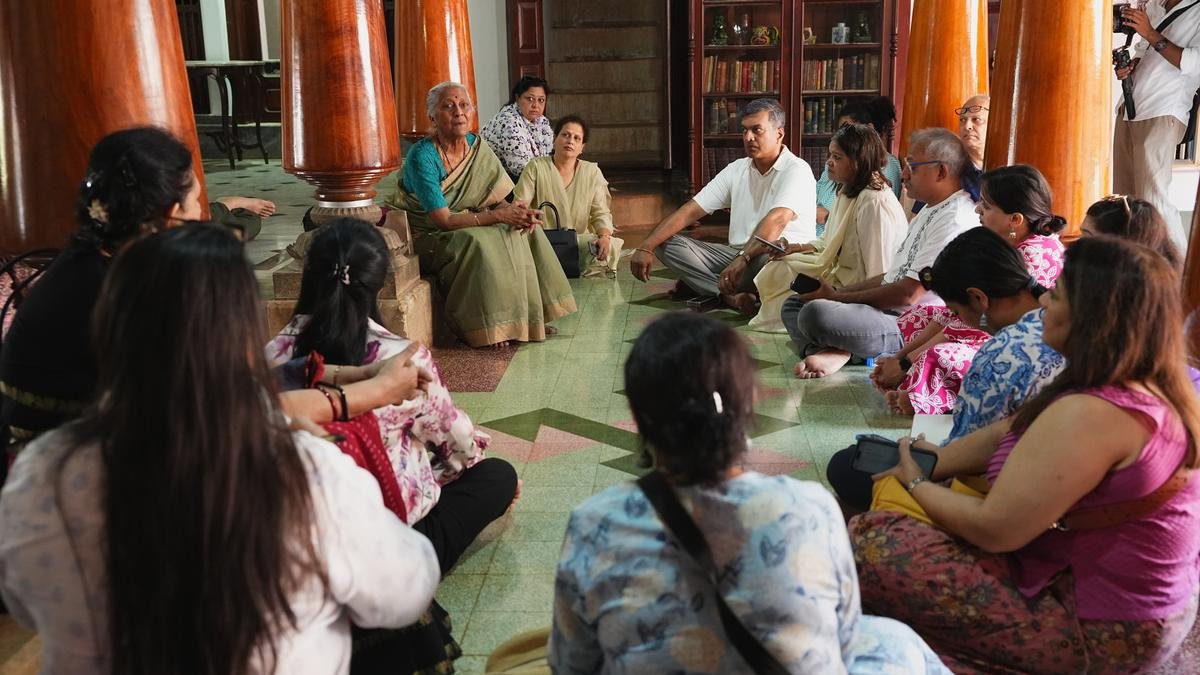
We sit cross-legged on the floor, notebooks open, as architect Sashikala Ananth pulls a measuring tape out of her handbag with the delight of a conjurer. She begins to measure a wooden pillar at AR House, its surface worn smooth by centuries of use. As she runs through a series of calculations with her audience, the logic behind the compelling visual rhythm of Chettinad’s 200-year-old mansions becomes evident: they are built on precise math.
Architect Sashikala Ananth with Darshini Ashok, Director of Public Relations at The Park, measuring a wooden pillar
| Photo Credit:
Special Arrangement
At a time of doom scrolling, intellectual flattening and 30-second attention spans, Kalai, The Chettinad Art and Architecture festival feels like a quiet pushback. Curated by The Lotus Palace, a part of The Park Hotels group, the festival spans four days of information-packed lectures that demand attention.
Lessons in stone and space
Chettinad’s stark, arid landscape and maximalist mansions turn into a classroom, where architects, historians, artists and locals teach. Instead of photo ops and drive-by tourism, we attend power point presentations on design in darbar halls lit with stained glass, walk through symmetrical courtyards to understand rainwater harvesting and explore temples carved out of rock to decode iconography.
The Lotus Palace Kanadukathan
| Photo Credit:
Special Arrangement
The region has been drawing tourists, designers, architects and Instagrammers for its gigantic mansions, each spanning 40,000 sq feet and more, rising seemingly out of nowhere in small dusty towns. But few look beyond the region’s obvious treasures: Athangudi tiles, mansion selfies and fish curry.
This is changing.
Starting with The Bangala’s influential Chettinad festival, which launched in 2022, the focus has been on immersive learning, drawing visitors who are looking for more than just a relaxed holiday by the pool.
And if Meenakshi Meyyappan of The Bangala is best known for putting Chettinad on the global map, Priya Paul, chairperson of Apeejay Surrendra Park Hotels, is now amplifying this effort, first opening Vaadyar’s House in 2018, followed by The Lotus Palace Chettinad in 2025. She says that by bringing together people from diverse backgrounds, the festivals play a vital role in promoting Chettinad’s unique identity, ensuring that “it is not only celebrated but, most importantly, sustained”.
Architect Sashikala Ananth demonstrating how courtyards ventilate Chettinad homes
| Photo Credit:
Special Arrangement
Last year, the Lotus Palace launched Suvai, a food festival highlighting neighbourhood nannari sherbet, pickle and vatthal makers, and local markets. This year, the focus sharpened with Kalai, held as always, in collaboration with the region’s most prominent hotels: The Bangala, Chidambara Vilas, Visalam, Saratha Vilas and Chettinad Mansion.
Beyond the photo op
Kalai, priced at ₹75,000 per couple drew a compact, but attentive, detail-oriented audience, proving that people are willing to pay for experiences that merge luxury with learning. They listened carefully, took notes and asked thoughtful questions after each session. Hema Balakrishnan, a social entreprenuer, who attended the festival and did additional online research every night on the learnings of each day, says she was drawn to Kalai because of her “fascination for traditional forms of architecture and interest in how culture defines the spaces that we live in”.
At The Lotus Palace, the festival begins with architect Sujatha Shankar deftly packing 200 years of Chettinad architecture into one hour, using photographs and diagrams to explain how the elaborate balustrades, defined high plinths and colonial arches started to come together. Chettinad was shaped by the Nattukottai Chettiars, who travelled the world for trade, and came home to build this majestic architectural landscape between the late 19th and early 20th centuries. Spread across about 75 villages, it had about 15,000 mansions at its peak. Today, fewer than 10,000 remain — many unoccupied.
While I knew that these houses were filled with treasures from around the world, Italian marble floors, Burmese teak pillars, Belgian mirrors and even British steel beams, I did not realise they were also a practical solution to a logical challenge. “The Chettiars sent out ships filled with spices, cotton and sometimes peacocks. The ships had to come back with a certain amount of weight to stay stable, and that’s why they brought in all the heavy steel, marble and teak,” Sujatha says.
Architect Sujatha Shankar on the evolution and planning principles of Chettinad architecture
| Photo Credit:
Special Arrangement
The facade of the 230-year-old Lotus Palace is joyous with fantastical details in stucco: Hindu gods and goddesses, a dapper British man in a bowler hat with a dog and walking stick, and a yali-inspired guardian on an elephant. “It’s an electric amalgamation of all styles,” says Sujatha, as she explains how the interiors, in comparison, follow a distinct layout. “The plan of any mansion has a central spine around which the courtyard and rooms are arranged.”
Design with purpose
On day two, Sashikala Ananth resumes class at AR House, introducing the Vastu Shastra and explaining how the multiple courtyards, which flood the homes with sunlight, are the “backbone of the structure.” She adds, “Measurements are critical. That is what gives visual order. In South India, our music is also based on playing with numbers,” she says, adding with a laugh, “We are number freaks.”
Historian and author Pradeep Chakravarthy at the Sathyagiriswarar Temple in Thirumayam Fort
| Photo Credit:
Special Arrangement
We later gather at the Sathyagiriswarar Temple at Thirumayam Fort to understand the region’s temple architecture. “We are standing in a gouged-out granite rock. Remember this was made in the 7th Century with just a hammer, chisel and plumb line,” says historian and author Pradeep Chakravarthy, pointing out the impeccably straight angles.
As the festival winds down, Kathiravan Karunanithi, the manager of Lotus Palace, who grew up in the area, quotes a popular local lament: “The older generation lives here, or visits often. Their children come for every festival and weddings. Their grandchildren visit once a year. Four generations from now, they will ask, ‘where is Chettinad?”
This is what festivals like Kalai are trying to shift – drawing people back, and giving them a reason to preserve what remains.
