



- Traditional agriculture’s water needs decline 66%
- Combined agricultural water demand falls 18%
- Upper Jhelum population nearly triples in four decades
- Study flags potential water shortages by 2100
Srinagar, Oct 28: The steady disappearance of paddy fields and expansion of fruit orchards across Kashmir over the past four decades has altered more than the Valley’s agricultural landscape. It has also changed who needs how much water, and for what.
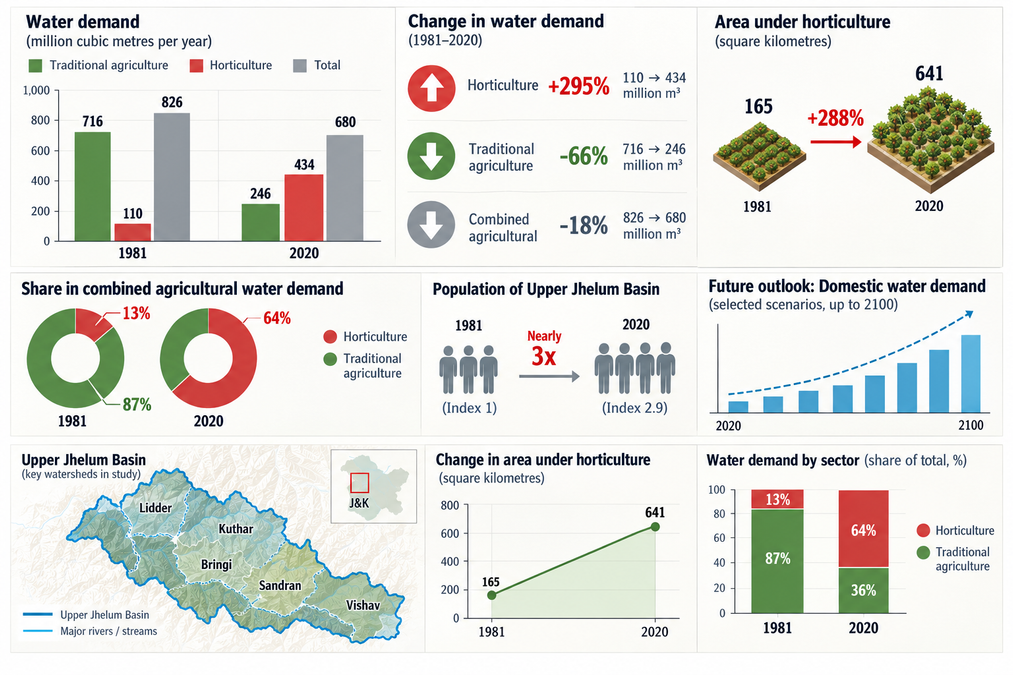
A new study by researchers at the University of Kashmir has found that between 1981 and 2020, the area under horticulture in the Upper Jhelum Basin increased nearly fourfold, from 165 square kilometres to 641 square kilometres. Over the same period, the annual water requirement of horticulture rose from 110 million cubic metres to 434 million cubic metres, an increase of 295 per cent.
The findings, published in the international journal Applied Water Science, show that horticulture has overtaken traditional agriculture in its water requirement in the basin, reversing a pattern that prevailed four decades ago.
In 1981, traditional agriculture required 716 million cubic metres of water annually, more than six times the requirement of horticulture. By 2020, its demand had fallen to 246 million cubic metres, while that of horticulture had climbed to 434 million cubic metres.
Put simply, for every 100 litres required by traditional agriculture in 1981, horticulture needed just 15. Four decades later, horticulture required approximately 176 litres for every 100 litres needed by traditional agriculture.
The shift is significant in a region where the conversion of agricultural land into orchards has been driven by changing economic priorities, with horticulture emerging as a major source of rural income.
The study, conducted by Ain us Saba Qazi and Shakil Ahmad Romshoo, examined changes in land use, population and water requirements in the Upper Jhelum Basin, which includes the Lidder, Kuthar, Bringi, Sandran and Vishav watersheds.
Its findings, however, reveal a distinction often lost in discussions about the impact of expanding orchards on Kashmir’s water resources.
Despite the sharp rise in horticultural demand, the combined annual water requirement of traditional agriculture and horticulture actually declined from 826 million cubic metres in 1981 to 680 million cubic metres in 2020.
The reason lies in the simultaneous contraction of traditional agriculture, whose water requirement fell by nearly 66 per cent.
The figures, therefore, do not establish that the shift towards horticulture has increased the overall agricultural demand for water. They show instead that the nature of that demand has changed substantially, with implications for how irrigation systems are planned and managed.
The researchers also found that the population of the basin nearly tripled between 1981 and 2020, placing additional demands on water resources beyond agriculture.
To assess what lies ahead, the study modelled water requirements under five socioeconomic scenarios extending to 2100. The projections point to the possibility of substantial unmet domestic water demand under certain scenarios, depending on future population growth and development patterns.
These are projections, not forecasts of an inevitable shortage. But they draw attention to a planning challenge: Kashmir’s water infrastructure must cater to a population and agricultural economy considerably different from those for which much of its irrigation network was originally developed.
The implications are particularly relevant to the Upper Jhelum Basin, where streams and rivers serve agricultural, horticultural and domestic requirements, and where changes in land use can alter the location and timing of water demand.
For decades, the economic argument for converting farmland into orchards has centred on the higher returns from fruit cultivation. The new research adds another dimension to that transition by quantifying how it has changed the basin’s water requirements.
It also suggests that measuring the impact of agricultural change solely through the expansion of orchards would give an incomplete picture. The decline in traditional cultivation, changes in population and future domestic requirements must be considered together.
Forty years ago, traditional agriculture dominated the basin’s irrigation demand. Today, horticulture accounts for the larger share. The challenge for water planners is no longer simply how much water Kashmir’s farms require, but where, when and for whom it will be needed.
