


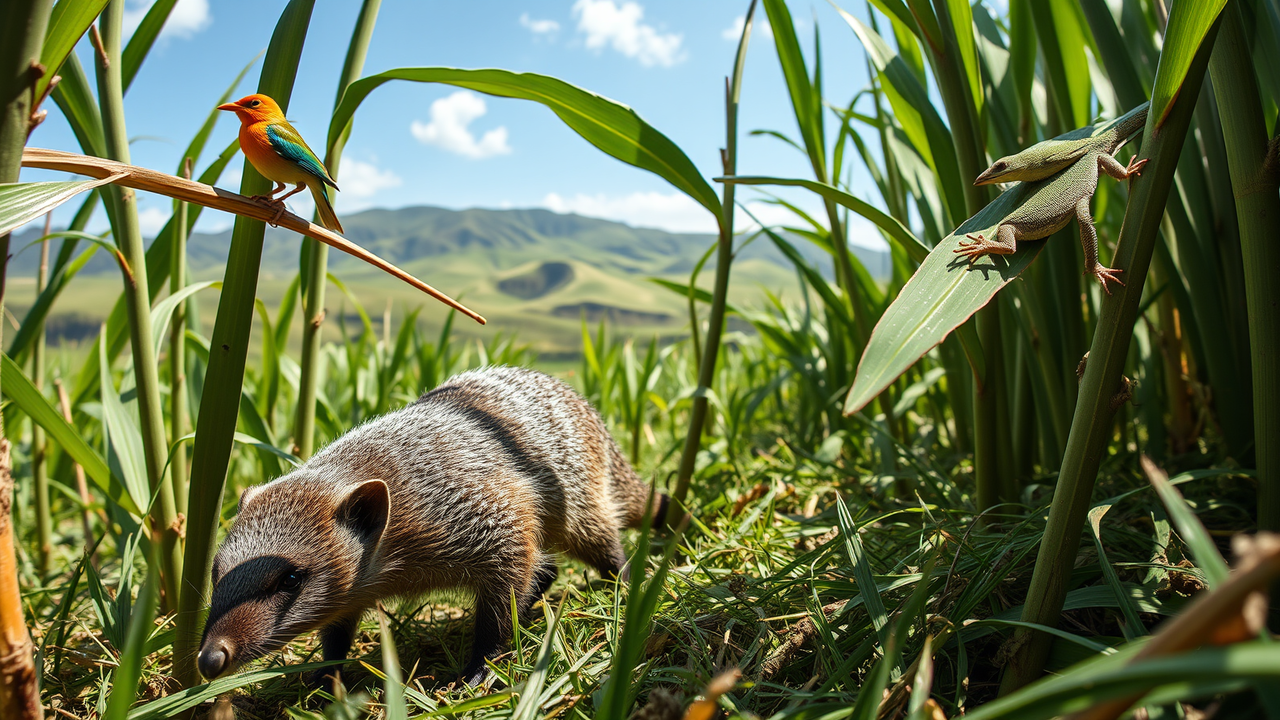
Back in the late 1800s, Hawaii’s booming sugarcane industry had a serious rat problem. Rats were tearing through the cane fields, cutting into profits, and plantation owners wanted a quick fix. Their answer was to bring in the small Indian mongoose, a fast, sharp-toothed little predator known for hunting rats and snakes back in its native range. It sounded like a simple solution at the time. Instead, it turned into one of the most cited examples of a conservation plan gone wrong, because the mongooses barely touched the rats and went after Hawaii’s native birds and reptiles instead, animals that had never faced a land predator before and had no way to defend themselves.
Why mongooses were brought to Hawaii in the first place
Sugarcane planters first introduced the small Indian mongoose to Hawaii Island in 1883, hoping the animals would clear out rats damaging their crops, according to Hawaii’s Department of Land and Natural Resources. The idea had already been tried in Jamaica a decade earlier for the same reason, and it seemed to make sense on paper, since mongooses in their home range do hunt rodents. From Hawaii Island, the animals were later brought to Maui, Molokai and Oahu as well, though Kauai never received any and remains mongoose-free to this day.
The basic mistake behind the mongoose plan
The problem came down to something surprisingly simple that nobody checked beforehand. Rats in Hawaii are mostly active at night, while mongooses do their hunting during the day. Because the two rarely crossed paths, mongooses ended up barely affecting rat numbers at all. This was not a case of carefully tested biological control either, state wildlife officials note, since the introduction was carried out by private plantation owners with no real research into what else the mongoose might end up eating once it was loose on the islands.
How mongooses turned to native birds instead
With rats mostly out of reach, mongooses did what any opportunistic predator would do, they went after whatever food was easiest to catch. That turned out to be Hawaii’s native ground-nesting birds, along with their eggs and chicks. According to a detailed review of the species published in the journal Pacific Science by researchers at the University of Hawaii, available through the University of Hawaii’s research repository, the small Indian mongoose has been introduced to at least 45 islands worldwide since the late 1800s, and its impact on native birds, reptiles and small mammals has been documented across nearly all of them.
Endangered Hawaiian birds still affected by mongooses
Many of Hawaii’s native birds evolved for thousands of years with no land-based predators at all, which meant they never developed the instincts to protect nests or eggs from something like a mongoose. State wildlife officials say mongoose predation has been linked to the decline of at least eight federally listed endangered Hawaiian bird species, including the nene, or Hawaiian goose, along with several species of native petrels and the Hawaiian crow. Ground-nesting seabirds have been hit particularly hard, since their eggs and chicks sit completely exposed with nowhere to hide from a fast-moving daytime predator.
Sea turtles and reptiles also affected by the mongoose
Birds were not the only casualties. Mongooses also prey on the eggs and hatchlings of endangered sea turtles, including hawksbill turtles that nest along parts of the Hawaiian coastline. Small reptiles have suffered too, since many island lizards and skinks evolved without any mammalian predators around and had little defence once mongooses arrived. Beyond the ecological damage, mongoose predation and related crop losses are estimated to cost Hawaii and Puerto Rico around 50 million dollars a year combined, according to state wildlife authorities.
Why removing mongooses from Hawaii is so difficult
At this point, getting rid of mongooses across Hawaii’s main islands entirely is not really realistic, since they have spread widely across Hawaii Island, Oahu, Maui and Molokai and reproduce quickly, with females capable of having two or three litters a year. Current efforts mostly focus on protecting specific high-value nesting sites using trapping and predator-proof fencing rather than attempting full-scale eradication. Kauai remains the one major exception, and conservationists there work hard to keep it that way, since even a single mongoose slipping onto the island could put its relatively intact native bird populations at serious risk.
A cautionary tale still relevant today
Looking back, wildlife officials are careful to point out that the mongoose introduction should not be labelled true biological control, since that term refers to a scientifically tested process, not an unregulated decision made by private landowners chasing a quick fix. The mongoose story in Hawaii has since become something of a textbook warning for conservationists everywhere, a reminder of how introducing one species to solve a problem can end up creating a much bigger one, especially on islands where native wildlife had no natural predators to begin with.
