






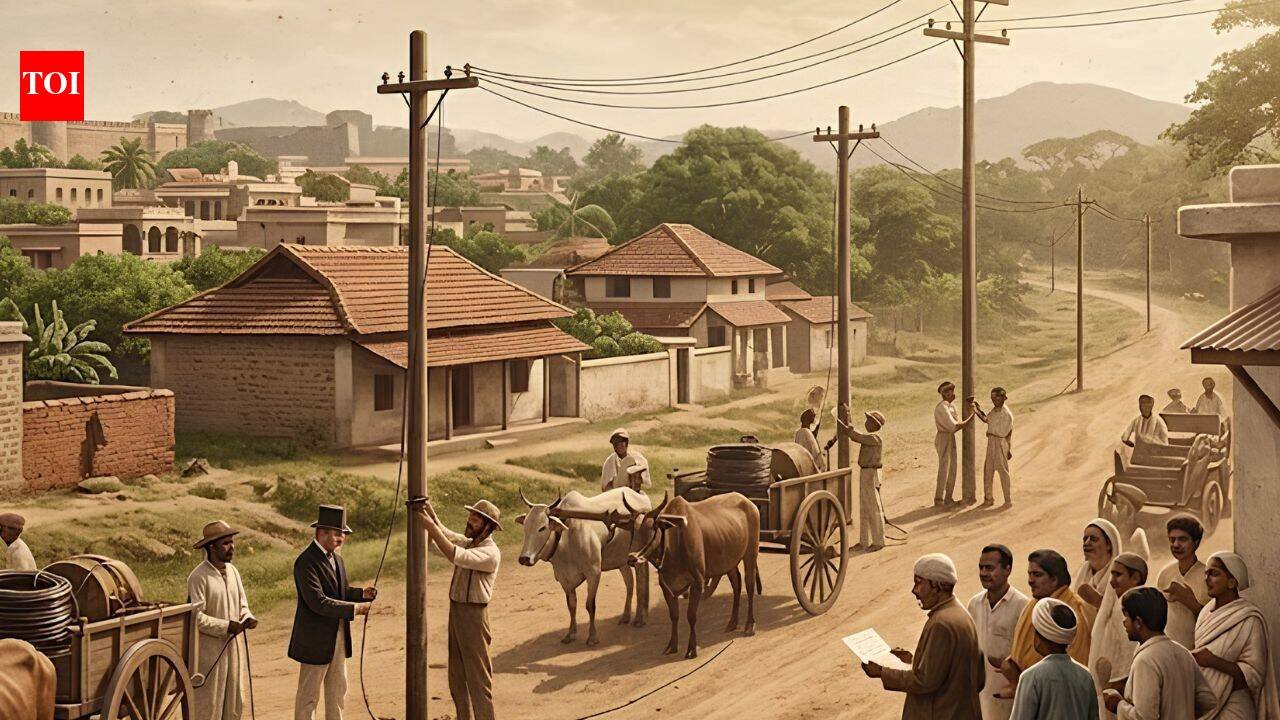
Today, a message can travel from Bengaluru to almost anywhere in the world in seconds. But in the mid-19th century, sending information across long distances was a far more complicated and expensive affair. In 1854, Bengaluru became part of India’s expanding electric telegraph network. The city’s telegraph office opened on May 23, 1854, giving residents access to a technology that could transmit messages far faster than traditional methods of communication. A 16-word message between Calcutta (now Kolkata) and Bengaluru cost 10 shillings at the time, according to a historical chronology of Bengaluru, as per multiple reports. The price reflected how new and specialised the technology was in its early years.
The wires that connected Bengaluru to bigger cities
Bengaluru’s telegraph connection was part of a larger line running from Madras towards Bellary, passing through the city. The network was later extended towards Bombay, placing Bengaluru on a route that connected several important centres in southern and western India. The expansion was part of the rapid development of electric telegraphy across India in the 1850s. William O’Shaughnessy, who had conducted some of the earliest experiments with electric telegraphy in India, played a major role in developing the system. Work on long-distance telegraph lines accelerated in the early 1850s. By March 1854, an electric telegraph connection between Calcutta and Agra had been established, and the network continued expanding to other major cities and towns. An account of the early Indian telegraph network published in the period noted the speed with which messages could be transmitted over long distances, making the technology particularly valuable at a time when travelling between cities could take days.
Bengaluru’s link with Mysore came a year later
The telegraph network around Bengaluru expanded quickly. In March 1855, a telegraph line connecting Bengaluru with Mysore was established and a telegraph office was opened in Mysore. The Bengaluru historical chronology records the line as being 84 miles long, with the establishment of the two offices costing over Rs 8,000. The new connection gave Bengaluru another important communication link — this time with Mysore, the capital of the princely state. By then, the city was becoming part of a much wider network in which information could move without waiting for a person or a physical document to travel between cities.
From messages carried by hand to messages sent through wires
Before the telegraph, communicating over long distances generally meant relying on people or physical transport to carry information. The electric telegraph changed that equation. A message could be converted into electrical signals, sent through wires and decoded at the other end For Bengaluru, this meant that information could travel along the city’s growing connections to Madras, Bellary, Bombay and Mysore. The technology also arrived at a time when Bengaluru itself was changing. Railways would follow in the next decade. In 1864, the city got its first railway connection when a line between Bengaluru Cantonment and Jolarpettai opened, creating another faster link with the wider region. Together, the telegraph and railway gradually reduced the isolation of a city whose communication and transport had previously depended heavily on slower methods.
The telegraph’s long life in Bengaluru
The technology that began with messages priced by the word eventually became an ordinary part of communication in Bengaluru. Telegrams were used for everything from urgent personal messages to business communication, particularly when a fast written message was needed. The service remained in use in the city for more than a century and a half. Telegram service was finally discontinued in 2013, bringing an end to a system that had begun in Bengaluru in the 1850s.At the time of the shutdown, multiple reports said Bengaluru had 21 telegraph offices. What began in 1854 with a costly 16-word message had thus become part of the city’s communication infrastructure for generations — long before Bengaluru’s present-day reputation for connecting people through phones, computers and the internet.


