



For most of human history, one of nature’s simplest questions had no real answer: Where do birds go when winter arrives, and th
Photo: Zoologische Sammlung der Universität Rostock
ey vanish from the sky? People had guesses, but almost nobody had actual proof. Then, in the spring of 1822, a wounded bird landed in a small German village and accidentally settled a debate that existed for centuries.But what made this discovery was not any technological advancement instead it was an injury.Let’s dig in to find out what exactly happened
Long before this, migration was mostly guesswork
Centuries before 1822, people had only theories about where birds disappeared to each winter. As far back as the fourth century BCE, Aristotle proposed that certain birds moved seasonally between regions, though he got plenty of details wrong. Later ideas were far stranger, some believed birds hibernated at the bottom of lakes, and in 1703 a Harvard professor even suggested they flew all the way to the moon, according to Audubon.
It all changed when a wounded stork was spotted near a German village
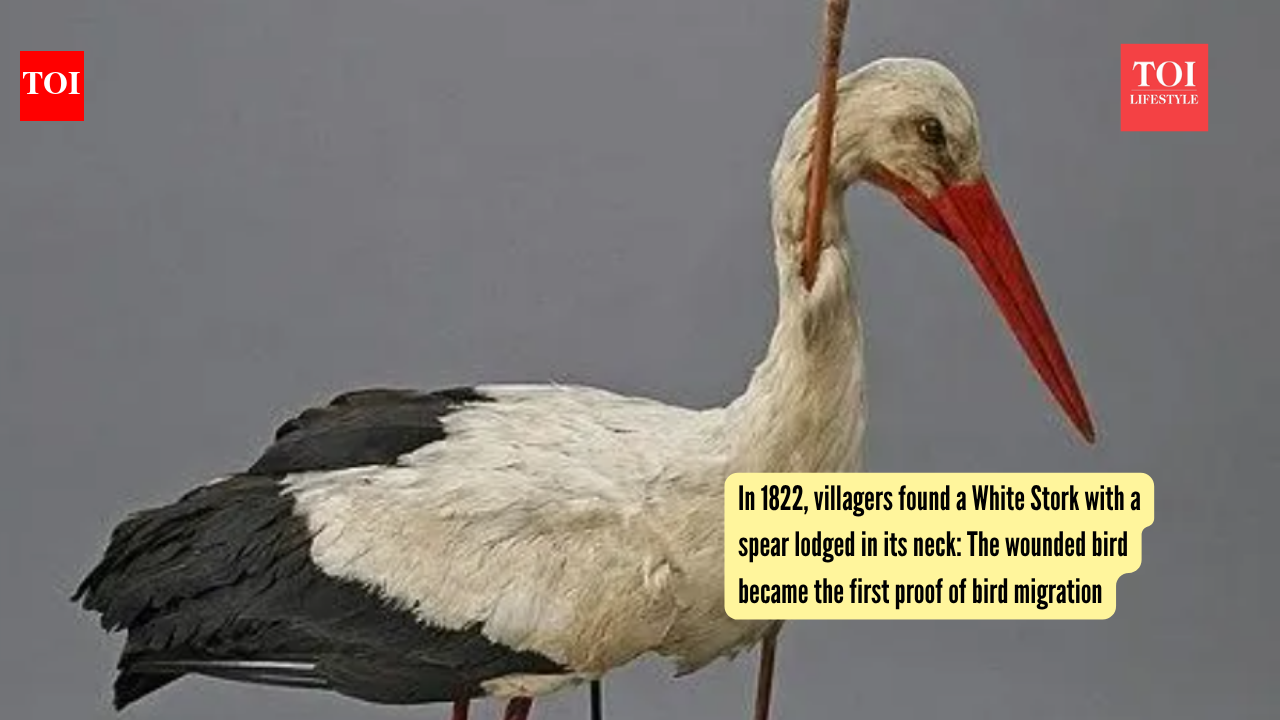
On May 21, 1822, near the village of Klütz on Germany’s Baltic coast, present-day Mecklenburg-Vorpommern, a white stork was found with a roughly 30-inch spear lodged in its neck, which had entered one side of its body and exited near the other. But, to the viewers’ surprise, the bird was still alive despite the injury, having apparently flown a considerable distance while impaled.
Photo: University of Rostock/ Zoologische Sammlung der Universität Rostock
Examining the spear reveals its true origin
The stork’s body was sent to the University of Rostock, where botanist Heinrich Gustav Flörke examined the weapon. He described it as having a broad iron tip fastened with sinews to a shaft of finely veined tropical wood, and concluded the bird had likely been struck while wintering somewhere in Central Africa and this helped discover that the stork had flown thousands of miles between continents.
The bird gets a name and a permanent home
The stork became known as the “Pfeilstorch,” a German word for “arrow stork,” and was taxidermied with the spear still in place. It remains on display today in the Zoological Collection of the University of Rostock, one of the strangest and most instructive exhibits in the museum’s history, according to Atlas Obscura.
More arrow stork cases followed over the decades
The Rostock bird wasn’t just a single case. Since 1822, roughly 24 to 25 similar cases have been documented, involving storks and other species that have appeared in n Europe with African arrows or spear fragments embedded in their bodies. Twentieth-century German ornithologist Ernst Schüz catalogued several of these cases, including a white-bellied stork in Tanganyika and a honey buzzard in Finland, according to Forbes.


