






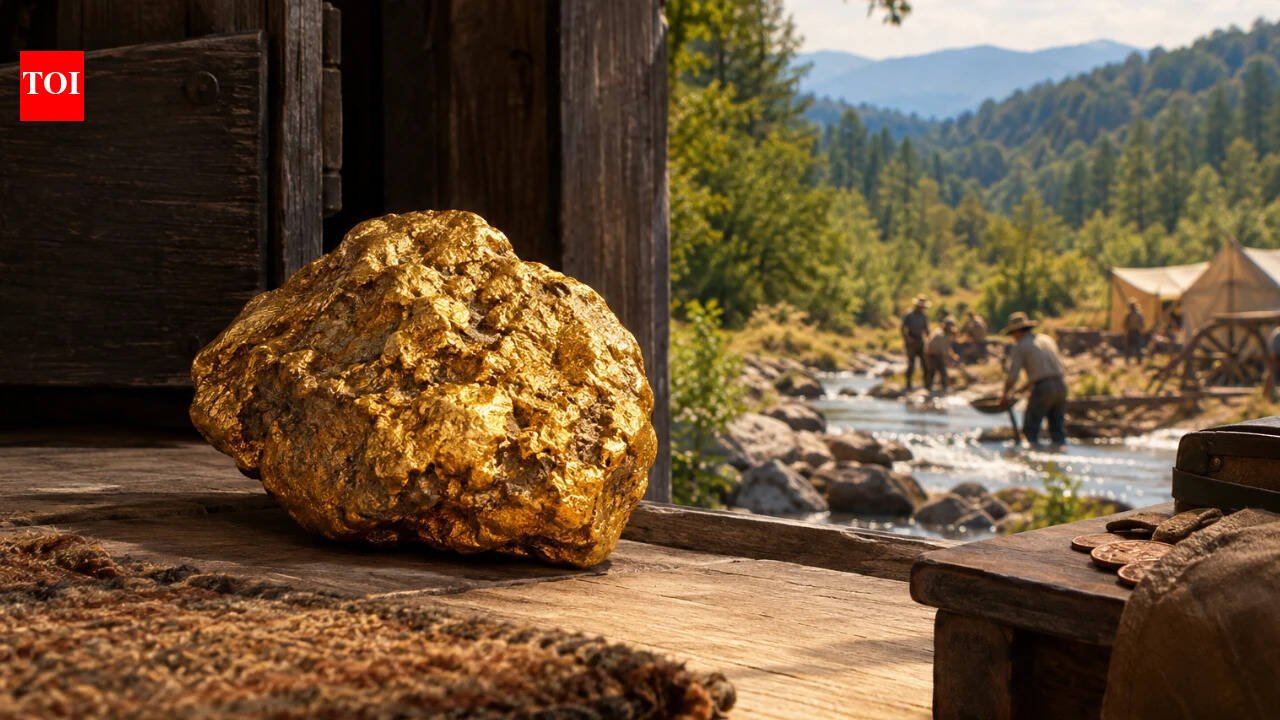
In 1799, when a boy of 12 years old, named Conrad Reed was playing in Little Meadow Creek, located within Cabarrus County, North Carolina, he unearthed a heavy golden stone weighing 17 pounds and brought it home to show his father, John Reed, who was a farmer. Neither John nor his son knew the value of the stone, and the two spent the following three years living with it without realizing its importance and how important it would prove to be for their lives. The heavy stone served as a doorstop in their family house. Once the stone was identified as gold, it became part of a discovery that made North Carolina the country’s leading gold producer for nearly 50 years, until the start of the California gold rush.John Reed, born Johannes Reith, settled in Cabarrus CountyThe story of John Reed, who was actually born as Johannes Reith, was rather a peculiar one. He was a Hessian soldier in the British Army during the American Revolutionary War and at its end, he deserted and settled down amongst the German-speaking community in the Piedmont area of North Carolina, according to the North Carolina Division of State Historic Sites. He anglicized his name and took up farming, raising corn and wheat.Conrad Reed finds a 17-pound rock in Little Meadow Creek, 1799This stone might definitely have remained unnoticed if Conrad had not discovered it in Little Meadow Creek in 1799 because of the unusual nature of the rock itself. Neither Conrad nor his father had known the rock’s worth until three years later, when a jeweler realized it was gold. It was in 1802 that the mystery was solved when John Reed brought the rock to the jeweler in Fayetteville during his usual trip selling agricultural products. The jeweler recognized the rock as gold, worth roughly a thousand times what he then offered for it, and asked Reed to name his price. Unaware of the rock’s true value, Reed asked for what he thought was a generous sum: $3.50, about a week’s wages for a farmer at the time.Reed forms a four-man mining partnership, 1803Reed believed that there were more deposits of gold in the vicinity after becoming aware of the sale. In the year following this incident, Reed brought in three partners to form a mining company, making four men in total; in exchange for half the land and profits, they provided him with tools and laborers. The following year, a boy named Peter, who was enslaved, found a 28-pound gold nugget. According to the North Carolina Division of State Historic Sites, this is the biggest nugget found at the Reed Gold Mine. The discovery soon attracted the attention of Reed’s neighbors.
Cabarrus/Stanly County Line on North Carolina Highway 73 in North Carolina. Image credits: Wikimedia Commons
According to records in The Western Carolinian newspaper dated 1825, gold mining ranked as the second largest industry after agriculture in North Carolina. By the year 1840, North Carolina mines were producing gold worth over $1 million annually, thus making North Carolina the leading gold producer in America. North Carolina remained America’s leading gold producer until 1848, when the California Gold Rush began and quickly overtook it in total production.Underground quartz mining begins at Reed’s property, 1831There were changes in the mining operation that took place at Reed’s estate over the following decades. At first, gold was extracted using the placer mining method from stream gravel. But soon enough, miners found out that gold could be found in veins of white quartz underground in the 1820s. Vein or lode mining was a much more costly operation than creek panning. Mining at Reed’s mine began underground in 1831. Disputes in the family led to the mine’s closure for ten years beginning in 1835, a closure that lasted until Reed died in 1845. His estate was sold in stages over the following decades. In 1895, it was purchased by Dr. Justin D. Lisle and the Kelly family for $15,000.Reed Gold Mine became a National Historic LandmarkThe site of Reed’s discovery remains intact today as a North Carolina state historic site and a National Historic Landmark. The tunnels have been restored, and visitors can see exhibits tracing the mine’s history, from the rock a boy carried home in 1799 to the discovery that followed.


