






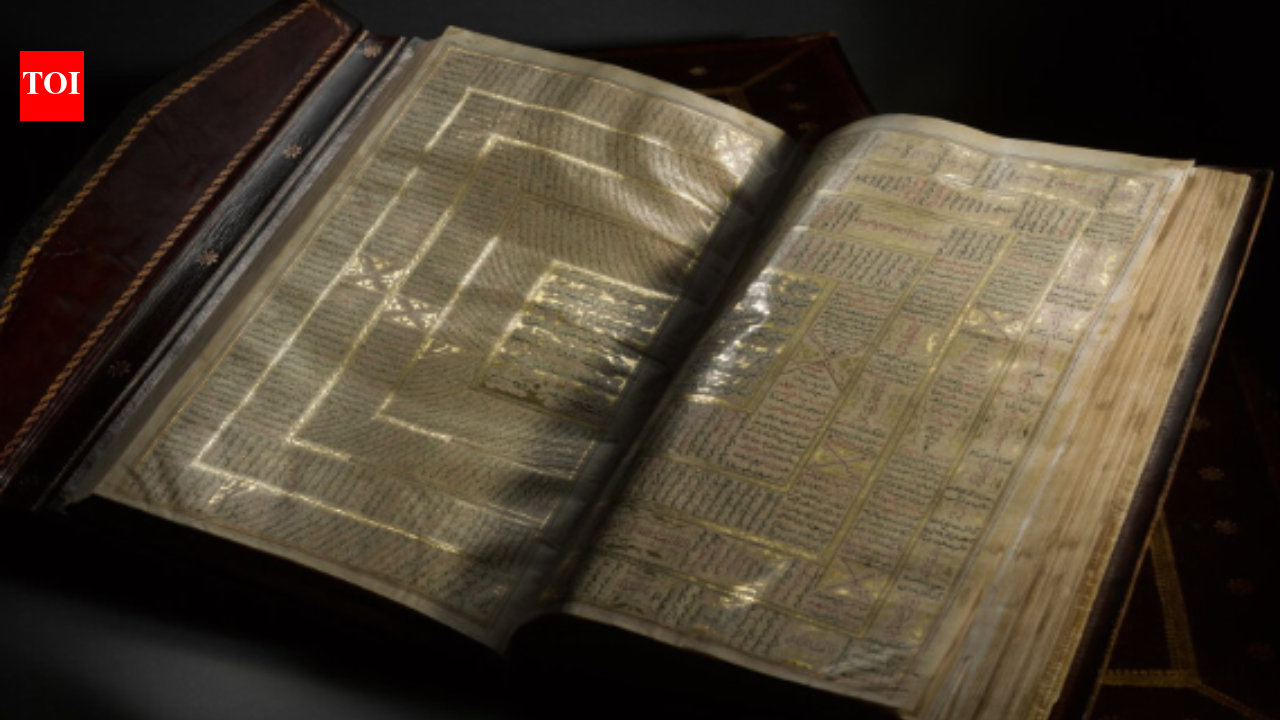
A rare Qur’an manuscript with a documented connection to Mughal emperor Akbar’s library has fetched £863,600 at a Sotheby’s auction in London, selling for more than 14 times its highest estimate after a 15-minute bidding battle. Dating to the late 16th century, the lavishly decorated manuscript carries traces of its passage through the Mughal royal collection, including library seals and inspection inscriptions that offer a glimpse into its history.The four-volume work was offered as the opening lot of Sotheby’s Arts of the Islamic World and India sale on October 29, 2025. It had been estimated at £40,000-£60,000, but the final price of £863,600, including the buyer’s premium, far exceeded expectations. The result was among the standout sales at an auction that brought together important works of Islamic and Indian art.What makes the manuscript particularly significant is not simply its age or the richness of its decoration. It combines the Qur’anic text with eight commentaries, bringing together centuries of scholarship in Arabic and Persian. Its surviving Mughal library marks also provide material evidence of its association with the imperial collection.
A manuscript connected to Akbar’s library
Sotheby’s catalogue identifies the manuscript as having belonged to Akbar (1542-1605), the Mughal emperor who ruled from 1556 until his death. Its provenance records it in his possession by 1602, establishing a link to the imperial library during his reign.The manuscript later remained in the royal collection through descent until the reign of Muhammad Shah (1702-1748), with the catalogue dating this stage of its history to around 1717-1727. It subsequently belonged to a Middle Eastern ambassador to the United Kingdom in the early 1970s.The manuscript’s final pages contain some of the most revealing evidence of its past. The fourth volume bears impressions of seals associated with Mughal librarians, along with inscriptions recording inspections of the work. Some of these markings are smudged or only partly legible, but the surviving details help researchers trace its history across successive reigns.One particularly important seal belongs to Muhammad Yusuf, a librarian active during the late reign of Akbar and the early reign of his successor, Jahangir. The impression carries a date corresponding to Akbar’s 46th regnal year. The page also bears a genealogical seal associated with Shah Jahan, while an inscription above one of the inspection notes refers to Emperor Alamgir, better known as Aurangzeb.Other seals are associated with the period of Muhammad Shah. Together, these marks suggest that the manuscript was examined and retained within the Mughal library tradition over generations, rather than merely being associated with the empire through later attribution.
Four volumes, eight commentaries and elaborate decoration
The manuscript is titled al-Itqan fi ‘Ilm al-Qur’an, translated by Sotheby’s as “Perfection in Qur’anic Science”. Originally conceived as one massive tome, it brings together eight works of Qur’anic exegesis, or tafsir – scholarly interpretations and explanations of the Qur’an.The commentaries span roughly five centuries of scholarship, up to and including Akbar’s reign. They include works by influential scholars such as al-Qushayri, al-Baghawi, al-Zamakhshari, al-Baydawi and the two scholars associated with Tafsir al-Jalalayn. The collection also includes the Tafsir-i Husayni and the Tafsir-i Muhammadi.The physical manuscript is equally striking. Written on gold-sprinkled paper, it comprises four volumes containing hundreds of leaves. The Qur’anic text appears in bold black naskh script, accompanied by an interlinear Persian translation in red nasta’liq script.Verses are separated by gold roundels accented with red and blue dots. Surah headings appear in white lettering against gold backgrounds, set within richly coloured decorative panels. Gold, red, blue and black rules frame the text, while the margins feature gilded vegetal motifs.The commentary occupies the four margins surrounding the central Qur’anic text, with key words and phrases highlighted in red. The opening pages feature illuminated designs, including gold medallion-like decorations known as shamsas. Each volume is enclosed in a brown leather binding with gilt-stamped decoration.The scale of this craftsmanship is considerable: Sotheby’s notes that the manuscript contains just short of a thousand gold-sprinkled leaves, extensively decorated with gilded floral motifs.
The rare commentary that sets it apart
Among the eight commentaries, one stands out for its rarity: the Tafsir-i Muhammadi, written by the Gujarati Chishti Sufi scholar Shaykh Hasan Muhammad ibn Shaykh Ahmad Miyanji Chishti, who died in 1575.According to Sotheby’s catalogue, this commentary is not known to survive in other manuscript copies. Its presence alongside seven more widely known works makes the collection particularly unusual.Hasan Muhammad Chishti spent much of his career under the patronage of the rulers of Gujarat before Akbar annexed the province in 1573. He is also associated with the Hasan Muhammad Chishti Mosque in Ahmedabad, built in 1565-66.Sotheby’s suggests that the manuscript’s contents may offer clues to the circumstances of its creation. Akbar’s interest in Chishti Sufism is well documented, and the inclusion of this relatively rare commentary raises the possibility that the manuscript was produced in the imperial scriptorium – the workshop where manuscripts were copied and prepared for the court — either during the scholar’s lifetime or shortly afterwards.The dating evidence is especially significant. The seal of Akbar’s librarian establishes that the manuscript existed by 1602, only 27 years after Hasan Muhammad Chishti’s death. The catalogue presents the possibility of an imperial connection as a hypothesis, rather than a confirmed account of where the manuscript was made.
A standout result at the London auction
The Qur’an’s sale was part of Sotheby’s Arts of the Islamic World and India auction, which achieved a total of £10,088,793 against a pre-sale estimate of £4.4 million to £6.6 million. According to the post-sale report, just over half the lots sold for prices above their high estimates, with bidders participating from 25 countries.The Qur’an was among the sale’s most notable results, alongside objects such as a pair of silver-mounted pistols made for Tipu Sultan, which sold for approximately £1.1 million against an estimate of £60,000-£80,000.Yet the manuscript’s importance extends beyond its auction price. Its pages preserve a combination of religious scholarship, Persian translation, intricate bookmaking and evidence of royal ownership. The seals and inspection notes are particularly valuable because they connect a surviving physical object to the people and institutions that handled it.More than four centuries after it entered Akbar’s library, the manuscript has once again drawn attention – this time in an international auction room, where its unusually rich contents and documented Mughal history helped make it one of the defining lots of


