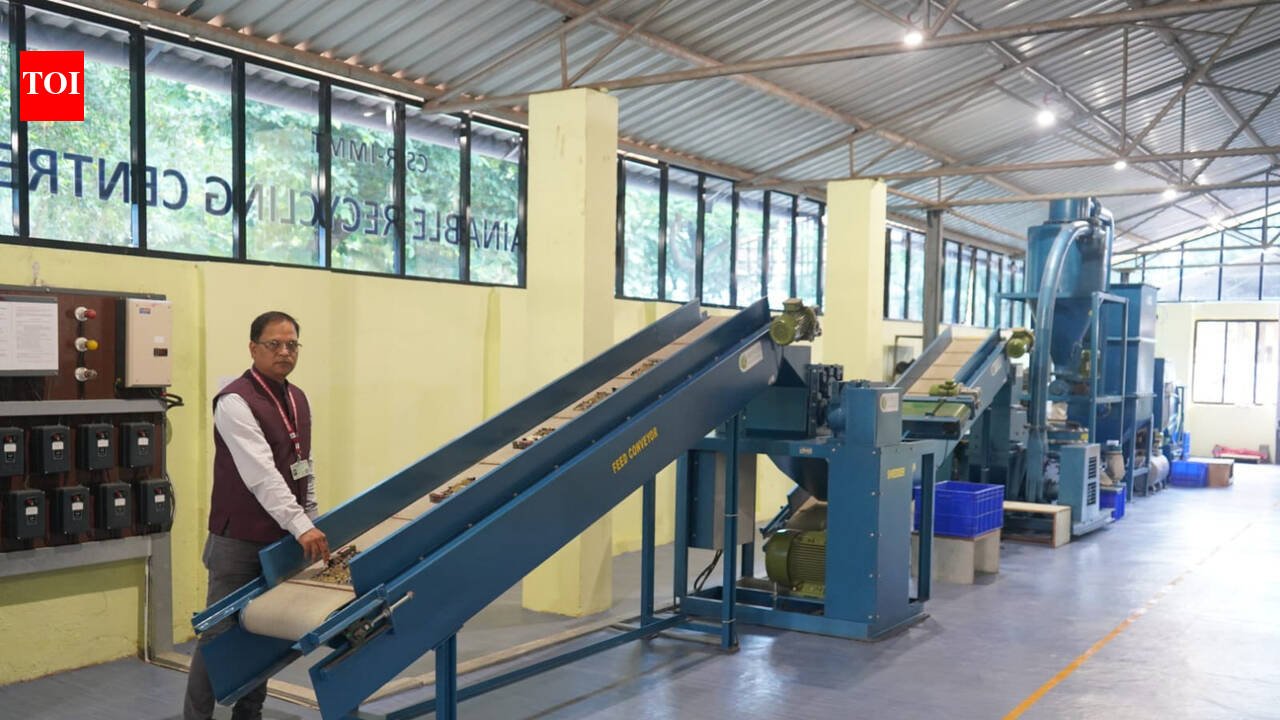
Bhubaneswar: The CSIR-Institute of Minerals and Materials Technology (IMMT), Bhubaneswar, has set up a sustainable e-waste recycling centre here to recover valuable metals such as gold, silver, palladium, platinum and copper from discarded electronic products.The centre, inaugurated by Union science and technology minister Jitendra Singh through videoconferencing on Sunday, has been established for research, technology development, demonstration and skill-building in scientific e-waste recycling. CSIR director general N Kalaiselvi and CSIR-IMMT director Ramanuj Narayan were present on the occasion.Built on the zero-waste concept, the facility segregates metals and non-metals from e-waste and aims to ensure that no material recovered during the recycling process is discarded. It has the capacity to process about one tonne of e-waste per day. The institute may later transfer the technology to private firms for setting up commercial e-waste-to-wealth plants, said the official sources.Santosh Kumar Behera, a CSIR-IMMT scientist, said electronic and electrical products contain several valuable materials that can be recovered, recycled and reused. The centre aims to transform e-waste into a valuable secondary resource through appropriate recycling and metal recovery technologies, Behera added.Explaining the process, he said e-waste received at the centre is first weighed, inspected and segregated according to type and composition. “It is then manually dismantled to separate components such as printed circuit boards, cables, plastics, ferrous metals and non-ferrous metals. The materials are subsequently shredded, screened and subjected to size reduction. The processed material undergoes physical separation through magnetic separation, screening, air-density separation and advanced sorting techniques. This helps concentrate metal-bearing fractions and separate unwanted materials. The concentrated fractions are then treated through hydrometallurgical and metallurgical processes. Selective leaching, separation, purification and precipitation are used to recover valuable and critical metals, including gold, silver, platinum, copper, palladium and other strategic elements, depending on the composition of the feed material,” Behera said, adding the recovered metals are purified and converted into usable or value-added products.Recyclable non-metallic fractions, including plastics, are also recovered wherever technically and economically feasible.Narayan said the centre, with its focus on circular economy principles, will help address the growing challenge of e-waste generation. The facility will support research and development, technology demonstration and skill development in e-waste recycling, while helping bridge the gap between formal and informal recycling sectors by promoting scientific and environmentally responsible practices, he added.