



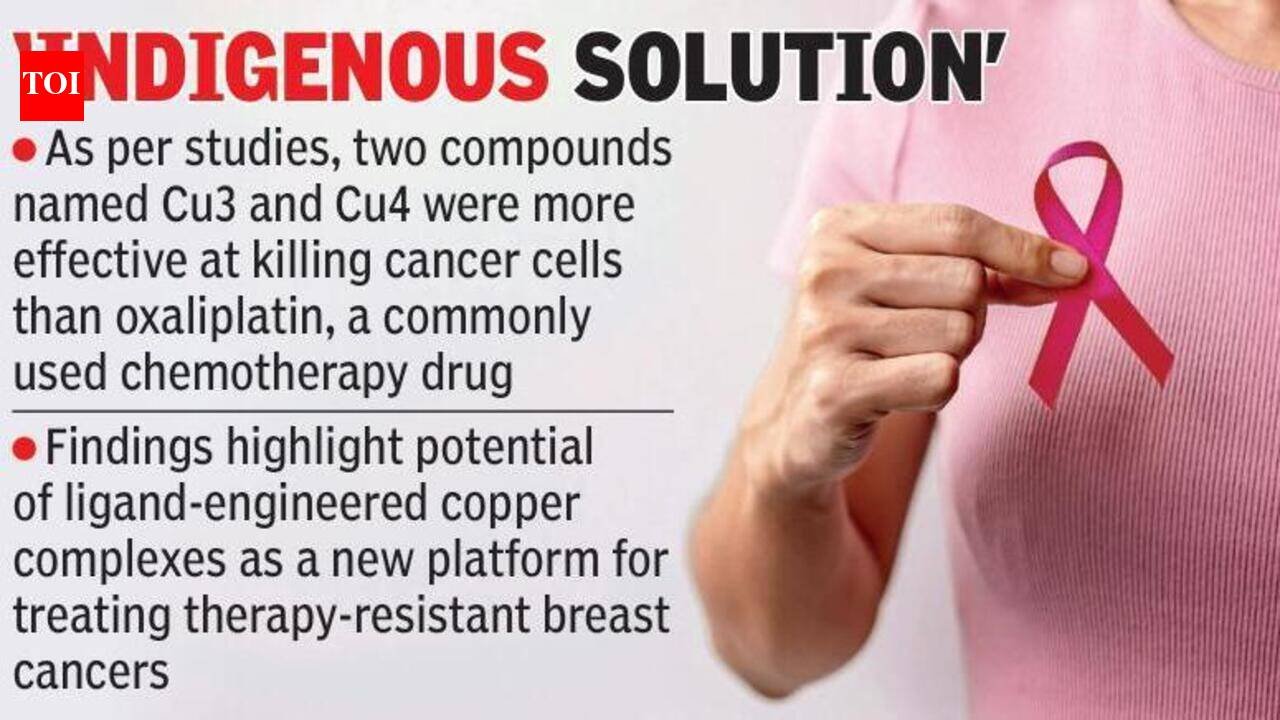
Hyderabad: Scientists at CSIR–Indian Institute of Chemical Technology (IICT) have developed new copper-based compounds that could offer a promising treatment for triple-negative breast cancer (TNBC), one of the most aggressive and drug-resistant forms of the disease. Laboratory studies found that two of the compounds, named Cu3 and Cu4, were significantly more effective at killing cancer cells than oxaliplatin, a commonly used chemotherapy drug.TNBC lacks estrogen, progesterone and HER2 receptors, making it unresponsive to hormone-based targeted therapies. Chemotherapy remains the primary treatment, but the cancer often recurs or spreads due to the presence of cancer stem cells, which are believed to drive tumour regrowth, metastasis and drug resistance.
To tackle this challenge, researchers designed four ligand-engineered copper (II) complexes, Cu1 to Cu4. Among them, Cu3 and Cu4 emerged as the most potent, showing strong antiproliferative activity against TNBC cells in laboratory experiments.The compounds also reduced the population of cancer stem cells marked by CD44high/CD24low and inhibited the formation of three-dimensional tumour spheroids, which are associated with tumour self-renewal and recurrence.In addition, Cu3 and Cu4 suppressed epithelial-mesenchymal transition (EMT), a biological process that enables cancer cells to migrate and spread. They also reduced the expression of EMT-related markers, including Vimentin, ZEB1 and SLUG.Another key finding was their ability to downregulate ABCG2 and ABCC1, drug-efflux transporters that help cancer cells expel chemotherapy drugs. By limiting these transporters, the compounds increased the retention of doxorubicin within cancer cells, potentially enhancing the effectiveness of existing chemotherapy.The study further showed that the copper complexes triggered cell-cycle arrest and apoptosis, or programmed cell death, by increasing reactive oxygen species and altering proteins involved in cell survival, including Bax, Bcl2 and Survivin.Researchers said the findings highlight the potential of ligand-engineered copper complexes as a new platform for treating aggressive and therapy-resistant breast cancers. However, the results are based on laboratory studies, and further in vivo research is needed to evaluate their safety and clinical potential.The study, published in ACS Medicinal Chemistry Letters, was carried out by researchers Vemavarapu Durga Prasad, Suriya Panneerselvam, Jyotirmoy Dutta, Arpan Bera, Tukki Sarkar, Sai Balaji Andagulapati and Bathini Nagendra Babu. The work involved from CSIR-IICT, Hyderabad, the Indian Institute of Science, Bengaluru, the Academy of Scientific and Innovative Research, Ghaziabad, and Handique Girls’ College, Guwahati.


