



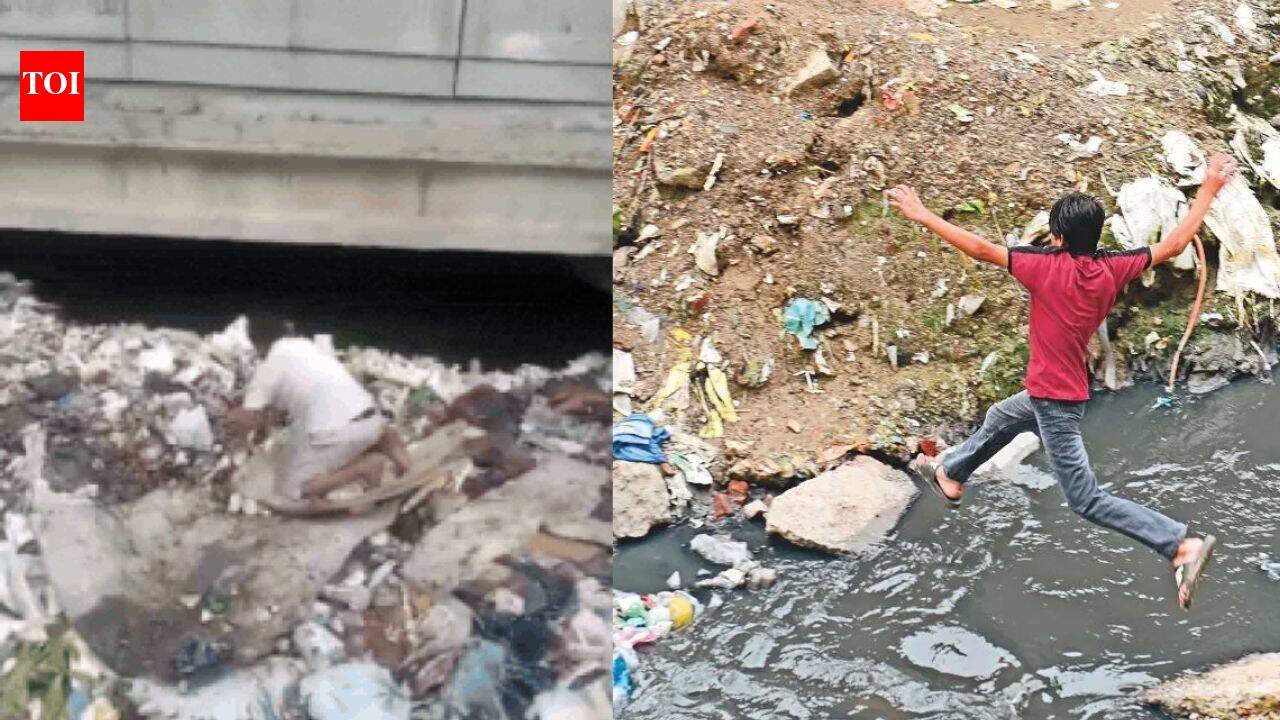
NEW DELHI: At Jasola, the open drain, in which 15-year-old Mithun fell while chasing a kite and died last week, runs alongside rows of matchbox-sized homes, shaping childhoods around fear and restriction. A woman points to the concrete ledge outside her doorstep, sitting 4 feet higher than the rest of the lane and designed to keep out the monsoon filth and keep in a crawling toddler.TOI visited multiple open drains across the city, including Jasola, Taimoor Nagar and Khajuri Khas, to speak with residents whose everyday lives are bound by toxic black water and constant vigilance.“We made sure our house was built higher,” Rita said. “We wanted to be safe when the water overflows, but more than that, I needed a barrier. I needed to make it hard for my children to step down, to crawl down toward it.”Here, open space is not an amenity; it is a hazard. Childhood is measured not in freedom, but in strict boundaries enforced by terrified parents. Parks are a distant luxury. Rita and other women said they take their children out only Sundays, travelling to an adjacent park near a mall. For the remaining six days of the week, play is strictly confined within four walls.A few doors down, a balcony hangs directly over the reeking channel. A man stands by the door frame. “I keep my 10-year-old locked inside, I don’t even let him step out onto the balcony,” he said. “He has spent a decade living like this, 10 years of playing indoors. In the absence of parks, you’d think a child could at least play in the street, but out there, a single misstep means I can lose my child, just like Awadhesh lost Mithun.“One close look at the floating garbage choking the Jasola drain, and the lane’s history reveals itself: several single rubber slippers, all different colours and sizes, a soaked school bag caught near more garbage, a small toy half-submerged.“Each object is a trace of a child who slipped, tumbled, and was pulled back just in time. We have to rob our own children of their playfulness to ensure their survival,” said Farhat Zahaan, who has two daughters, aged 4 and 6.A few kilometres away in Taimoor Nagar, the primary route to school is a narrow, makeshift wooden bridge which was made over a pipe over the drain. When TOI visited, it found children navigating it, carrying school bags larger than themselves. Down near the drain were 10-12 children chasing dragonflies hovering over the black water, playing tag right on the edge, one foot slipping away from falling inside.“The children’s school is on the other side of our colony,” said Firoza. “When we are out for work, they have no option but to hold hands and just cross alone. Every single day, we leave with the same prayer, hoping our child is home safe when we get back in the evening.”Along one stretch of the bank is a half-built concrete structure fitted with iron grills, which locals claimed is a municipal promise of a boundary wall. “They have told us it will take another five or six months to complete, but we have seen the brief patch of wall currently standing took nearly two years to erect,” said Shobha, a young mother.Sitting on an exposed pipe directly over the channel, Mohammad Zahil and Abdul keep watch over the crossing. “We would never let them fall,” Zahil said, his eyes scanning the children playing near the brink. “When we sit out here, it’s not just to pass time. We’ve had to learn how to swim through this muck by default, simply because we’ve had to pull out so many children, women and elderly people who slipped and fell.”In northeast Delhi’s Khajuri Khas, near the metro station, boys like Mithun stand in a row scattered, with some distance between one another, dangerously flying kites directly above a flowing open drain. Here, every narrow lane opens straight into the black water. With no playgrounds here too, children jump over the exposed drain, playing tag from one lane to the next. At times, they grip onto the walls of the houses to balance themselves. At the end of several lanes, families have parked rusted scooters side-by-side as a makeshift barricade to stop children running before they take a fatal step.Residents here largely consist of fruit and vegetable sellers. Fatima, 70, said, “I’ve spent 39 years watching this drain fill with garbage. I raised my children here, and now my grandchildren are growing up on the same bank. No one has ever given us a timeline for when it will be covered.”


