


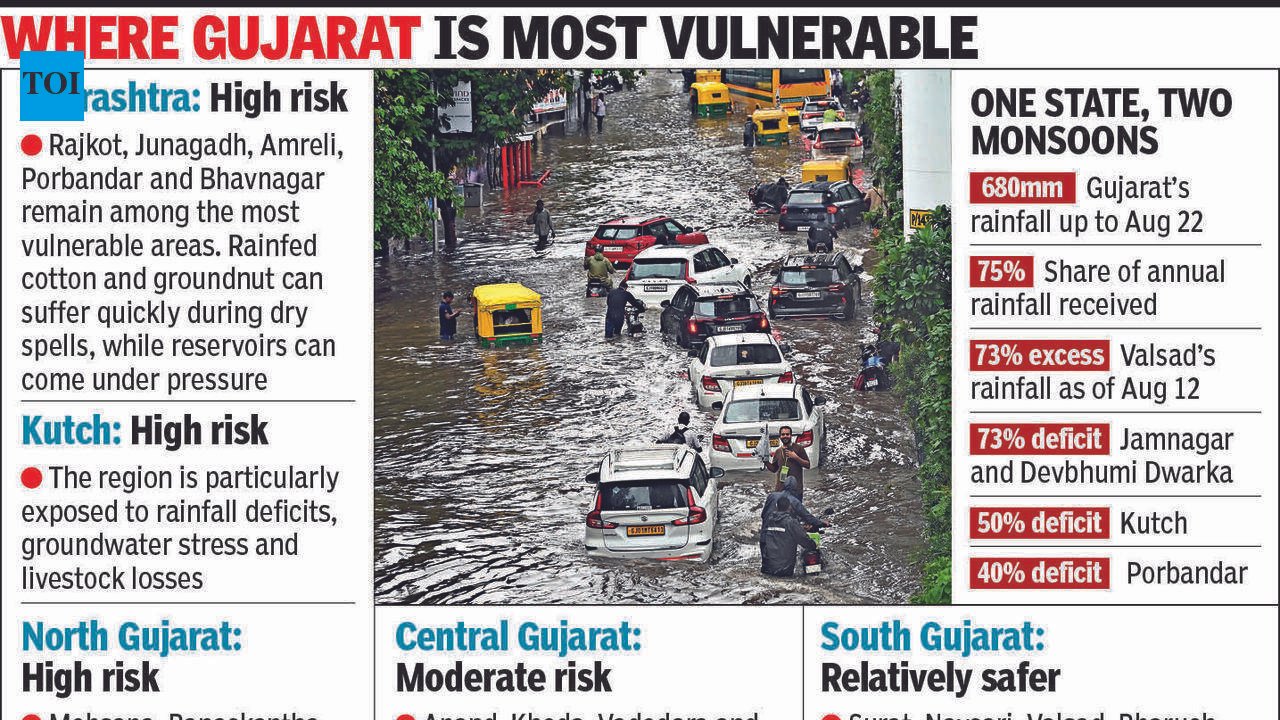
Vadodara: Gujarat’s monsoon has delivered a striking contradiction this year—while cities such as Ahmedabad and Surat have battled flooding and intense spells of rain, parts of the state are still staring at significant rainfall deficits. This anomaly is raising fresh questions about the strengthening of El Nino and what it could mean for the rest of the season.The state had received 680 mm of rainfall up to Aug 22, amounting to around 75% of its annual rainfall, but the statewide figure masks a sharply uneven distribution.A study by researchers from the ICAR-Indian Institute of Soil and Water Conservation, Research Centre in Vasad, points to the same divide. It has noted that Gujarat’s rainfall pattern this year has been “very skewed”.The researchers—D Dinesh, Gaurav Singh, N K Meena and M J Kaledhonkar—have analysed five decades of El Nino events and their impact on Gujarat’s agriculture and have warned that El Nino could make 2026 a particularly difficult year for rain-dependent farming.The contrast is already visible in the rainfall data cited in their analysis. While Valsad had received 73% excess rainfall, Kutch was running 50% below normal. Jamnagar and Devbhumi Dwarka had recorded a deficit of 86%, while Porbandar was 40% below normal, according to India Meteorological Department (IMD) data as of Aug 12 cited by the researchers.The unevenness clearly shows that El Nino does not necessarily translate into uniformly low rainfall across the state. Instead, it can alter the distribution and timing of the monsoon, leaving one region drenched while another struggles through prolonged dry spells.“El Nino doesn’t treat Gujarat as one place,” the researchers observe, pointing out that some regions are much more vulnerable than others. The difference is particularly stark between rain-dependent Saurashtra, Kutch and north Gujarat and the more irrigation-supported parts of central Gujarat.The El Nino warning behind the paradoxEl Nino originates thousands of kilometres away, with abnormal warming of surface waters in the central and eastern Pacific Ocean. According to the researchers, this warming can weaken the winds that carry moisture towards India and has historically left Gujarat’s rainfed regions waiting for a fuller monsoon.Their review of the past five decades shows why farmers remain wary.During the 1982-83 El Nino, Gujarat’s rainfall was 20% below normal and Saurashtra and Kutch suffered severe drought and crop losses. The 1987 event brought a 19% deficit and acute statewide water scarcity. In 2002, rainfall was again 19% below normal, while the 2009 El Nino year saw a 23% deficit and widespread crop failure. The 2015 event brought a comparatively smaller 14% deficit but was accompanied by intense heat, particularly in north Gujarat.For the researchers, the lesson from those years is simple—less rain is only one part of the problem. Dry spells, high temperatures, declining soil moisture and pressure on groundwater can combine to hit farm incomes much harder.“Every El Nino year tells the same basic story with a different ending— less rain, thirstier soil, a harder season and less income,” the researchers write.2026: Why is the concern bigger?The researchers say El Nino conditions have developed in the Pacific and are strengthening, with meteorological agencies including the IMD, National Oceanic and Atmospheric Administration (NOAA) and the APEC Climate Centre pointing towards the possibility of the phenomenon intensifying into a “Super El Nino” by the last quarter of 2026.The warning comes even as Gujarat has already received three-fourths of its annual rainfall. The concern, therefore, is not simply how much rain the state receives but where, when and in what intensity.The study says central and north Gujarat have been experiencing delayed and lower-than-average rainfall, while a neutral Indian Ocean Dipole (IOD) is offering little counterbalancing moisture. The researchers caution that this combination could make the kharif season difficult, with the consequences potentially showing up in reservoirs, groundwater levels and prolonged heat.The possibility of a Super El Nino does not, however, mean Gujarat is headed inevitably for another 1987 or 2009. The researchers themselves caution that there is no guarantee of a repeat of those extreme drought years. But the warning is significant because the impact of rainfall deficit is likely to be highly localised.BOXWhere Gujarat is most vulnerableSaurashtra: High riskRajkot, Junagadh, Amreli, Porbandar and Bhavnagar remain among the most vulnerable areas. Rainfed cotton and groundnut can suffer quickly during dry spells, while reservoirs can come under pressure.Kutch: High riskThe region is particularly exposed to rainfall deficits, groundwater stress and livestock losses.North Gujarat: High riskMehsana, Banaskantha, Sabarkantha and Patan face the combined threat of shorter monsoon spells, fodder scarcity and heat.Central Gujarat: Moderate riskAnand, Kheda, Vadodara and Ahmedabad have the advantage of irrigation and canal networks, although the researchers caution that canal supplies can also thin.South Gujarat: Relatively saferSurat, Navsari, Valsad, Bharuch and Dang are comparatively better placed, with the Tapi basin providing some cushion. However, localised dry patches remain possible.BOXOne state, two monsoons680 mm — Gujarat’s rainfall up to Aug 2275% — Share of annual rainfall received73% excess — Valsad’s rainfall as of Aug 1286% deficit — Jamnagar and Devbhumi Dwarka50% deficit — Kutch40% deficit — PorbandarFarmers could feel the impact firstThe researchers say the first signs of a deficient or erratic monsoon are likely to appear on farms rather than in statewide rainfall statistics. Delayed sowing, poor crop establishment and moisture stress could affect major rainfed crops such as cotton and groundnut. Farmers may also have to spend more on irrigation and re-sowing, while reduced biomass could create fodder shortages and eventually squeeze farm incomes.What researchers suggestShift towards short-duration and drought-tolerant varieties of cotton, groundnut, pulses and millets.Expand drip and sprinkler irrigation and farm ponds in rainfed areas.Create fodder banks and silage reserves, particularly in Kutch and Mehsana.Diversify farm livelihoods through livestock, horticulture and agro-forestry.Ensure timely Pradhan Mantri Fasal Bima Yojana (PMFBY) crop-insurance enrolment and monitor drought-relief measures.
