



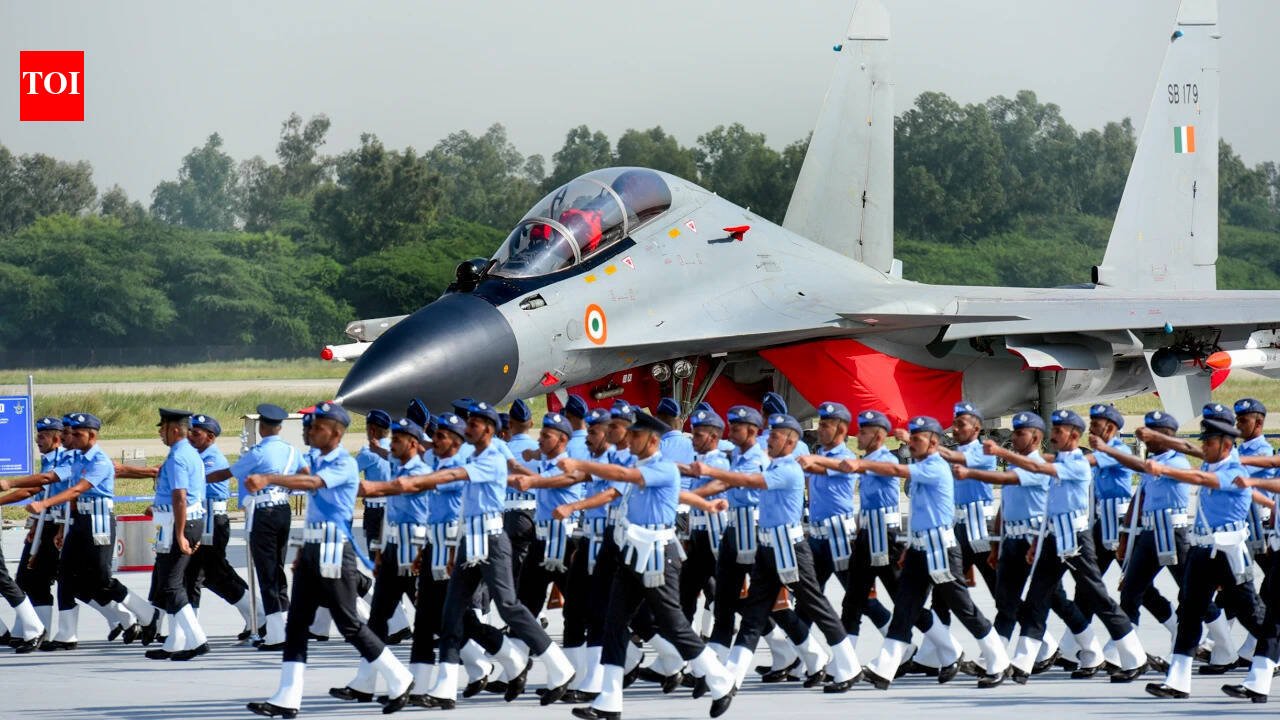
IAF turns 94 short on squadrons; Air Marshal (Dr) Diptendu Choudhury (Retd) says capacity, not capability, is the worry.The Indian Air Force turns 94 on Thursday with its skill proven in combat but its strength stretched thin. One of its foremost strategic thinkers warns that the shortfall now threatens India’s ability to deter its adversaries.“We are a capable air force. We have a lot of capabilities, but presently our strategic capacity is what is worrying,” Air Marshal (Dr) Diptendu Choudhury (Retd), former Commandant of the National Defence College, told TOI in an Air Force Day conversation.The IAF has about 30 fighter squadrons against a sanctioned 42. Asked whether it could credibly fight on two fronts, he did not hedge. “If it’s a short conflict, we’ll probably manage it. But if it is a full-fledged war, even a full-fledged one-front war, we’ll be hard-pressed. And a two-front war with our present capacity is an incredibly difficult task.” The problem in long wars, he explained, is that no one can say when they will end. “If you can’t define that, you have to spread your capacity for the entire period.”
‘A Maharatna should deliver national security first’
He saved his sharpest words for Hindustan Aeronautics Limited. HAL, he said, “has lost the faith of its most important and largest customer” and must win it back. “There are red lights flashing on the state of a Maharatna. A Maharatna should deliver national security goals first, then seek profits.”He said the company has the largest order book in the world but cannot deliver on it “with its present capacity and present approach.” He added that HAL’s export ambitions depend on keeping its home customer satisfied: “The best advertisement and sales pitch will come from how happy your air force is with your platforms.”
The HAL Tejas Mk-1A is an advanced 4.5-generation, single-engine, multirole combat fighter developed in India by Hindustan Aeronautics Limited (HAL) for the Indian Air Force (IAF)
He pointed out that the Tejas Mk1A the IAF ordered has still not reached the force, and that HAL is again asking the IAF to accept aircraft with concessions, promising to add capabilities later. “This is exactly what has happened in the past.”
Sindoor and the logic of deterrence
Choudhury flew more than 5,000 fighter sorties, close to 3,000 of them on the MiG-21. He linked capacity directly to deterrence, using Operation Sindoor as the example. What brought Pakistan to a ceasefire, he argued, was not India’s ability to defend against drones and missiles but the way the IAF struck the Pakistan Air Force after its attacks. “Even conservatively, if they took 10% damage in peacetime in 88 hours, that is an enormous shock for an air force to bear.“
Mig 21 Fighter Jet
He traced that offensive thinking back to 1971, which he called the IAF’s defining war. Air Chief Marshal PC Lal’s strategy of attacking enemy targets as whole systems hit fuel depots at Karachi, the Sui gas plant and the Attock refinery, and nearly choked Pakistan’s fuel supply. “When you target an enemy deep inside, it gives you a strategic capability, and that is what deters an adversary.”
The fleet: Rafale now, AMCA with room to grow
On the Rafale, he said the jet performed very well in Sindoor and had been unfairly made “a victim of its publicity.” His regret is the timing. “This is an aircraft we should have had a decade ago. If we had got those 126 aircraft, we would have been a different air force today.” The IAF currently operates two Rafale squadrons, 36 jets in all, at Ambala and Hasimara; a deal for 114 more is still under negotiation.
The Indian Air Force is facing a massive numbers shortfall, with the indigenous 5th-gen fighter no way near the horizon.
Air Marshal Choudhury wants the new Rafale deal concluded quickly, ideally by year-end, and the Sukhoi fleet upgraded and expanded. He said the government must decide whether to keep the Tejas Mk2 or fold that effort into AMCA. AMCA itself should be built as a 5.5-generation fighter with room to grow, not as “a standalone end in itself.” He also flagged that every Tejas will fly on a US engine, even if it is made in India, so supply-chain risks will remain. Working with foreign engine makers, he argued, would build India’s skills rather than weaken self-reliance. “It is a vulnerability, but it is an opportunity.”
Every air warrior a war fighter
Air Marshal Choudhury believes that IAF’s edge still lies in its people, and that modern warfare has widened who counts as a combatant. A woman controller on a radar screen who detects, identifies and tracks an intruder “is a war fighter,” he said. So is the missile controller in a distant, networked cabin who clears the shot. “Everyone has become a war fighter.”
Top three priorities
Restoring strategic capacity, he said, must be the IAF’s top priority for the next decade. Next come aerospace domain awareness and defence, which means watching the band up to low-Earth orbit through which missiles now travel. Third is a shift towards becoming an air and space force, a step he said would also open a large economic opportunity in aerospace. “What really deters an adversary,” he said, “is when it knows it’s going to be hurt hard if it takes a chance with us.“
