



It takes a rare kind of alchemy to make a dining room in Bengaluru feel as though it has been lifted straight out of the misty hills of Shillong. Stepping into the pop-up presented by Meghalaya Tourism in collaboration with Seeti Movement, the shift was immediate and immersive. Also read | I travelled 145 km from Bengaluru to Mysuru to try the famous ‘Mysore ramen’ at Neon Castle, a couple-run restaurant inside a 90-year-old bungalow
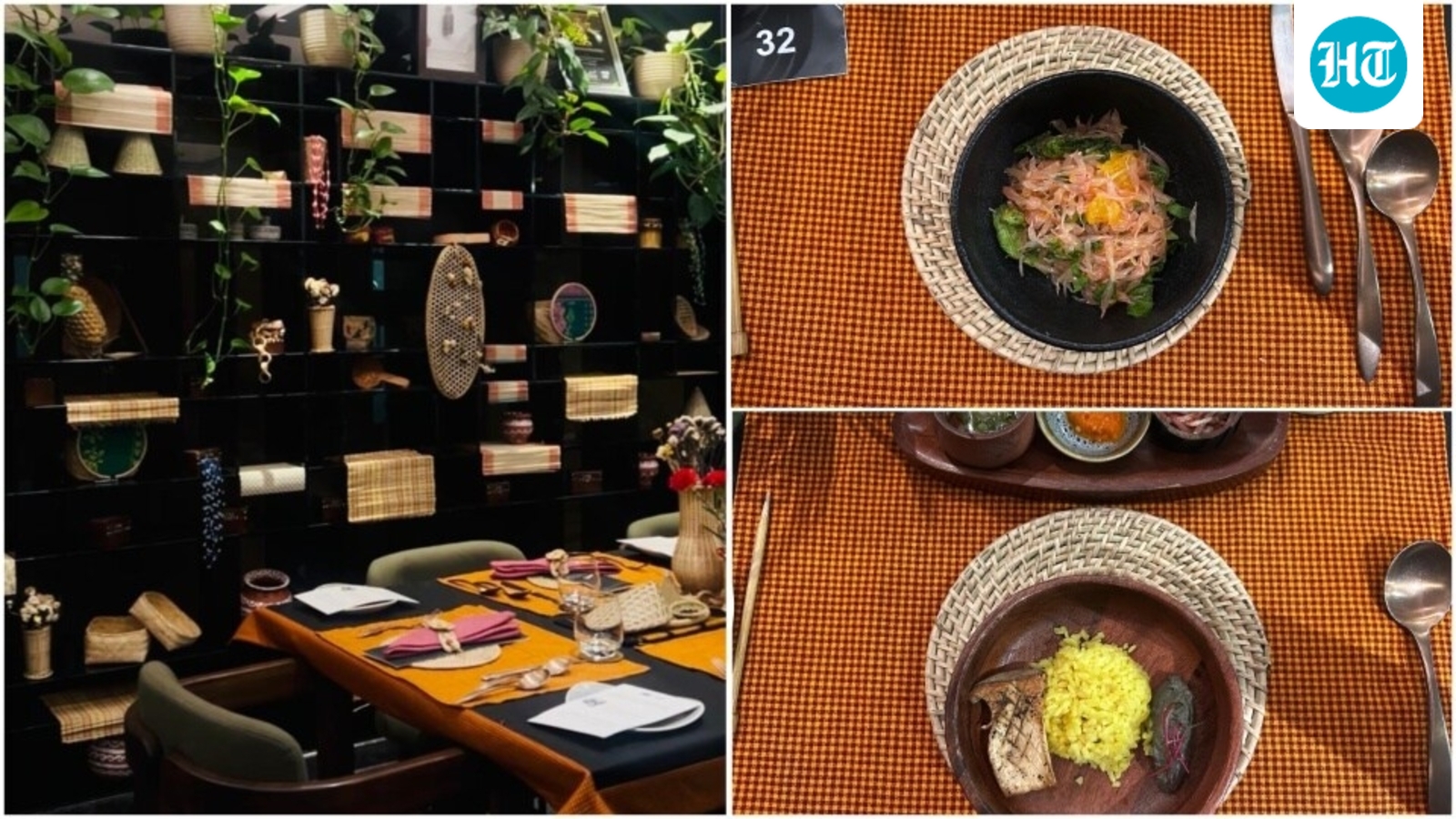
Inside Tijouri at Radisson Blu Atria, wooden shelves spilt over with Meghalayan crafts and greenery, while woven cane baskets and brassware mingled with centrepieces of indigenous bamboo and native beaded necklaces — all laid over bold mustard-and-maroon checked placemats so charming I wanted to take one home. It felt less like a pop-up and more like a vision of what a refined Meghalayan restaurant could be, where craft, history and hospitality meet.
The table where I was seated felt like its own world
The room was electric with energy, bringing together a cross-section of diners: food bloggers, chefs, entrepreneurs, and journalists. And yet, for all its luminaries, the room was defined by ease and warmth. At my table was Priyadarshini Raje Scindia, who co-founded Seeti Movement with Sid Mewara — the Wharton-educated, professionally trained chef behind The Big Forkers and co-host of Warner Bros. Discovery’s I Should Have Stayed Home, whose career has moved between professional kitchens, media and restaurant development.
Priyadarshini Raje Scindia herself is unmistakable. Effortlessly elegant, she carries the quiet poise of someone born into a royal household, married into a prominent political lineage, and regarded as one of the most influential cultural figures of her heritage. Yet any formality dissolved within moments. She was vibrant, gracious and entirely present — happy to connect with anyone and everyone over a shared love for regional Indian culture and food.
This was a very busy evening for her — hosting, moving between tables, keeping the whole room together — and she still took the time out when I asked if we could step aside for a quick chat, sharing insights into her world. Beyond style, her presence reflects a deliberate, mindful way of living. That is a story for another day — one she has graciously agreed to share in detail.
The spirit of generosity extended right across our table. I connected with a fellow guest — a fellow Cancerian who loved nothing more than feeding people. Most of the table was busy documenting the dishes, photographing each course as it arrived, while trading notes on the local and international dining scene and where to find authentic Northeastern food in Bengaluru. Running into familiar faces from the city’s culinary scene only added to the feeling that this wasn’t just a dinner, but a gathering of kindred spirits. Between courses, Sid joined us, trading stories and laughing at old memories.
The 10-course Meghalaya feast
What elevated the evening beyond a standard tasting was the intimacy. Chefs Reuben Sooting, Tanisha Phanbuh and Adonijah Lyngdoh from Meghalaya visited every table for every course, talking through the provenance of the forage, the local techniques, and the story behind each component. That answered every lingering question I had — including what fish mint was and why it kept appearing in my vegetarian plates. Turns out, it’s a uniquely tangy, herbaceous leaf from Meghalaya. No fish involved, just a name that throws you off.
Coming in as a vegetarian, I had carried an old, lingering misconception that northeastern food is overwhelmingly non-vegetarian. The night’s menu completely shattered that assumption. Every single course offered a thoughtful, beautifully executed vegetarian interpretation that never felt like an afterthought. Some of the plant-based courses were so vivid and playful that they won over even the die-hard meat-eaters at the table. Also read | Bengaluru’s secret cafe: 16 strangers in 1 apartment with themed menus, specialty coffee and zero awkwardness
The menu celebrated seasonality, preservation and wild forage across the Khasi, Garo and Jaintia hills:
1. Black sesame, tree tomato tart
The meal opened with rich local mushrooms cooked down in earthy black sesame and indigenous spices, nestled inside a delicate pastry tart set over a vibrant, tart bed of tree tomato salsa. It offered a deep, nutty, umami start.
2. Garo wetepa-inspired banana blossom
Inspired by traditional Garo wetepa (cooking in banana leaves over open embers), this dish presented tender banana blossom infused with local herbs and steamed in a banana leaf packet. It was subtle, aromatic, and deeply comforting.
3. Pomelo, mustard leaf and Khasi mandarin salad
A refreshing, vibrant bowl featuring juicy, pink pomelo sacs tossed with peppery mustard greens and sweet Khasi mandarin. It was sharp, spicy, tart, and beautifully balanced — a celebration of Meghalaya’s winter-to-spring harvest.
4. Forest after rain (mushroom dumpling with chilli oil and crispy ginger)
Smoked-over flavours reminiscent of Dawki, these delicate mushroom dumplings were set on a layer of banana leaf, finished with fragrant chilli oil and crispy ginger threads. They carried a velvety, earthy warmth.
5. Fish mint, tomato and pumpkin
A gorgeous plate featuring charred tomato, silky pumpkin puree, and an herbaceous emulsion highlighting fish mint. The herb lent a uniquely fresh, tangy, and pungent profile that brought the plate together.
6. Pear, roselle and Khasi wild apple granita (palate-cleanser)
A refreshing transition course celebrating the mountain produce: warm poached pear cut through with bright, ruby-red roselle (hibiscus) and a frozen, tart granita made from Khasi wild apples. This was pure, delightful fun: crisp, tart, unexpected, and refreshing.
7. Ja stem, tit nei ïong (yellow rice and mushrooms)
Served in a rustic wooden bowl, fragrant turmeric-dyed rice (Ja stem) was paired with deeply spiced mushrooms (Tit nei Ïong) and accompanied by traditional condiments.
8. A twist of the hills (spaghetti tossed in fish mint pesto)
This course became an unexpected highlight of the night. Thick strands of pasta were coated in an aromatic green pesto made from indigenous fish mint. It was so bright and delicious that my non-vegetarian dining companions happily finished off my plate — a welcome gesture given how substantial 10 courses can be.
9. Whispers of Lakadong (turmeric sponge, infused milk, black sesame tuile)
As someone who usually admires desserts from afar — avoiding the inevitable sugar high and calories — this course blew me away and became my favourite of the entire night. Built around Meghalaya’s famed Lakadong turmeric, it featured a light, golden turmeric sponge soaked in turmeric-infused milk, topped with an ornate black sesame tuile. It was barely sweet, deeply spiced, creamy, and wonderfully earthy.
10. Autumn song (soh ïong, ginger flower and black rice)
The grand finale featured a silky white panna cotta paired with a rich dark preserve of soh ïong (wild purple cherry), ginger flower, and a crunchy, toasted black rice crumble. It ended the night on a clean, floral, and deeply textural note.
The vision behind Seeti Movement
Between courses, Priyadarshini Raje Scindia explained the thinking behind Seeti Movement and its ‘Seeti In Your City’ series. The name itself was the starting point. What sounds familiar in an Indian kitchen, she said, can also be a provocation.
She told Hindustan Times, “By the name Seeti, it’s the cooker. Seeti is a call to arms — you know when you blow a whistle, it means you are getting everyone’s attention. And in India, your first experience of the kitchen is that pressure cooker. You walk in, and you’re like, ‘Oh my god.’ And that’s what we try to create… an environment for people to think out of the box.”
The philosophy extends well beyond the plate. For her, the project has always been about tracing ingredients to their sources and situating them within a broader cultural context: “We went to the smallest of places to explore little ingredients. It’s not just what’s at your table. It’s food. It’s culture. It’s craft. It’s music. It’s history. Seeti comes in with generosity. You have to be generous of spirit. If your table is not generous, your food will not be good. I think all Indian cuisine is underrated. Most of the time you go abroad to eat Indian food, it’s the same five things — nihari, butter chicken, dal makhani… I would love for people to come and experience a state they may not have experienced before.”
It was past midnight when I walked out, carrying more than the memory of a good meal. I left with a renewed appreciation for indigenous Indian ingredients, a notebook full of stories, a few new connections, and a sudden urge to book a trip to Meghalaya for its food, textiles and hills. If that resonates, this edition of Seeti Movement travels through November and December, with pop-ups planned in Hyderabad, Bengaluru, Gurgaon and Mumbai. Details are on their Instagram.
The author was hosted by Seeti Movement upon editorial invitation.
