



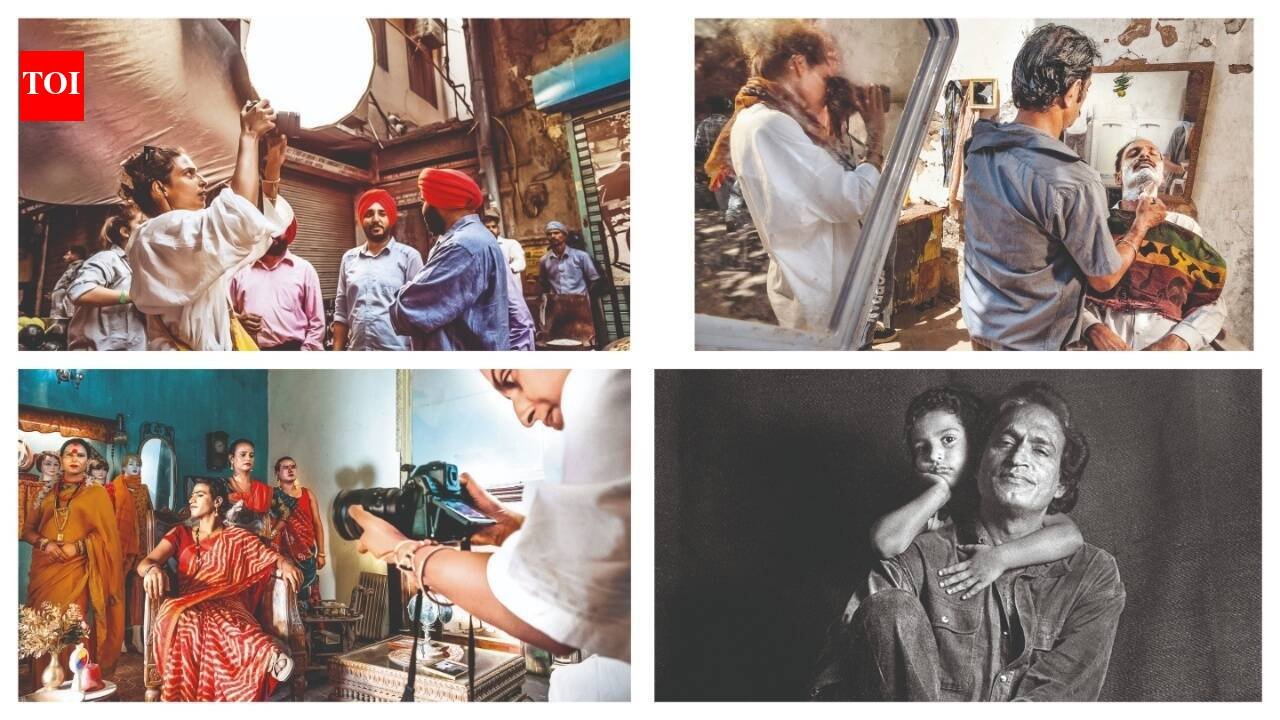
Stepping into one of the world’s most prestigious photography commissions while mourning the loss of her legendary father, Avani Rai found herself completing the 2027 Pirelli Calendar in a way that was both deeply personal and distinctly her own.In an exclusive interview with Bombay Times, the photographer reflects on carrying forward Raghu Rai’s values rather than his style, resisting global stereotypes about India, and why the country’s contradictions -not neatly packaged narratives- deserve to be seen through an honest, contemporary lens. Excerpts…The Pirelli Calendar is one of the most coveted commissions in global photography, but for you it also became deeply personal after your father’s passing. How did you navigate the fine line between honouring Raghu Rai’s vision and ensuring the work remained authentically yours rather than an imitation of his style?I don’t think I ever set out to imitate him, because that would have been impossible. My father’s photographs came from sixty years of looking at the world with extraordinary empathy, curiosity and dignity. To photograph like him, I wouldn’t just have to make pictures like him – I would have to be the person he was. And I’m not. Nor would he have wanted me to be. He never once told me to photograph like him. Instead, he taught me something much more important. He would say, “Look here. Look there. Look everywhere.” Stay awake to every inch of the frame, and more importantly, to every inch of life. He believed that photographs aren’t chased, they arrive when the world, your attention and your presence come into alignment. More than anything, he taught me how to receive a moment. When the Pirelli Calendar came to me after his passing, it carried an emotional weight that went far beyond the commission itself. It wasn’t only a responsibility; it was an extraordinary gift. He had entrusted me, unknowingly, with something he had begun. To be able to complete that work while carrying forward the values with which he lived and photographed the world was one of the greatest honours of my life. The visual language naturally became my own because our lives, our questions and our experiences are different. His photographs came from his journey through the world; mine can only come from mine. In the end, the project became less about stepping into his shoes and more about realising that what he had given me was far more valuable than a photographic style. He had given me a way of looking, a way of being present, and a way of meeting the world with openness. That is something I hope stays with me for the rest of my life.For decades, your father shaped how the world viewed India through his lens. As a photographer of a different generation, do you ever feel the weight of that legacy, or is it important for you to consciously challenge and redefine the visual narrative of India for today’s audiences?I don’t wake up thinking about challenging my father’s legacy. That would be the wrong place to begin. Every generation inherits a different world. My father photographed India at a time when the act of witnessing itself carried an urgency. My generation has inherited a country that is photographed constantly. Images are no longer scarce—they’re everywhere. The question has shifted from Can we document this? to What deserves our attention? I also think I’m too young to compare my work with his. He spent over six decades photographing India. I’m still discovering what my own questions are. What interests me isn’t replacing an older narrative of India with a newer one. India has never been one story. It has always contained many truths, many contradictions, many ways of seeing. If my work contributes anything, I hope it simply adds another perspective to that conversation.The 2027 Pirelli Calendar places India at its centre – a country often reduced to stereotypes in global imagery. What conversations did you and the creative team have about resisting exoticism and presenting a more nuanced, contemporary portrait of India?One thing we all agreed on very early was that we didn’t want to explain India. India has often been photographed through someone else’s expectations – either as spectacle, as poverty, as spirituality, or increasingly as luxury. None of those are untrue, but none of them are complete. The country has always resisted being reduced to a single narrative. For me, one way of resisting that was to return to the streets of Old Delhi. That’s where my father spent over sixty years photographing life. Not because he was searching for an “authentic” India, but because he believed that extraordinary human moments exist within ordinary life. I wanted to begin from that same place. I worked with artisans, workers, families, and people from different parts of the country. They weren’t there to perform an idea of India. They came with their own histories, gestures and ways of inhabiting the world. My role wasn’t to direct those emotions but to create a space where they could simply exist. Then I waited. That’s something my father taught me, that you don’t force a photograph into being; you remain present until life offers you one. The conversation with the creative team became less about resisting stereotypes directly and more about trusting complexity. We wanted images that felt lived rather than performed. Images that didn’t ask people to play “Indian” for an international audience. For me, nuance comes from specificity. The more honestly you pay attention to a person, a gesture, a relationship or a fleeting moment, the more universal it becomes. I don’t think authenticity comes from trying to represent an entire country. It comes from paying close attention to one small truth at a time. India doesn’t need to be translated into a neat narrative. It needs to be encountered in all its contradictions, tenderness and complexity.You have spoken about ‘stepping into your father’s gaze’ while completing this project. Was there a particular photograph or moment during the shoot that made you realise you were no longer just finishing his work, but creating a chapter of your own?There wasn’t a single dramatic moment. It happened much more quietly. Somewhere in the ordinary rhythm of waiting, the thing my father taught me before anything else – I realised I wasn’t trying to imitate his patience anymore. Waiting had simply become part of how I worked. He always believed that you don’t chase a photograph; you allow the world to arrive. Somewhere during the shoot, I realised I wasn’t consciously remembering that lesson anymore. It had become instinct. I also realised something about my relationship with him. For a long time, I looked at myself as his daughter, and in many ways he was my first audience. His understanding of my photographs meant everything to me. I wanted to prove that I had found my own voice while still making work that he would recognise as honest. After he passed, something shifted. I stopped feeling as though I was standing opposite him, trying to earn his approval. Instead, I felt as though I was standing beside him. Not because our work had become the same, but because I finally understood that what he had given me was already inside me. I think that’s what inheritance really is. It’s not resemblance. It’s not style. It’s not trying to become someone else. It’s realising that their way of being in the world has quietly become part of your own. To stay awake to every moment. To receive it with humility. To look without prejudice. Those things no longer feel like lessons I remember; they feel like the way I naturally move through the world. That’s when I realised I wasn’t simply finishing his work anymore. I was continuing my own, carrying forward the values that first taught me how to see. I stopped feeling as though I was standing opposite him, trying to earn his approval. Instead, I felt as though I was standing beside him.Photography has always been as much about what is left outside the frame as what is included. If you had complete creative freedom to make another global project on India- without the commercial framework of the Pirelli Calendar- what truths or contradictions about the country would you want the world to confront through your lens?I’d want to sit with contradiction rather than resolve it. India is often presented as if it has to be one thing – ancient or modern, spiritual or technological, traditional or progressive. But that’s never how it feels to live here. We contain all of those realities at once. Several centuries can occupy the same street corner, and none of them feel out of place. I’m interested in those overlapping worlds. In the distance between what we say we are and how we actually live. In the quiet negotiations between faith and freedom, family and individuality, memory and progress, love and politics. Those tensions exist everywhere, in our homes, our cities, our bodies.Perhaps because so much of my own work returns to Punjab, I’m also interested in the invisible borders we inherit. Not just national borders, but emotional ones. The memories that survive inside families, the histories that are never written down, the stories that continue to shape us long after the events themselves have passed.


