



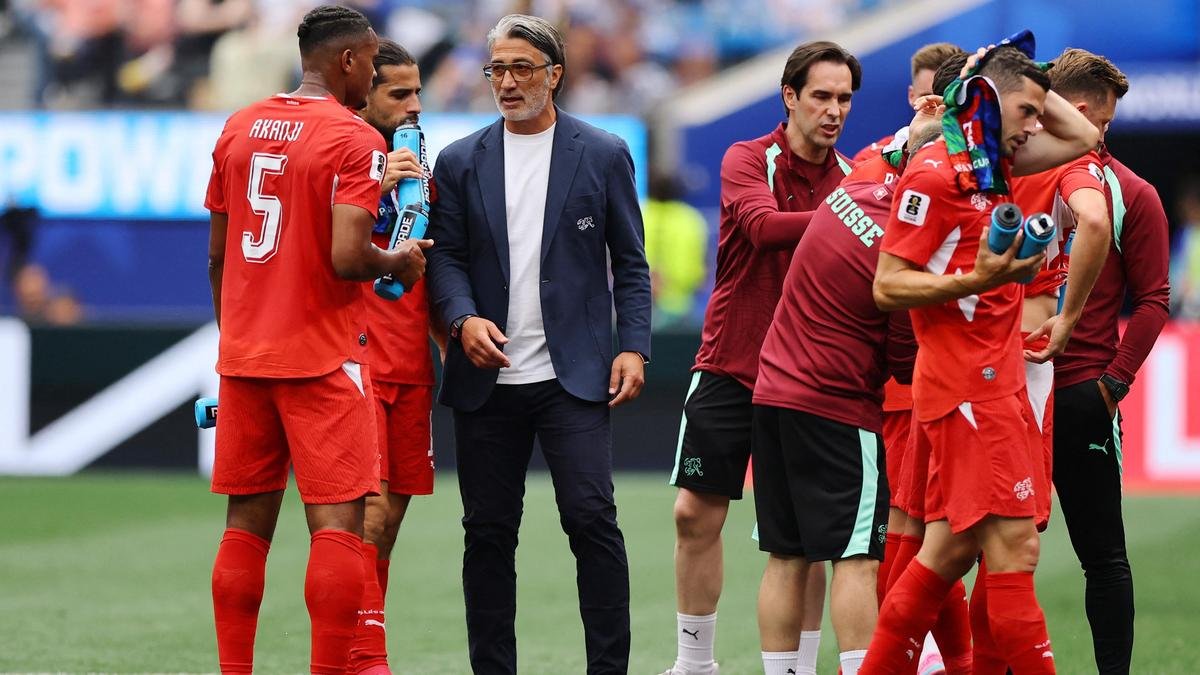
Yakin believes the tactical changes after the second hydration break gave Switzerland the edge against Bosnia and Herzegovina.
| Photo Credit: REUTERS
The hydration break — arriving at the 22nd minute mark of each half — was introduced by FIFA ahead of the 2026 World Cup to protect players from the overbearing heat in venues across North America. One week into the tournament, it appears to be doing more than helping the players cool down.
Across the first 28 games of the tournament, players have spent a combined 184.1 minutes on these water breaks, listening to coaches and catching their breath. The 56 hydration breaks have consumed more than three hours of match time.
What was expected to be just a welfare measure appears to be also influencing the course of matches.
Fifty-six of the 89 goals registered at the tournament, so far, have arrived after the hydration breaks with 19 of them scored within 10 minutes of the restart. Eight of those 19 goals have come minutes after the first cooling pause, while another 11 have arrived following the second break.
In Norway’s 4-1 victory over Iraq, Erling Haaland scored his team’s opener minutes after the first hydration break, before Leo Ostigard added the team’s third after the second-half pause. Vinicius Junior equalised for Brazil against Morocco within 10 minutes after the players had returned to the field in the hot and humid conditions of the New York New Jersey Stadium.
The trend has continued elsewhere. The United States scored its second goal against Paraguay in the 31st minute, soon after the first break, while Sweden’s second goal against Tunisia arrived in the 30th minute. Switzerland opened its account against a resolute Bosnia and Herzegovina in the 74th minute of its Group B match, before scoring another three to secure a 4-1 victory.
Whether these breaks are responsible for the results will be open to debate. But coaches have quickly recognised the tactical possibilities they offer.
“It was very important that after the second hydration break, we would change a few things, because then the opponent can’t react immediately,” Switzerland coach Murat Yakin said after the Bosnia and Herzegovina match.
“Maybe that was the edge we had”.
We brought in very fast players, and our opponent couldn’t run [with them], and it opened up gaps on the edge. That was my strategy. I waited until the break.”
Substitutes Johan Manzambi and Ruben Vargas scored three goals to alter the complexion of the tie.
Others, though, have been less enthusiastic. South Africa coach Hugo Broos, after his side’s draw with Czechia in the covered arena of Atlanta, argued that interruptions affect the rhythm of a match. “I think it’s very, very useful when it’s hot,” Broos said. “When at that moment you are the best team and you dominate, suddenly your domination is blocked for five minutes or I don’t know how long. In that stadium [Atlanta Stadium], we don’t need to drink after 20 minutes.”
The breaks are also creating a lucrative commercial opportunity for the broadcasters. FIFA’s rules effectively provide broadcasters with two minutes and 40 seconds of advertising time during each drink stoppage, adding more than five minutes of commercial inventory per match.
Note: all stats till the Mexico-South Korea match on Thursday
Published – June 19, 2026 09:28 pm IST


