


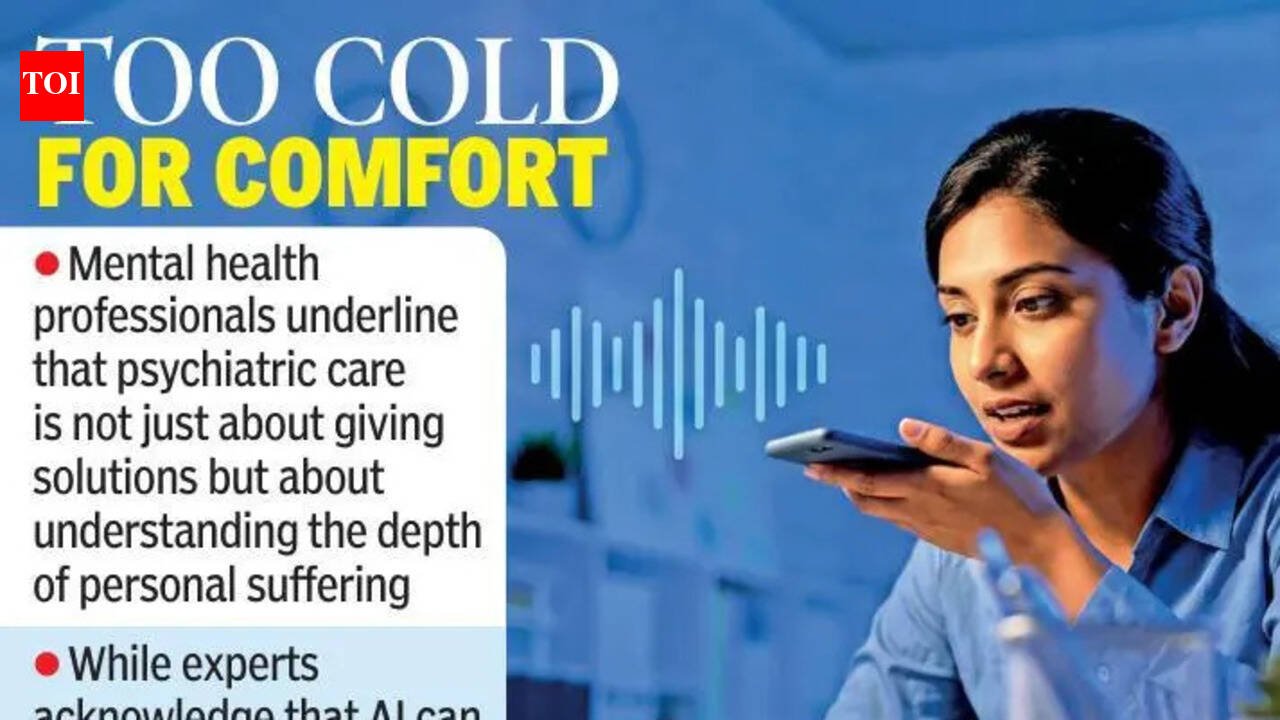
Hyderabad: Amid the growing reliance on AI tools like ChatGPT for emotional support, mental health professionals are now witnessing a reverse shift, with an increasing number of youngsters turning back to the govt-run Tele-MANAS counselling service.The helpline is currently handling around 120-130 calls daily, with nearly 60%-70% linked to relationship issues, breakups, academic stress and emotional distress among students and young adults.According to counsellors, while AI tools initially gained popularity as a free and easily accessible alternative to therapy, many users say the experience often lacks emotional depth and understanding.Some callers shared troubling experiences. “The chatbot said I’m overreacting, but I still feel like hurting myself,” one caller told counsellors. Another said, “I think I confused it, it didn’t understand what I was trying to say.”Cost remains a major factor driving youth towards AI tools. “I tried taking counselling outside, but one session cost ₹1,500 or more. I couldn’t afford it, so I resorted to AI therapy,” a student told TOI.However, psychologists cautioned that AI platforms come with limitations. Dr Jawaharlal Nehru P, senior psychologist at Tele-MANAS, explained that AI responses depend entirely on user input and lack true emotional intelligence. “So far, what we have observed is that AI has very limited understanding of emotions. It reflects what you say but doesn’t truly grasp the feeling behind it. It cannot guide behaviour in a meaningful or personalised way,” he said.He added that mental health issues require deeper evaluation. “Anything that affects behaviour needs proper assessment. AI cannot provide a balanced psychological evaluation or understand context beyond what is typed,” he added.Dr Vivaswan Boorla, senior psychologist at the Institute of Mental Health, echoed similar concerns. He said that while AI can offer structured responses, it lacks the ability to interpret human emotions and subtle cues. “The wavelength of human interaction is completely different. What you get from a trained professional — empathy, reassurance and understanding — cannot be matched by a machine,” he said.Experts emphasised that many young callers are dealing with complex emotional challenges, particularly in relationships. Counsellors observed that relationship conflicts often arise from unmet expectations and miscommunication. Another key advantage of helplines such as Tele-MANAS, experts say, is the ability for callers to express themselves freely in their mother tongue, helping them articulate emotions more clearly. Counsellors also stress that their role goes beyond offering advice — they actively listen, build trust and provide a safe space for individuals to open up.Mental health professionals underline that psychiatric care is not just about giving solutions but about understanding the depth of personal suffering. “Sometimes people don’t want treatment immediately, they just want someone to listen,” said Dr Nehru. While experts acknowledge that AI can still play a supportive role as a first step for basic guidance, they caution against viewing it as a substitute for professional care. AI tools, they say, operate within programmed limits and lack independent thinking or emotional awareness.“The ideal approach is to use technology as a supplement, not a replacement,” said Dr Boorla.
