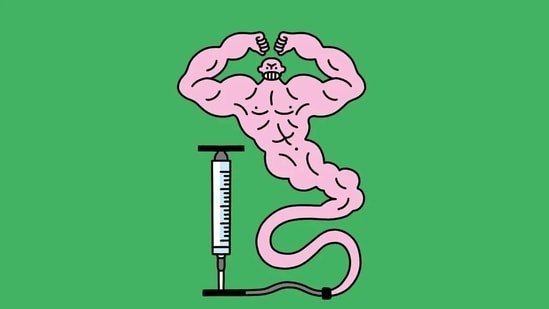
MOST SPORTING bodies prohibit performance-enhancing drugs. The Enhanced Games revels in the possibilities they offer. The competition, which kicks off on May 24th, allows athletes to use all sorts of substances, provided they are licensed and that they are administered under a doctor’s supervision.
Many athletes competing in the games have been cagey about their plans. But in April Mitchell Hooper, a Canadian who has twice won the World’s Strongest Man competition, revealed his in detail. Aside from Adderall, a stimulant, Mr Hooper’s “stack” consists of various anabolic-androgenic steroids (AAS), a class of compounds that are chemical cousins of testosterone, the chief male sex hormone.
That makes sense: AAS are some of the most potent performance-enhancing drugs known, especially for boosting strength and power. They will probably be doing most of the heavy lifting for every athlete at the games. And they are popular with non-athletes, too: one meta-analysis from 2014 estimated that 6% of men have used them at least once. But just how effective are they?
In short, very—at least when it comes to packing on muscle. In a much-cited study done in 1996, for instance, young men given high-ish levels of testosterone and told to do no exercise saw a 19% improvement in their lower-body strength after ten weeks. That was about the same as participants given placebo drugs but who hit the weight room three times a week. Those who combined steroids with training saw a 38% increase. Several other randomised-control trials conducted since then have reported similar results.
Steroids also boost levels of oxygen-carrying red blood cells, which might help with endurance sports. Gym wisdom holds that they improve recovery too, allowing athletes to train harder—though that has yet to be rigorously proven in humans.
What this means for sporting performance is harder to quantify. Since steroids are banned in most sports, controlled trials on elite athletes are usually a non-starter. But in 1997 Clinical Chemistry published a remarkable paper based on documents from the East German state-sponsored doping programme that began in the 1960s. One chart shows turinabol, a steroid taken orally, improving the shot-put distance of a female athlete by around 15% in just 11 weeks.
All this extra power comes with side-effects. For one thing, taking high levels of steroids raises the risk of heart disease. Artificial AAS also suppress production of the natural sort, causing infertility and, in men, testicular shrinkage. Usually, the body will resume production when you stop taking the drugs—but sometimes it does not.
Cosmetic side-effects are another worry. In men genetically predisposed to baldness, steroids will accelerate hair loss. As testosterone is the chemical from which the body synthesises oestrogen, some AAS can lead to unnaturally high levels of that hormone—causing some men to grow breasts.
In women, steroids can enlarge the clitoris; encourage the growth of body hair and beards; and deepen the voice. Some of the doped East German athletes (most of whom took steroids unwittingly) suffered lifelong health complications, and in 2006 won payouts from the company that made the drugs.
Steroids clearly work. But powerful drugs have powerful downsides—a lesson that competitors in the Enhanced Games would do well to bear in mind.