



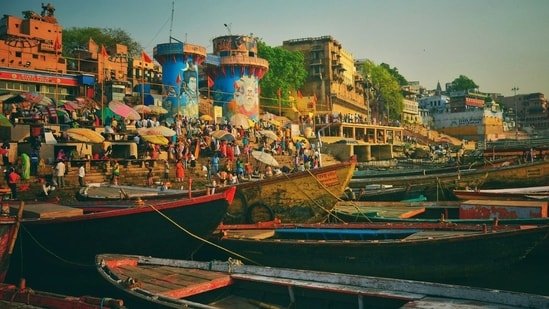
The first time I set foot in Varanasi, it was a crisp evening in December 2023. I had barely deboarded from my auto when I found myself swept into the tide of pilgrims moving through Godowlia, all of us walking towards the Dashashwamedh Ghat. With the setting sun, brass bells rang across the cold breeze, and multi-tiered lamps blazed in tribute to the river. That evening was surreal, sacred, and unforgettable. Then the aarti ended — and the crowds began to move. Caught in the pressing tide of thousands funneling through the same narrow ghat exit brought me back to a sharp reality.


This is the experience of the millions of pilgrims and tourists who visit Varanasi every year: profound religious festival experiences punctuated by overwhelming crowds. Varanasi’s religious and cultural heritage have made it one of India’s most visited destinations, with 13 crore (130 million) pilgrims and tourists visiting in 2023 alone. But each year’s swelling crowds, far beyond what the city’s historic infrastructure was designed for, strain its narrow alleyways, centuries-old ghats, and the residents of the old city.
The good news is that Varanasi has a long history of adapting to the times in which it exists. A 21st century Varanasi can use cutting-edge technologies to manage crowd flows and create a more livable, safer city for residents, tourists, and pilgrims alike.
Varanasi’s pilgrims are part of what makes the city special, and they will always be welcomed. But the surge in footfall in recent years brings with it serious challenges. Basic civic amenities–clean public toilets, drinking water, waste management–become difficult to access when demand outstrips supply. For vulnerable communities such as elderly pilgrims and persons with disabilities, the situation is more acute. Narrow alleys, uneven terrain across the ghats, and dense crowd gatherings make navigating sacred sites difficult.
Varanasi’s administration has made admirable progress in addressing these crowd management challenges. Their year-round preparedness – and especially their coordination during major events such as Mahashivratri, Shravan maas, and Dev Deepawali–is indicative of their commitment to ensuring pilgrims can experience Varanasi in its best light and with minimum crowding. Investments in physical restructuring, improved signage, and stronger on-ground coordination across departments have made a real difference. Yet given the escalating number of visitors coming to the city every year, more is needed to match the scale of the challenge. Next-generation technologies are waiting in the wings to take Varanasi’s crowd management to the next level.
AI-enabled surveillance, digital signage, real-time crowd monitoring, and smart navigation tools are no longer aspirational–they are real and have been proven effective in other cities that draw large number of pilgrims. Mecca, for example, has deployed sophisticated crowd monitoring systems for the hajj pilgrimage, using AI-powered camera networks, drones and real-time command centres to redirect flows before dangerous densities build up. Varanasi already has much of the digital infrastructure in place to implement similar solutions — an expansive CCTV network, a virtual version of the infrastructure to monitor and test (a digital twin), and extensive GIS mapping. The foundation is strong; what is now needed is to activate and integrate these systems into a live, responsive crowd management framework.
Varanasi’s administration has already commenced addressing this challenge. The city is one of three selected from 200 applicants, and the only one from the Global South, to win the $3 million Sustainable Cities Challenge funded by the Toyota Mobility Foundation. Through the initiative, Varanasi is partnering with innovators to develop data-driven, human-centred solutions for crowd management in Kashi’s old precinct. These solutions deploy AI infrastructure to deliver real-time crowding information to the city, use refined mapping tools of the city’s dense network of walking paths to guide pedestrians towards alternative routes, and offer colour coded street design and signage to make traveling through the city easier for visitors and vulnerable communities.
These technologies have the potential to transform how crowds are distributed through Varanasi. However, technology alone cannot solve what is at its core a spatial problem. Tactical urbanism can address specific, localized barriers to movement and create a more cohesive and navigable environment for everyone.
Examples can be found across the globe. For example, New York’s transformation to a pedestrian-friendly city with temporary road markings and chairs, eventually became permanent infrastructure. Barcelona converted central streets into pedestrian and community spaces. These cities have made themselves more capable of managing their crowds through thoughtful design, and by extension have improved their residents’ quality of life.
They offer lessons for Varanasi’s old city, where narrow ghats and dense lanes create natural bottlenecks. Solutions gleaned from other locales include prominent signs pointing towards amenities and directions, colour-coded streets, and dedicated rest areas for elderly pilgrims. These fixes, and more, can meaningfully reduce risk and empower people to move about the city, particularly those in vulnerable communities.
Thanks to what I already see taking hold in Varanasi, I envision another December evening, this one in 2030. Once again, I am rushing alongside throngs of pilgrims, brimming with excitement for the aarti. But tonight, something is different. I see people, especially the elderly, the children, the differently-abled, moving through Kashi’s narrow alleyways with ease, guided by smart navigation apps and well-placed signs that adapt to the language of visitors. And when the last chants end, the crowds don’t surge; they flow, guided along the safest routes. Varanasi, with its commitment to crowd-friendly urban design, digital infrastructure, and a globally recognised community of innovators, will have achieved something far greater than crowd management. It will have become a blueprint for every sacred city in the world on how to balance faith with footfall.
This article is authored by Pras Ganesh, executive vice president, Toyota Motor Asia & executive programme director, Toyota Mobility Foundation.


