


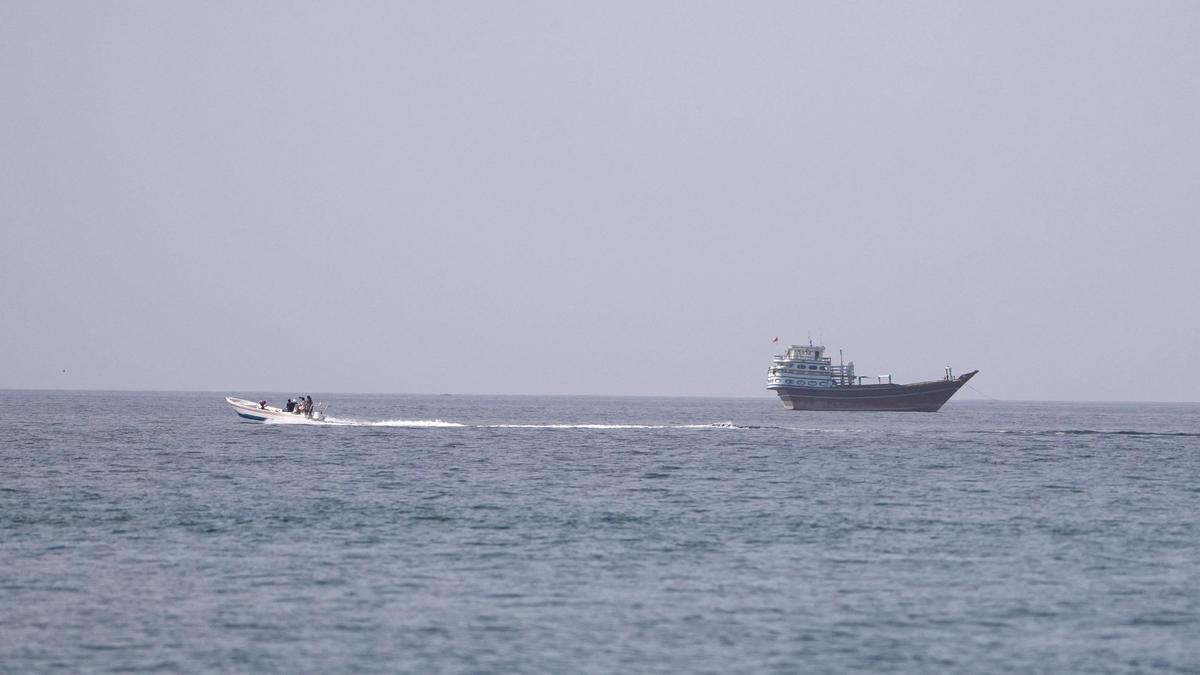
The second phase of the Iran-U.S. war is being fought almost exclusively over the future of the Strait of Hormuz. The sequence of events leading to the restart of hostilities suggests there was no genuine meeting of minds when the MoU was signed. As before, by holding out and retaliating, Iran has forced the issue — shipowners now seem resigned to paying a “logical” toll, even as they worry about the precedent it sets for other straits.
The MoU, signed on June 14, stipulated Iran would allow ships to pass “with no charge for 60 days only,” and that Iran would work with Oman to “define the future administration and maritime services” in the strait. Two days later, the Persian Gulf Strait Authority — set up by Iran in May to handle transits — circulated terms reasserting itself as the nodal transit authority, requiring every vessel to hold a passage permit and PGSA-approved insurance, free for now but with fees reserved for later. Iran was formalising its stake as a legal outcome of the MoU.
U.S. and Iranian delegations met in Switzerland on June 21, and sanctions were lifted the next day. But the PGSA, already sanctioned, was never explicitly relieved — leaving shipping firms wary of dealing with it.
U.S. Secretary of State Marco Rubio then toured the UAE, Kuwait and Bahrain from June 23-25, culminating in a GCC meeting in Bahrain. Amid that visit, on June 24, the IMO — working with Oman — formally announced a temporary corridor with two routes: a southern one via Oman, alongside the northern route Iran championed. This effectively formalised the Omani route. Iran complained it had not been consulted and said any other route barring the route it had specified was “unauthorised and dangerous.”
The next day in Bahrain, Mr. Rubio said accepting a toll near a country’s territorial waters “will spread throughout the world like a contagion,” adding that no Gulf state supported one. The US and GCC signed a statement opposing Iran’s control of the strait. Iran did not take this quietly. The IRGC threatened vessels on non-Iranian routes, and the IMO’s governing council “strongly condemned” Iran’s bid to “establish an entity purporting to control traffic through the strait.”
On June 30, U.S. and Iranian officials met in Doha. Reports said Iran and Oman had floated a plan to monetise transits — a voluntary toll modelled on the Malacca-Singapore Straits — which Washington rejected in favour of the pre-war status quo.
A Maritime and Port Authority of Singapore spokesperson, responding exclusively to The Hindu, said the Straits of Malacca and Singapore are, like Hormuz, Straits Used for International Navigation, and that Indonesia, Malaysia and Singapore accordingly levy no fees or tolls on ships exercising transit passage. A voluntary Aids to Navigation Fund exists, backed by contributors including The Nippon Foundation, but the spokesperson stressed its “contributions are not for the exercise of transit passage and should not be misconstrued as fees, tolls or payment imposed on transiting ships.”
Talks in Doha broke down over U.S. resistance to any formal management arrangement — effectively a bid to walk back the MoU’s own Hormuz clauses.
The first week of July brought the mourning period for Ayatollah Ali Khamenei. As the NATO summit opened in Turkey on July 7 — where U.S. officials restated their Hormuz position, and Donald Trump complained European allies weren’t helping keep the strait free for navigation — Iran struck three ships on the Omani route, among them the India-bound Al Rekayyat, one of the largest LNG carriers built. An exploding LNG tanker at a chokepoint ranks among shipping’s worst-case scenarios. Mr. Trump declared the ceasefire over. War had resumed.
On July 11, 2026, Iranian Foreign Minister Abbas Araghchi met with Omani Foreign Minister Badr Albusaidi in Muscat to discuss the strait but the meeting apparently produced no agreement. A few hours later, Iran attacked DFS Galaxy, in which one Indian seafarer died, bringing the recent Iranian attacks on ships to six.
The U.S. began attacking merchant ships too, as part of its blockade against Iranian oil trade. It has reinstated the sanctions it had briefly lifted.
Washington keeps claiming it has degraded Iran’s capacity to strike shipping — a claim repeated after nearly every strike, rebutted each time by a fresh attack. For instance, on July 13, CENTCOM said strikes on six Iranian sites would “further degrade” that capability; the IRGC responded the same day by claiming it had disabled two tankers.
Strikes on Greater Tunb Island on July 15 drew the same claim. Yet on July 16, the Joint Maritime Information Center raised its Hormuz risk rating to “severe,” and nine Greek-operated LNG tankers stayed put rather than risk transit — insurers, the most reliable independent judges, are pricing in continued Iranian capability. Lloyd’s List data shows weekly transits that nearly doubled to 282 for June 22-28 have since fallen to 164 for July 6-12, concentrated on the Omani route.
Iran has now turned to alternatives to the strait — targeting ship-to-ship transfers off UAE’s Fujairah pipeline and pushing the Houthis to shut off Saudi Arabia’s East-West pipeline route by attacking ships taking the Red Sea route.
“Shipping companies are super tired [of] all this back and forth,” said Dimitris Maniatis, CEO of Greek maritime risk firm Marisks, at a Lloyd’s List webinar. “Most would accept a toll amount that is logical, not 20% though which is ludicrous. If a legitimate arrangement is formulated, shippers would welcome the development.”
Published – July 19, 2026 09:42 am IST
