


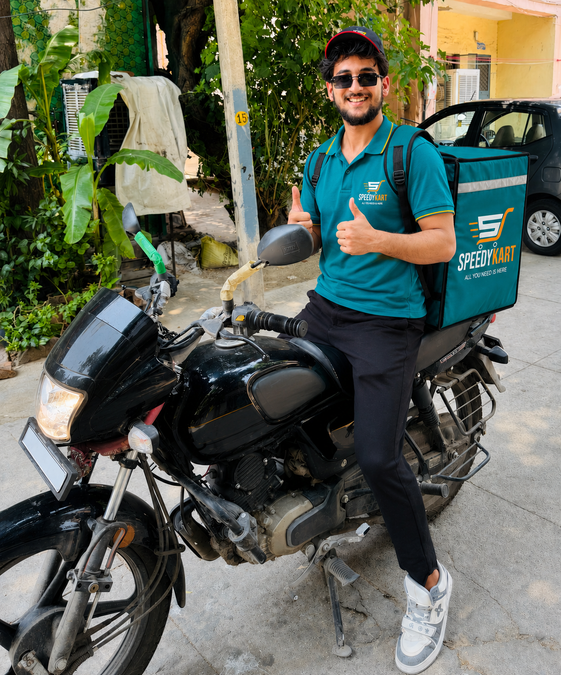
At an age when most 15-year-olds are occupied with school, exams and deciding what they want to become, Murtaza Rafiq had already discovered his passion.
Armed with a camera, basic editing software and an internet connection from his home in Tral in south Kashmir’s Pulwama district, he began creating videos with little more than curiosity and determination. Nearly a decade later, that teenage experiment has grown into two successful careers, one as a digital creator followed by hundreds of thousands online, and the other as the founder of one of Kashmir’s fastest-growing quick-commerce startups.
Known online as Emminerr, the 24-year-old YouTuber and entrepreneur has built a career that bridges content creation and technology-driven business, demonstrating how the creator economy can flourish even in a region more often associated with conflict than innovation.
His latest venture, SpeedyKart, is attempting to reshape how people across Kashmir shop, order food and receive everyday essentials.
“I never wanted to stop at making videos,” Murtaza says. “I always wanted to build something that could create jobs and solve a real problem.”
A Camera, A Dream And A Small Room
Murtaza’s journey began long before quick-commerce became India’s latest startup buzzword.
He was just 15 years old when he started experimenting with content creation from a modest setup at his home in Tral. Like many young creators, he began with dubbed music videos, hip-hop recordings and simple edits, teaching himself production skills through trial and error.
For Murtaza, content creation was never simply about entertainment. Acting fascinated him, travelling inspired him, and social media became the platform where he could combine both passions.
Growing up in Tral, a town with limited opportunities and exposure, Murtaza dreamed far beyond the Valley. As a teenager, he began travelling solo, visiting countries including China, the United Arab Emirates, Saudi Arabia, Vietnam, Thailand, Turkey, South Korea and more. Each journey broadened his perspective and enriched his storytelling, helping him connect with audiences through experiences that were uncommon for a young creator from Kashmir.
As his confidence grew, so did his ambitions.
He gradually shifted towards lifestyle and travel vlogging, documenting journeys across eight to nine countries while introducing audiences to destinations and luxury experiences through the lens of a young Kashmiri creator.
His videos became more ambitious, both in scale and production quality.
Inspired by international creators, particularly MrBeast, he ventured into large-scale challenge videos and giveaways. From distributing bicycles to children to giving away iPhones, his content began attracting millions of impressions and significantly expanded his audience.
A defining milestone came in 2025 when he met global YouTube sensation MrBeast during a shoot in Riyadh.
For many creators, such a meeting would have been the culmination of years of work.
For Murtaza, it became a source of inspiration.
“It showed me that content can become much bigger than entertainment,” he says. “It can build businesses, communities and opportunities.”
Today, his online presence spans more than 330,000 YouTube subscribers, 135,000 Facebook followers and 100,000 Instagram followers, making him one of Kashmir’s most recognised digital creators.
Beyond Views And Subscribers
Despite his growing popularity online, Murtaza believed content creation alone wasn’t enough.
While India’s metropolitan cities witnessed the rapid rise of quick-commerce platforms, Kashmir continued to depend largely on conventional retail and slower delivery systems.
Rather than waiting for established companies to enter the Valley, he decided to create a local solution.
Development on SpeedyKart began in 2022.
For nearly two years, Murtaza and his team worked on building the technology, delivery network and operational infrastructure required for a service that had little precedent in Kashmir.
The app officially launched on August 5, 2024.
Unlike conventional delivery platforms, SpeedyKart operates through two verticals.
Its express-delivery service, Hotbox, focuses on delivering food, groceries and daily essentials within an average of 30 minutes across a 10-kilometre radius.
Its second arm, SpeedyMart, caters to fashion, electronics and other e-commerce products with delivery extending beyond Kashmir to customers across India.
The model has been designed around Kashmir’s unique geography, where weather conditions, dispersed populations and logistical challenges often complicate supply chains.
Building Jobs Alongside Business
For Murtaza, launching the platform wasn’t only about introducing faster deliveries.
It was equally about creating employment.
Today, SpeedyKart employs around 100 people across Tral, Awantipora, Anantnag, Verinag, Srinagar and Hazratbal.
Since quick-commerce was still relatively unfamiliar in Kashmir, he personally trained nearly 70 per cent of the workforce.
“We weren’t just hiring delivery executives,” he says. “We were introducing an entirely new way of working.”
The company has since expanded beyond logistics, operating multiple retail outlets while also establishing a 2,000-square-foot fine-dining concept in Rajbagh, signalling ambitions beyond app-based deliveries.
The Numbers Behind The Vision
SpeedyKart’s growth reflects increasing consumer confidence in locally built technology.
Within its first year, the startup recorded an annual revenue of around Rs 1.5 crore.
By its second year, that figure had increased to nearly Rs 2.5 crore.
Over the past two years, the platform has completed more than 2.5 lakh deliveries, maintaining an average delivery time of approximately 30 minutes.
For Murtaza, however, these figures represent more than business success.
“They represent trust,” he says. “Every order means someone chose to believe in a homegrown Kashmiri company.”
A New Generation Of Entrepreneurs
For decades, Kashmir has been known for its artisans, apple growers, tourism and handicrafts.
Today, another identity is quietly emerging: that of digital creators, startup founders and technology entrepreneurs building businesses from within the Valley.
Murtaza Rafiq belongs to this new generation.
His journey illustrates how a camera can become a catalyst for entrepreneurship, how social media can evolve into sustainable enterprise, and how local innovation can solve local challenges.
From filming videos in a small room in Tral at the age of 15 to building a company that now serves thousands of customers across Kashmir, his story reflects the aspirations of a generation that is equally comfortable creating content, building technology and generating employment.
For Murtaza Rafiq, success was never just about going viral.
It was about creating something that lasts.
