



National Science Day, observed on February 28, commemorates the discovery of the Raman Effect by Nobel laureate physicist C. V. Raman in 1928. Over the decades, the day has evolved from a symbolic celebration to a policy and education milestone, prompting reflection on how effectively India is nurturing scientific temper, research capacity and innovation-led learning across schools and universities.
Nearly a century after Raman’s breakthrough, India’s science education ecosystem is undergoing visible changes. Classrooms are gradually moving away from rote memorisation towards inquiry-driven learning, while universities are embedding research exposure much earlier in academic programmes to align with the country’s growing ambitions in deep-tech, climate science and advanced manufacturing.
From theory-driven classrooms to inquiry and experimentation
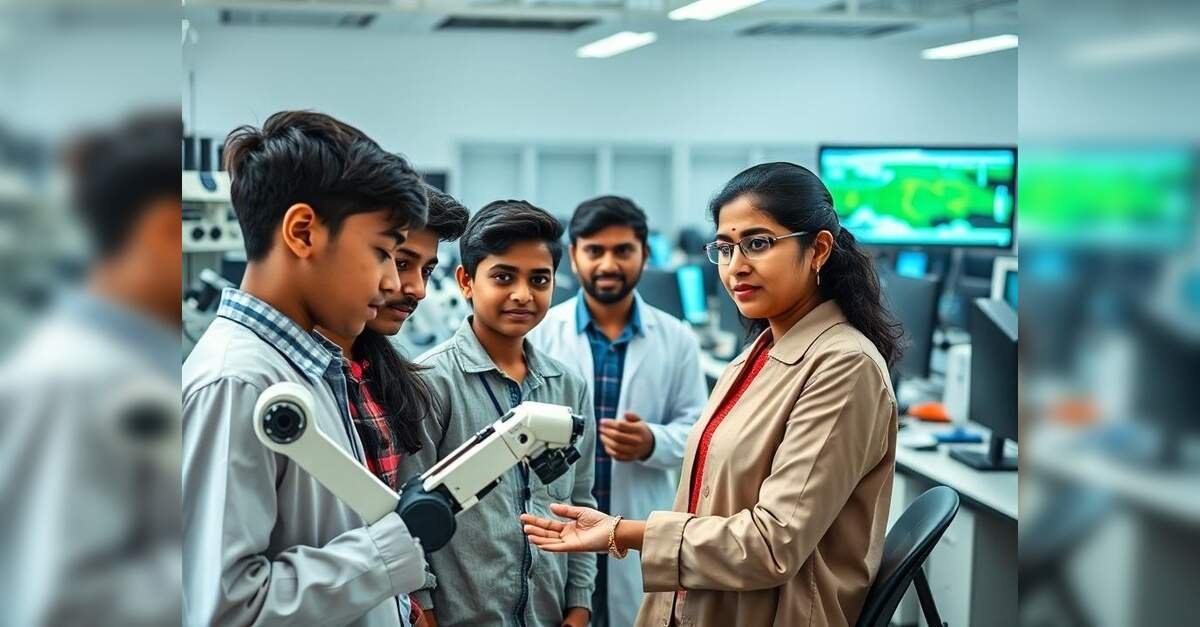
Educators across higher education institutions say the most significant shift is the integration of hands-on experimentation and data-driven learning into core curricula. Laboratories are increasingly being treated as spaces of discovery rather than supplementary facilities.
Dr Vishal H Shah of BIT Mesra said that while textbooks provide the foundational grounding, genuine scientific temper develops only when students transition to practice. “Undergraduates work on externally funded projects in advanced electronics, biotechnology, remote sensing and AI systems. They test theories, manage datasets and justify findings. Method, inspection and accountability help foster scientific temper,” he said.
He noted that research participation is embedded in academic progression, with students contributing to projects on satellite data validation, electric mobility and biosensor development. Capstone and dissertation components require experimentation and formal technical defence, ensuring that students engage with “actual research contexts rather than simulated activities.”
Industry-linked research and interdisciplinary laboratories
Private and interdisciplinary engineering institutions are also investing heavily in advanced research infrastructure and industry partnerships to bridge the gap between academic learning and real-world scientific problem-solving.
Dr Visalakshi Talakokula, Associate Dean at Mahindra University’s École Centrale School of Engineering, said scientific temper cannot remain confined to lectures or prescribed content. “Foundational theory is important, but scientific temper develops when students begin to ask questions, test assumptions and work with uncertainty,” she said, pointing to specialised research spaces where undergraduates work on projects involving hydrogen fuel systems, sustainable materials and graphene derived from fly ash.
According to her, structured hands-on exposure begins from early semesters through lab-intensive and project-based courses. Students often join research teams alongside postgraduate and doctoral scholars and present live projects before industry leaders for validation. “Students don’t just observe, they operate and innovate,” she said, adding that internships and industry-supported research help translate classroom learning into applied scientific solutions.
NEP reforms and regulator-led curriculum modernisation
The transition in science education has also been driven by policy reforms under the National Education Policy 2020. Regulators such as the University Grants Commission and the All India Council for Technical Education have pushed curriculum modernisation, interdisciplinary credit frameworks and faculty development aligned with emerging scientific domains.
Dr Deepak K. Sinha, Deputy Director at Jain University’s Faculty of Engineering and Technology, said inquiry-led classrooms and expanded research access are central to the ongoing transformation. “Classrooms nationwide are transforming, with inquiry-based learning replacing rote memorisation and students engaging in hands-on experimentation. NEP 2020 has unlocked undergraduate research opportunities in emerging fields like AI and climate science, making innovation accessible to more young minds,” he said.
He added that stronger industry-academia partnerships are exposing students to real scientific challenges while teacher training and curriculum reforms are strengthening the STEM ecosystem. “With UGC and AICTE actively modernising curricula and investing in teacher training, the scientific temper that defined Raman’s genius is now flourishing in schools and universities across the nation,” Sinha said.
Government push: NRF, innovation missions and emerging science priorities
The broader transformation in science education is closely tied to the government’s expanding research and innovation agenda. The proposed National Research Foundation is expected to significantly widen research funding access across universities and colleges, strengthening research culture beyond a handful of elite institutions. The aim is to promote interdisciplinary projects, faculty-led innovation and industry collaboration at scale.
Parallel initiatives such as the Atal Innovation Mission are nurturing scientific curiosity at the school level through Atal Tinkering Labs, where students experiment with robotics, prototyping and design thinking. Together, these efforts are intended to create a continuous pipeline that begins with early experimentation in schools and extends to advanced research in universities, aligned with national priorities in artificial intelligence, semiconductor technologies, quantum research and climate science.
School-level innovation and early scientific temper
School leaders say the emphasis on inquiry-based learning is already visible at the foundational level. Ganesh Tiwari, Principal of Seth Anandram Jaipuria School, Kanpur said the focus has shifted from content delivery to experimentation and evidence-based reasoning embedded within daily learning. “At our school, the Atal Tinkering Lab functions as a structured innovation space where students work with robotics, 3D printing, prototyping and design thinking to address real-world problems through iterative experimentation,” he said.
He highlighted a student-developed solution, SAARTHI, a Soil Analysis and Agro-Recommendation Technology for High Yield, as an example of socially relevant innovation emerging from school-level research exposure.
On structured research exposure, Tiwari pointed to student-led events such as Comfest, where learners from across India participate in contests involving robotics, coding and ethical hacking to solve real-world problems. “The curriculum encourages students to take the lead in experimentation and innovation,” he said.
Preparing students for AI, climate science and interdisciplinary research
Educators across school and higher education segments agree that students today are increasingly aware of emerging technologies and global scientific challenges. Tiwari noted that the current generation, having grown up with digital tools and easy access to information, is well positioned to engage with domains such as artificial intelligence if guided with the right skills and ethical perspective. He also observed a growing inclination among students to work on sustainability and climate-related solutions, supported by the rise of interdisciplinary learning models.
India’s expanding scientific landscape
The renewed focus on science education is closely linked to India’s broader scientific progress. Organisations such as the Indian Space Research Organisation and premier research institutions including the Indian Institute of Science and the IITs have driven advances in space exploration, clean energy, biotechnology and data-driven technologies. This expanding ecosystem has increased the demand for graduates trained not only in theoretical knowledge but in interdisciplinary research and innovation.
The legacy of pioneers such as Homi J. Bhabha, Vikram Sarabhai and A. P. J. Abdul Kalam continues to shape India’s scientific vision, reinforcing the role of education in building long-term research capacity.
Persistent gaps and the road ahead
Despite visible progress, challenges remain. Experts highlight delays in curriculum updates in fast-evolving areas such as AI, semiconductors and climate modelling, the need for flexible faculty recruitment in specialised domains, and consistent funding for advanced laboratories and high-performance computing infrastructure. Uneven distribution of research facilities across institutions also remains a concern, particularly for state universities and emerging colleges.
As India marks National Science Day 2026, the focus has clearly shifted from celebration to capability-building. The growing integration of inquiry-led learning, early research exposure, school-level innovation labs and national research funding initiatives indicates a systemic attempt to align education with the country’s scientific and technological ambitions. The next phase will depend on sustained policy execution, equitable infrastructure development and continued encouragement for students to question, experiment and innovate.


