



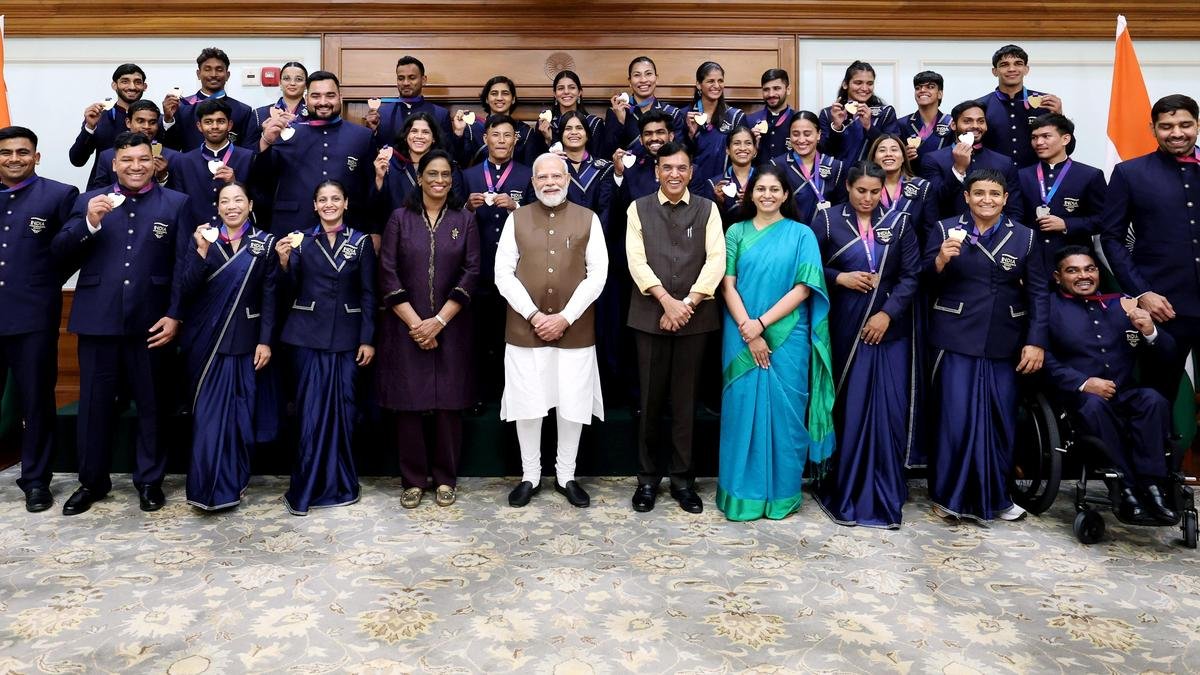
India finished fourth at the 2026 Commonwealth Games in Glasgow, which concluded last week on August 2, with 39 medals — 13 gold, 17 silver and nine bronze. The result came despite the absence of several sports disciplines that have historically supplied the bulk of India’s Commonwealth haul, marking another chapter in a medal history that has grown from one medal in 1934 to 603 across editions.
India’s Commonwealth success has long been concentrated in a handful of sports. Shooting, wrestling and weightlifting alone account for 390 of India’s 603 medals, roughly two-thirds of the total. While boxing, badminton, and table tennis have added another 113.
Shooting, wrestling, badminton, table tennis and hockey, all important contributors to India’s past medal tallies, were absent. Glasgow hosted a pared-down programme of 10 sports after the Commonwealth Games was forced to find a replacement host following Victoria’s withdrawal. The 2026 programme included athletics, swimming, track cycling, weightlifting, 3×3 basketball, lawn bowls, netball, artistic gymnastics and judo and boxing, alongside para events.
Even without many of its traditional medal-producing sports, India still finished fourth.
A brief history
India’s Commonwealth journey began in London in 1934, when wrestler Rashid Anwar won India’s first medal, a bronze in the 74kg freestyle category and a 12th-place finish. India missed the 1930, 1950, 1962, 1986 editions, won no medals in 1938 and remained unranked in 1954. Its first gold medals came in 1958, when Milkha Singh won the 440-yard race and wrestler Lila Ram triumphed in the 100kg category, and Lachmi Kant Pandey won a silver.
The tally steadily grew, reaching 10 medals in 1966, 12 in 1970 and 15 in 1974, when India finished sixth each time. By 1990, it had risen to 32 medals and fifth place.
Women gradually became a larger part of India’s medal haul. Their first Commonwealth medal came in 1978, when badminton players Ami Ghia and Kanwal Thakar Singh won bronze in the women’s doubles at Edmonton. India then won two women’s medals in 1994 and three in 1998.
The breakthrough came in 2002, when the tricolour began to rise on the Commonwealth stage. India crossed the 50-medal mark for the first time, winning 69 medals and finishing fourth. It followed that with 50 medals and another fourth-place finish in 2006. Then came its greatest Commonwealth campaign at Delhi 2010, where India won a record 101 medals — 64 by men, 36 by women and one in a mixed event — finishing second.
In Glasgow 2026, India won 39 medals and women accounted for 41% of India’s tally.
The longer-term trend puts Glasgow in perspective. India accounted for just 0.5% of all medals awarded in 1934, when it won its first Commonwealth medal. Its share crossed 5% for the first time in 1990, when it won 32 of the 638 medals awarded. The share rose sharply from 2002 onwards, reaching 7.7% in 2002 and 6.7% in 2006. At the Delhi 2010 Games, India reached its peak, winning 101 of the 828 medals awarded —12.2% of the total. Its share remained above 7% in 2014 and 2018, at 7.8% and 7.9%, respectively, before falling to 7% in Birmingham in 2022.
In Glasgow, India won 39 of the 671 medals awarded, accounting for 5.8%. This was its lowest medal haul since 1958, when it won three medals. However, the smaller programme and the absence of several sports in which India has historically performed strongly make direct comparisons with earlier editions difficult. Overall, India won 603 of the 10,636 medals awarded across the editions in the editions India participated, accounting for 5.7% of the total.
Australia back on top
Australia finished first in Glasgow, returning to the top of the Commonwealth medal table after England topped the standings at Birmingham in 2022.
Australia’s dominance is also striking when viewed against India’s much larger population. It has accumulated 2,773 Commonwealth medals, compared with India’s 603, despite having a population of roughly 28 million against India’s 1.46 billion. Canada has won 1,709 medals with a population of about 41.7 million, while New Zealand has won 743 medals with just 5.3 million people.
The comparison is not intended as a medals-per-capita ranking — the countries have competed in different circumstances and across different numbers of Games — but it highlights the very different sporting systems behind their Commonwealth records. Australia has consistently converted a much smaller population into a far larger medal haul, as children have access to many sports, usually experimenting with multiple sports before finding their specialisation. Its nation-wide ‘Little Athletics’ is their initial introduction to athletics, equipped with experienced coaches, who are unrestricted by bureaucratic central bodies. Australian athletes aren’t pushed to perform young, and many gain experience in American colleges before competing officially. In contrast, India’s medals have historically been concentrated in a relatively narrow group of sports.
(With inputs from Sachin Swaraj who is interning with The Hindu’s Data Team. Gauri Singavarapu is also an intern with the team.)
Published – August 12, 2026 07:00 am IST


